

Here are some key findings from the U.N. Office on Drugs and Crime’s (UNODC’s) latest report on the Afghanistan opium trade:
- In order to meet demand for illicit opiates supplied by the Northern route in 2010, 1000 tons in opium equivalents were required to transit or be produced in northern Afghanistan….
- Opium production in northern Afghanistan can account for very little of this supply requirement….
- Northern Afghanistan sources heroin mostly from the southern and eastern parts of the country. The low volume of seizures heading northward highlights weaknesses in law enforcement manning these routes.
- Surprisingly, there is more evidence of opium flows from the largely poppy-free north than from the opium-rich south. In 2010-2011, several seizures of opium were reported en route from north to south, but hardly any seizures were made traveling in the opposite direction….
- Most internal opiate routes converge on Afghanistan’s capital, Kabul. The city is the key node connecting the various opiate producing regions of Afghanistan….
- Northern Afghanistan is one of the safest regions of the country, but it seizes very little opiates relative to its importance in processing and trafficking for the Northern route. Crime groups controlling the trade in this region also appear to operate with a high degree of impunity. Corruption rather than insecurity appears to be the main corollary to high-volume opiate trafficking in northern Afghanistan….
Get the picture?
Here’s another tidbit:
There are an estimated 40-50 active heroin laboratories in northern Afghanistan, notably in Badakhshan province.
And here’s a map:
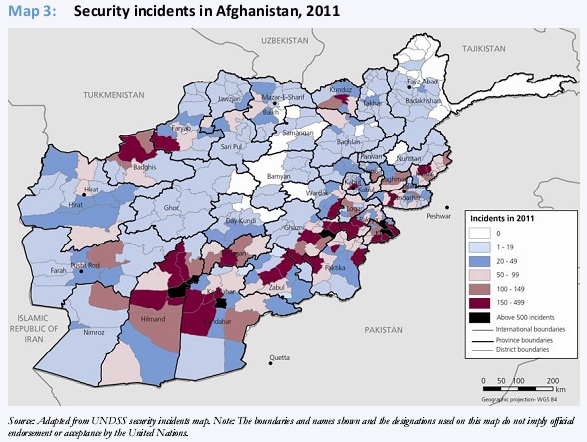
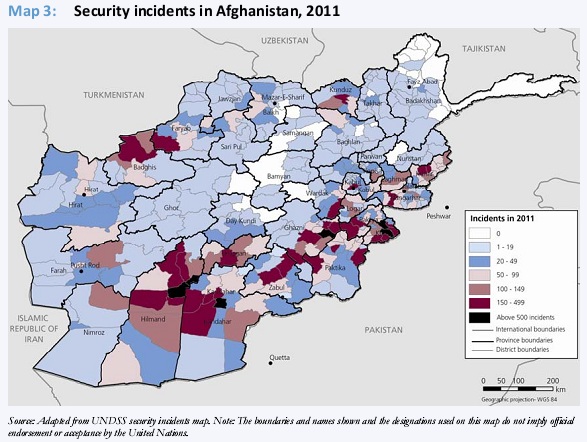
Notice that Badakhshan (upper right) is an area of relatively high security (i.e. little Anti-Government Element activity, e.g., Taliban). The occupying NATO military forces have had this province under their control (until it was handed over to local forces earlier this year).
Some more information:
UNODC has not seen strong evidence of current insurgent involvement in opiate trafficking through Central Asia…
In Afghanistan, the involvement of Taliban insurgents in the drug trade is evident, particularly in the south, and has been detailed in previous UNODC research. However, excessively focusing on insurgents’ linkages with the drug trade risks obscuring the deeper involvement of corrupt governmentofficials in the Afghan opiate trade. In northern Afghanistan, many actors who in previous years had been involved in opiate trafficking have now become public officials, politicians and businessmen. Some of these stakeholders continue to be involved in drug trafficking, making high-level corruption another important cog in the large wheel of organized crime in Afghanistan….
The “majority of Northern route opiates continues to flow nearly uninterrupted into Tajikistan”, and is trafficked by “large, well-organized groups”, which trafficking “mostly occurs by road”.
