Table of Contents
Introduction
As Edward Herman and Noam Chomsky convincingly argue in their book Manufacturing Consent: The Political Economy of the Mass Media, the major media in the US fulfill a propaganda function by systematically misinforming the public in order to engineer consent for various government policies. Debate about important issues is limited to a narrow range of allowable opinion. Perspectives challenging fundamental assumptions of the mainstream discourse are marginalized. Alternative voices are relentlessly attacked and demonized rather than their legitimate criticisms substantively addressed.
An enlightening example of how propaganda works is the media’s use of the term “fake news”. A New York Times editorial last week titled “Who Will Tell the Truth About the Free Press?” pointed out that oppressive regimes have been using the term to dismiss criticisms over human rights violations. When the Times reported last month that the government of China has been placing Uighurs, Kazaks, and other Muslim minorities in the Xinjiang region in mass detention camps, the regime responded by dubbing it “fake news”.
The Times editors are certainly right to express concern over the use of euphemistic language to justify government oppression. As they note, “Adolf Hitler and the Nazis came up with the slogan ‘Lügenpresse’—translated as ‘lying press’—in order to discredit independent journalism.”
They proceed to blame the present trend of dismissing independent journalism as “fake news” on Donald Trump:
Now the tactic has been laundered through an American president, Donald Trump, who adopted the term ‘fake news’ as a candidate and has used it hundreds of times in office.
That is how, barely a generation after the murder of millions of Jews in Nazi death camps, the term “fake news” has come to be deployed so brazenly by another repressive regime to act against another minority, to cover up the existence of prison camps for hundreds of thousands of Muslims. . . .
When an American president attacks the independent press, despots rush to imitate his example. Dozens of officials around the world—including leaders of other democracies—have used the term since Mr. Trump legitimized it. . . .
The rise of the epithet of “fake news” as a weapon is occurring at an already perilous moment for the supply of information about the world as it truly is. The financial foundations of an independent press are eroding under the influence of the internet, which has simultaneously become a global conduit for malicious falsehoods. It’s harder and harder for anyone to know what stories to believe.
The Times editors go on to suggest that internet companies—such as Facebook and Google—should be pressed “to accept responsibility for the roles they have already assumed as the world’s leading information publishers. The press has to do its part as well, by committing itself to a forthright accounting of any mistakes, an unending struggle against bias in news and an uncompromising pursuit of truth.”
Unfortunately, the New York Times with this very editorial is not pursuing truth but issuing propaganda for the purpose of advocating a dangerous political agenda. While lecturing others on how to behave, the Times editors are being the opposite of forthright and objective. It’s not that the editors are wrong about Trump’s influence on leaders in other countries. They’re just blatantly lying about how the term “fake news” came to be “legitimized” as a weapon to attack independent journalism.
This is because the Times has itself been among the chorus of mainstream voices attacking online independent journalism that threatens both the business model of the major corporate media and the political agendas these corporations have aligned themselves with.
In this case, the Times editors’ political agenda is to manufacture consent for the government pressuring internet companies to censor information from alternative media sources. This obviously helps mainstream sources like the Times maintain their dominance in influencing the mainstream discourse about important issues. It also enables the statist Times to push various other political agendas by confining public discourse to a narrow range of allowable opinion through the a priori dismissal of inconvenient truths as “misinformation”.
The True Origin of the “Fake News” Euphemism
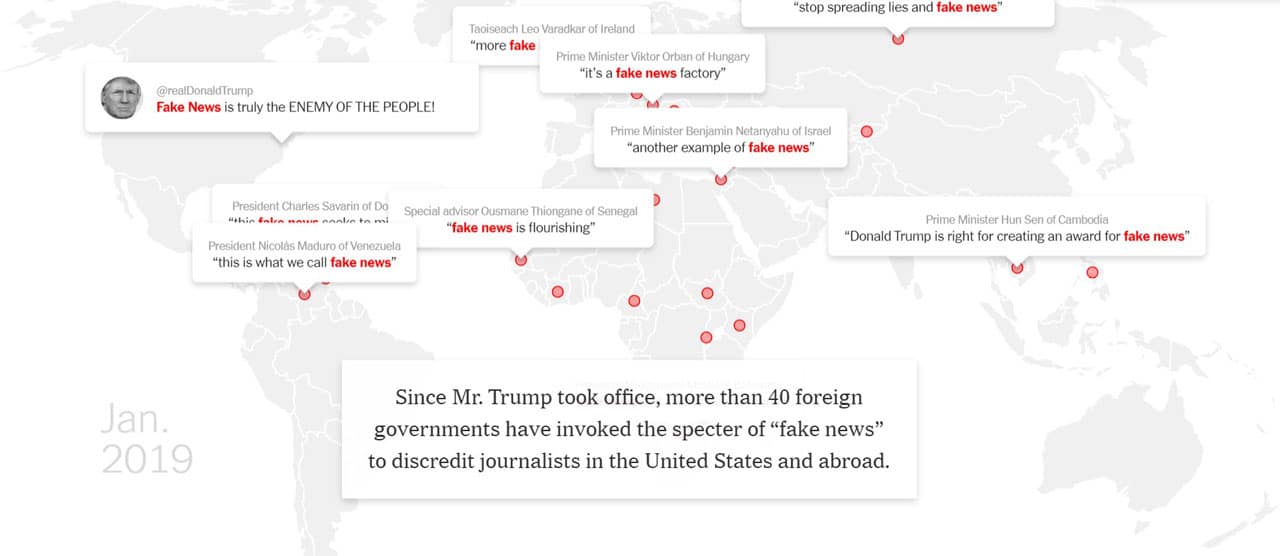
At the top of the editorial on the Times website, there’s an interactive feature identifying Trump’s first use of the term “fake news” on Twitter. In that instance, on December 10, 2016, the President-elect responded to a CNN report claiming that he had determined to remain an executive producer of his NBC show “Celebrity Apprentice” even after taking office.
As you scroll down the article page, the map fills with tweets from other state leaders similarly using the term to criticize the media. But what the Times editors are choosing to conveniently forget is that it wasn’t Trump who originated or popularized such use of the term “fake news”. In truth, the tactic was laundered first through mainstream corporate media themselves, which, barely a generation after the Holocaust, brazenly deployed it as a weapon to attack independent journalism.
When Donald Trump started using the term, he was just imitating the mainstream media’s example. He was mocking the media for leveling the accusation of “fake news” at others while themselves purveying misinformation.
On November 19, 2016, three weeks before Trump first used the term on Twitter (by the Times’ own account), the Times editors themselves had utilized the term “fake news” to accuse “internet companies like Facebook and Google” of facilitating the spread of misinformation, including “hoaxes” that were “bouncing around among like-minded conspiracy theorists”.
Companies like Facebook and Google use complex algorithms that are constantly being adapted toward the goal of better enabling users to find the types of informational content that they want. In other words, they are responding to a market demand by continually trying to improve their services.
This threatens the business model of the mainstream media because if people can gain the knowledge they’re seeking for free just by checking their Facebook feed or doing a quick Google search and reading content that’s not behind a paywall, then they have no need to subscribe to major newspapers like the New York Times.
As the Pew Research Center notes, “Newspapers are a critical part of the American news landscape, but they have been hit hard as more and more Americans consume news digitally.” Print circulation has long been on the decline, and the industry has struggled over the years to find ways to sustain or increase profitability. That is why the Times in 2011 “experimented” with its business model by switching from a read-for-free to a subscription model for its website. The Times’ success with this model paved the way for other major media companies to adopt it, too.
As a corporation prone to institutionalized biases, the Times also adopts various political agendas—including the agenda to silence the large number of small competitors whose collective voice frequently challenge mainstream propaganda narratives on important issues. Alternative online publications and truly independent journalists regularly force alternative perspectives into the mainstream discourse despite the corporate media’s best efforts to either marginalize them or pretend they don’t exist.
This is not to say that there isn’t a lot of misinformation floating around the internet that originated from alternative media sources. There is. Without having investigated them, I presume that the November 2016 Times editorial presented one or more legitimate examples of misinformation also being spread on social media like Facebook and Twitter. But then, without having investigated the matter, Trump, too, may have been tweeting a legitimate example of CNN likewise spreading misinformation.
This is the point. The Times wants to remain among an elite few who dictate to the rest of us what constitutes “misinformation”. The problem is that terms like “fake news” and “misinformation” are being used euphemistically to mean any information, no matter how factual, that challenges whatever political agendas are being pushed during any given news cycle.
The Times, in other words, wishes for the corporate media to preserve their oligopoly in determining what information the public should and should not be made aware of. The Times editors wish to preserve their leadership in determining for us what we should think about any given issue and to determine for us which issues we should regard as important.