

Table of Contents
Introduction
America’s “newspaper of record”, the New York Times, incessantly issues political propaganda masquerading as journalism. Its propaganda serves to manufacture consent for criminal government policies, from wars like the illegal war of aggression against Iraq to domestic authoritarianism like the COVID‑19 lockdown regime and its coerced mass vaccination endgame.
A recent Times article titled “The Steep Cost of Ron DeSantis’s Vaccine Turnabout” provides a useful case study of the propaganda function served by the newspaper. It’s an exercise in apologetics for the disastrous lockdown measures and the brazen lies told by “public health” officials to persuade people to accept experimental COVID‑19 vaccines.
Florida under the governorship of Ron DeSantis was an exception to the rule when it came to COVID-19 lockdowns and their coerced mass vaccination endgame. While at first part of the herd in implementing extreme measures in the first month of the declared pandemic, Florida very quickly eased its measures and reopened its economy, drawing ire from advocates of continued lockdowns who chose to conveniently forget how these measures were sold to the public as “two weeks to flatten the curve”.
By ending lockdown measures, proclaimed the lockdowners at the time, DeSantis would be dooming Florida to a wave of mass death from COVID‑19.
This is similar to what happened with Sweden, which was likewise criticized for not locking down like the rest of Europe, but which wound up with one of the lowest rates of all-cause mortality on the continent.
The case of Florida also challenges the lockdowners’ dogma by having ended up with a COVID‑19 death rate lower than the average among states in the US—most of which joined the bandwagon of “following the science”, the standard euphemism describing inept leaders’ blind deference to whatever “public health” officials in the federal government were saying, regardless of what the scientific literature actually had to say about it.
Throughout the pandemic, government officials routinely lied to the public, but instead of doing journalism and correcting the record, the mainstream media mainly fulfilled the same propaganda function as the New York Times, which sets the standard.
The media “fact check” industry set out to help propagate the government’s deceptions by joining with social media companies colluding with the government to censor factually accurate information that exposed official disinformation coming from “public health authorities”.
The Times naturally cheered on the lockdowns, so the political agenda it is serving by attacking DeSantis is obvious. But, to that end, the Times has a big problem: Florida’s COVID‑19 data stand as a testament to the folly of lockdowns.
In its absurd article, the Times tries to overcome that obstacle by effectively blaming Governor Ron DeSantis for Florida merely doing slightly better than the US average in terms of age-adjusted COVID‑19-related mortality.
DeSantis should have done better for Florida, the Times argues, and could have by aggressively pushing COVID‑19 vaccines instead of opposing vaccine mandates and telling people the truth about the limits of their effectiveness and the low risk posed to most of the population from COVID‑19.
The Predicted Wave of Death in Florida

The Times seems to have forgotten how, very early into the pandemic, the media were up in arms about Florida bucking lockdown measures, issuing warnings about how this would result in Florida having a much higher death rate than lockdown states.
“States rushing to reopen are likely making a deadly error, coronavirus models and experts warn”, declared a Washington Post headline on April 22, 2020, mentioning Florida as an example.
On April 28, the Daily Beast bemoaned that Florida was among a number of states taking a “spectacular risk” by “veering toward a terrifyingly premature end to their COVID‑19 lockdowns”. Modelers were warning of an “alarming” increase in deaths as a result of Florida’s reopening.
If DeSantis were to reverse himself by keeping businesses closed and reimplementing stay-at-home orders, there would be at most 3,014 deaths by mid-June, according to the modelers. Under the best-case scenario of reopening with low employee contact, the number of COVID‑19 deaths could reach 4,106; under the “medium” contact case, deaths could surpass 5,000; and “if businesses returned to their pre-COVID-19 levels”, the death rate could be “as high as 15,523 deaths”.
In actuality, according to data from the Centers for Disease Control and Prevention (CDC), by the week ending June 13, Florida had a cumulative total of 3,008 COVID‑19-related deaths (that is, deaths “with confirmed or presumed COVID‑19”).
On May 5, CNN reported how epidemiologists were “baffled” that the predicated wave of death hadn’t occurred in Florida as a result of lockdown measures being abandoned. Florida was “an enigma” that “puzzled” experts; but, CNN reasoned, the relatively low rate of deaths despite the state’s reopening could simply be “luck” attributable to factors like Florida’s heat and humidity, which “may have slowed transmission of the coronavirus.”
The New York Times on May 11, 2020, reported that researchers were predicting “a wave of unexpected deaths” as a result of Florida reopening its economy. “The costs” of reopening, the Times warned, “may be measured in lost lives.”
The dire predictions made by lockdown advocates never came to pass. As the Times concedes in its recent article attacking DeSantis, “Overall, the state’s death rate during the pandemic, adjusted for age, ended up better than the national average.”
The Times usefully provides this graphic illustration of Florida’s slightly superior performance:
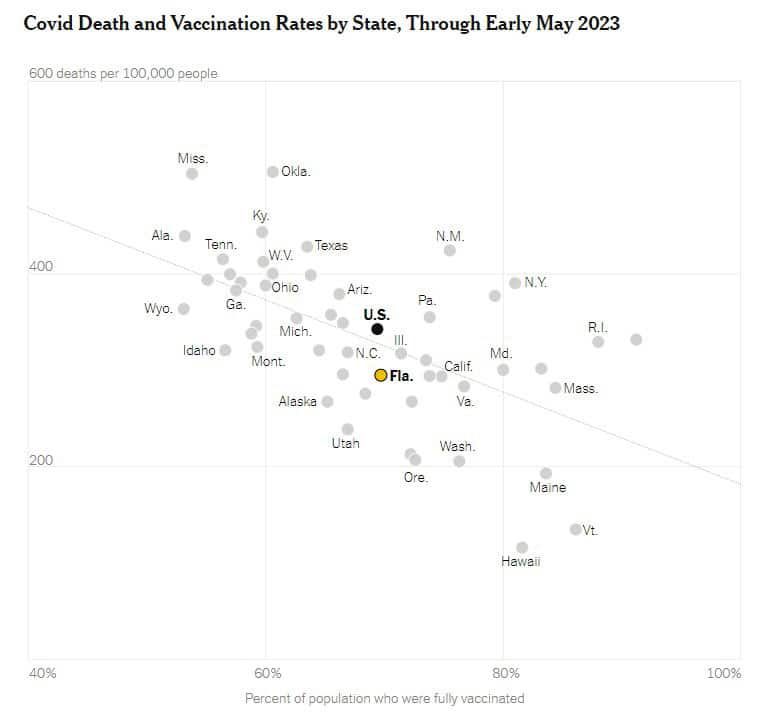
But the Times tosses down the memory hole the early dire predictions of Florida disastrously exceeding lockdown states in COVID‑19 deaths.
One might think that DeSantis is worthy of some measured praise for leading his state through the pandemic and having a lower rate of death than most other states while bucking authoritarian policies including coerced vaccination.
Instead, the Times sets out vainly to defend the disastrous lockdowns and coerced mass vaccination by criticizing DeSantis for taking the alternative approach of favoring freedom.
By September 2020, the New York Times recalls, “Mr. DeSantis had begun listening to doctors who believed the virus’s threat was overstated, and he no longer supported preventive measures like limiting indoor dining. Mr. DeSantis was going his own way on Covid.”
Now, DeSantis, who is running for president, “argues that ‘Florida got it right’ because he was willing to stand up for the right of individuals despite pressure from health ‘bureaucrats.’ On the campaign trail, he says liberal bastions like New York and California needlessly traded away freedoms while Florida preserved jobs, in-person schooling and quality of life.”
Tellingly, the Times doesn’t argue that DeSantis is wrong to conclude that his approach of favoring freedom worked. Instead, the Times criticizes that DeSantis’s account “leaves much out.”
Of course, that same accusation can be reasonably leveled at the Times itself. Its omission of the dire predictions of how much worse Florida would be than lockdown states is one example already noted. We’ll come to additional illustrations of the Times’ gross hypocrisy.

Congratulations Jeremy
Conscientious reporting and an excellent read
Thank you, Margaret!
Really strong article. Makes me a little bit concerned about your safety, but as long as legacy media can still pretend you’re not there, I guess you’re OK.
You doubled the following, though: “But that study was just another model for which the results were dependent upon the assumptions factored into it by the study authors.”
Thanks! As much as I would like to reach a larger message, I’m also glad that I kind of fly under the radar. Thanks for pointing out that redundancy. This was an editing error. A paragraph that started out one way in my draft ended up going another way, and evidently I’d failed to remove the original start to my thought. I’ve corrected it.