

During a Senate hearing on April 22, Health and Human Services Secretary Robert F. Kennedy, Jr. informed that the dramatic decline in infectious disease mortality observed during the twentieth century was primarily driven by factors related to an increasing standard of living—not vaccinations.
The servile New York Times tried to discredit that factually accurate observation of Kennedy’s, with Times reporter Sheryl Gay Stolberg arguing as follows (emphasis added):
Mr. Kennedy stuck by his longstanding assertion that improvements in hygiene and sanitation, and not vaccination, fueled the decline in deaths from infectious diseases during the 20th century.
“If you want to talk about what, why disease mortality has disappeared in the 20th century, it was not vaccines,” he said, testifying before the Senate health committee Wednesday afternoon.
As proof, Mr. Kennedy cited a study published in the journal Pediatrics in 2000. But he failed to note that the study also reported that vaccines introduced in the second half of the 20th century had “virtually eliminated” deaths from diseases including polio and measles. In 1999, the Centers for Disease Control and Prevention listed vaccination as one of “ten great public health achievements” of the 20th century.
After Mr. Kennedy made the assertion, Senator Bill Cassidy, the Republican chairman of the Senate health committee, asked about the author of the study; Mr. Kennedy gave him the author’s name. Later in the hearing, Mr. Cassidy produced the paper and told Mr. Kennedy he had taken it out of context.
The hypocrisy here is extraordinary because it is the Times itself that is demonstrably quoting a two-word phrase from the study completely out of its context.
The study in question was published in December 2000 in Pediatrics, the official journal of the American Academy of Pediatrics (AAP). It is titled “Annual Summary of Vital Statistics: Trends in the Health of Americans During the 20th Century”, by Bernard Guyer et al.
The Times wants its readers to believe that this study does not support the claim for which Kennedy cited it. But it does.
The Times wants its readers to believe, moreover, that the study contradicts Kennedy, that it credits the measles vaccine with the dramatic decline in measles deaths. But it does not.
This is a useful example of how propaganda works.
Here is the relevant section of the paper in full, with bold emphasis added, so you can see that it is Kennedy who told the truth and the New York Times that is trying to deceive you (emphasis added):
For children older than 1 year of age, the overall decline in mortality experienced during the 20th century has been spectacular (Fig 8). In 1900, 3 in 100 children died between their first and 20th birthday; today, 2 in 1,000 die. Nearly 85% of this decline took place before World War II, a period when few antibiotics or modern vaccines and medications were available.
In 1900, the age-specific death rates for children in the United States were 1983 per 100,000 population for 1- to 4-year-olds, 466 for 5- to 9-year-olds, 298 for 10- to 14-year-olds, and 484 for 15- to 19-year-olds. By 1998, the death rates in these age groups had declined by 98%, 96%, 93% and 85%, respectively. Compared with the other age groups, the decline in death among adolescents has plateaued since the 1960s.
At the beginning of the 20th century, the leading causes of child mortality in the 1- to 19-year-old age group were infectious diseases, including diarrheal diseases, diphtheria, measles, pneumonia and influenza, scarlet fever, tuberculosis, typhoid and paratyphoid fevers, and whooping cough. Between 1900 and 1998, the death rate from the major infectious diseases declined 99.7%, from 466 to 0.7 deaths per 100,000. The percentage of child deaths attributable to infectious diseases declined from 61.6% to 2%. This decline incorporates the emergence of human immunodeficiency virus (HIV)/AIDS which in 1998 accounted for 0.3% of child deaths. Once again, nearly 90% of the decline in infectious disease mortality among US children occurred before 1940, when few antibiotics or vaccines were available. . . .
The major declines in child mortality that occurred in the first third of the 20th century have been attributable to a combination of improved socioeconomic conditions in this country and the public health strategies to protect the health of Americans. These public health measures included the establishment of local health departments in nearly all of the states. State and local health departments implemented these public health measures including water treatment, food safety, organized solid waste disposal, and public education about hygienic practices. These improvements in water and food safety and purity are linked to the major decline in diarrheal diseases seen in the early years of the century. Similarly, improvements in housing and decreased crowding in US cities are linked to the reductions in mortality from tuberculosis and other diseases attributable to person-to-person airborne transmission.
Vaccination, while first used in the 18th century, became more widely implemented in the middle part of the century. Vaccines against diphtheria, tetanus, and pertussis became available during the late 1920s but only widely used in routine pediatric practice after World War II. Thus, vaccination does not account for the impressive declines in mortality seen in the first half of the century. The reductions in vaccine-preventable diseases, however, are impressive. In the early 1920s, diphtheria accounted for about 175,000 cases annually and pertussis for nearly 150,000 cases; measles accounted for about half a million annual cases before the introduction of vaccine in the 1960s. Deaths from these diseases have been virtually eliminated, as have deaths from Haemophilus influenzae, tetanus, and poliomyelitis.
So, there you have it. Kennedy told the Senate committee that the dramatic decline in infectious disease mortality observed during the twentieth century was primarily attributable to factors other than vaccines.
To support that assertion, he cited the Pediatrics study.
Does it support his assertion?
Yes, it does.
But the New York Times doesn’t want you to know what the scientific literature really says, so it lies that this study contradicts Kennedy’s claim and that he took it “out of context”.
The Times wants its readers to believe that the cause of the virtual elimination of measles deaths was the measles vaccine.
But that is a lie.
Notice also how Sheryl Gay Stolberg is guilty of her own accusation of taking her own quote from that paper out of context: it did not say that deaths from measles were “virtually eliminated” by the vaccine. It rather said that the vaccine was responsible for a dramatic decline in measles cases; and it reiterated that deaths from measles and other diseases were virtually eliminated—with, again, most of that decline occurring before there were vaccines available to help explain it.
Here is how the Times would have put it if it were interested in telling the truth about vaccines:
Mr. Kennedy stuck by his longstanding assertion that improvements such as hygiene and sanitation, and not vaccination, fueled the dramatic decline in deaths from infectious diseases during the 20th century.
“If you want to talk about what, why disease mortality has disappeared in the 20th century, it was not vaccines,” he said, testifying before the Senate health committee Wednesday afternoon.
As proof, Mr. Kennedy cited a study published in the journal Pediatrics in 2000. The study noted that vaccines impressively reduced incidence of some diseases, such as measles, but were not primarily responsible for the dramatic decline in deaths from infectious diseases.
After Mr. Kennedy made the assertion, Senator Bill Cassidy, the Republican chairman of the Senate health committee, asked about the author of the study; Mr. Kennedy gave him the author’s name. Later in the hearing, Mr. Cassidy produced the paper and told Mr. Kennedy he had taken it out of context.
However, Mr. Kennedy had accurately described the study, which notes that “nearly 90% of the decline in infectious disease mortality among US children occurred before 1940, when few antibiotics or vaccines were available”. The decline was instead due to factors such as “water treatment, food safety, organized solid waste disposal, and public education about hygienic practices”, as well as “improvements in housing and decreased crowding in US cities”.
Now, why doesn’t the Times report it like that?
Simple! You aren’t supposed to know the truth.
You are supposed to believe in the mythology of the vaccine religion.
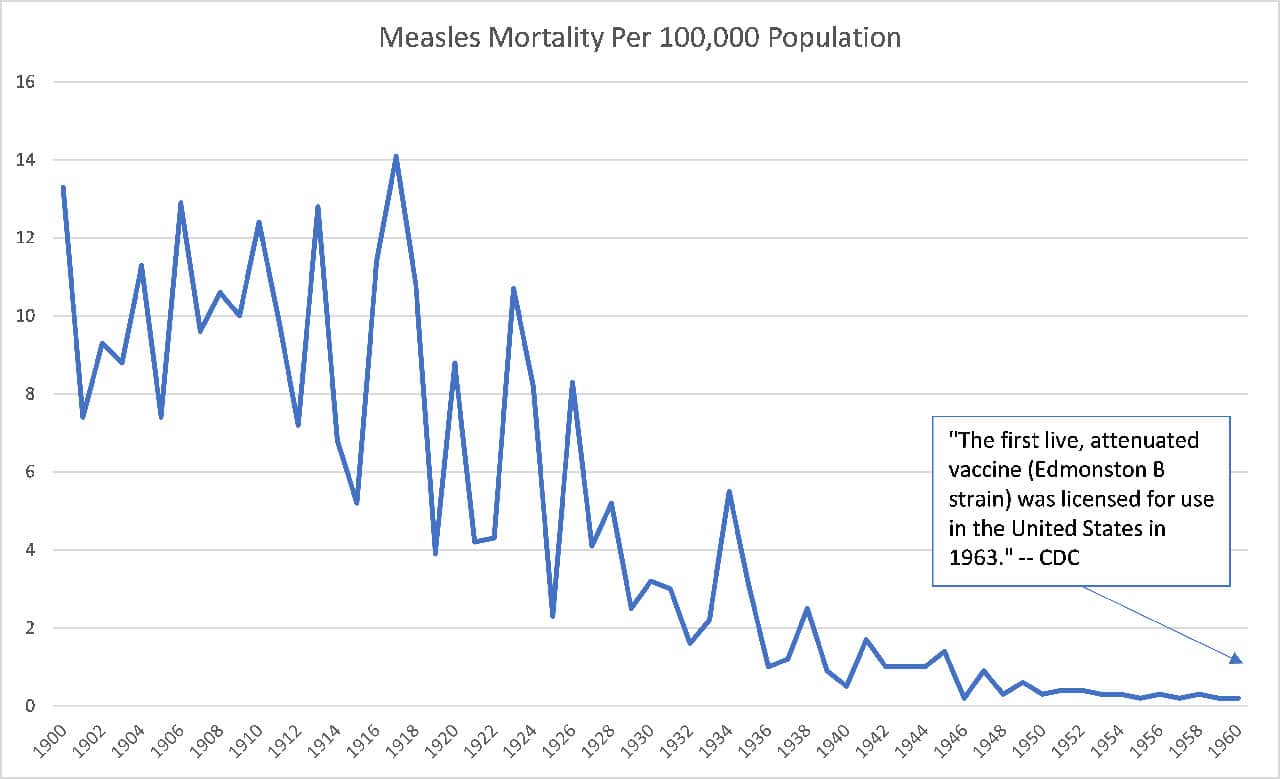
I’ve graphed some of the data—accessible at the CDC’s website—for myself.
Here is diphtheria:

Here’s pertussis:

And here’s the dreaded measles:

To learn more about how the mainstream media serve the state and Big Pharma by routinely lying to you about the safety and effectiveness of vaccines, read my freely available e-book The New York Times vs. Robert F. Kennedy, Jr.: How the Mainstream Media Spread Vaccine Misinformation.
