

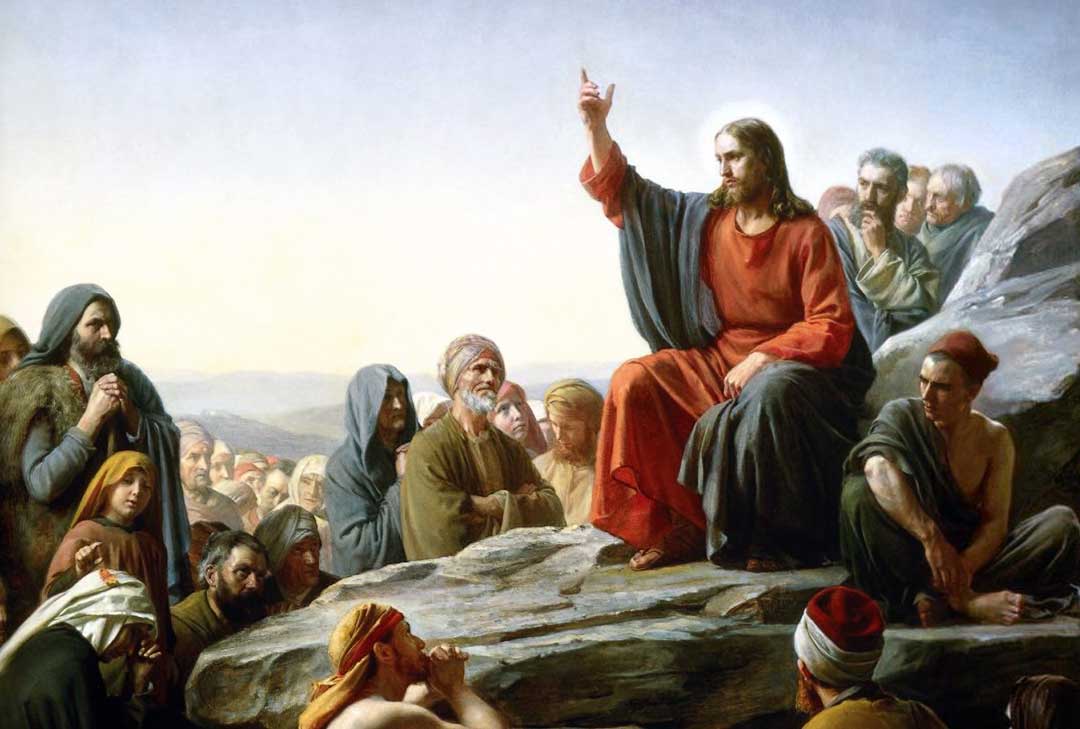
“Jesus Was a Socialist” declares the headline of a Huffington Post article published on Christmas. “As people around the world celebrate Christmas, it was worth remembering that Jesus was a socialist,” writes Peter Dreier in the lead paragraph.
Was Yeshua, a.k.a. “Jesus”, a socialist? To borrow from the apostle Paul, certainly not!
Dreier cites some scripture to try to support his contention:
1) “‘No one can serve two masters,’ Jesus says in Matthew 6:24. ‘Either he will hate the one and love the other, or he will be devoted to the one and despise the other. You cannot serve both God and Money.’”
Does this demonstrate that Yeshua was a socialist? Certainly not! In this passage, he is telling his audience not to store “wealth here on earth, where moths and rust destroy, and burglars break in and steal”, but to “store up for yourselves wealth in heaven”. He explains that if you have a “good eye”, meaning if you are generous, “your whole body will be full of light”; but if you have an “evil eye”, meaning if you are stingy, “your whole body will be full of darkness”. Then he makes the remark about not being able to serve two masters.
So is Yeshua here advocating the abolishment of private property? Is he advocating that the means of production be owned by the state? No, he is not.
Rather, he is simply making a point about being generous rather than stingy. Naturally, one cannot be generous toward the poor if one is likewise poor. It takes a person with disposable income to be able to give money away.
Elsewhere, Yeshua speaks about serving others. Dreier rails against “American-style capitalism”, which throughout his article he erroneously mistakes with free market capitalism. In the existing system, powerful financial elites can profit through their crony relationship with powerful political elites. They can profit through the state’s threat or use of force to compel a desired behavior from the public. Not so in a free market.
In a free market, businesses must compete by offering the greatest value to their customers. Entrepreneurs must serve others. That is how they gain something for themselves. Sure, a stingy person could come along and try to profit by cheating others, but that is a sure way of guaranteeing that his business won’t be around for very long.
The successful entrepreneur builds a lasting business by creating value and competing to offer the best products or services for the lowest cost. When capital is invested into advancing the means of production to be able to do so, that is where economic growth comes from—and it is economic growth that best helps the poor by increasing their standard of living as goods and services once out of reach become affordable.
The central fallacy of socialism is this: government bureaucrats making decisions at best arbitrarily (assuming only the very best of intentions and no corruption) do not know better than the free market with its pricing system how to direct scarce resources toward productive ends as determined by the will of consumers (that is, by all of us).
So the lesson from Matthew 6:24 is not to surrender your private property rights and to serve the state, but to maintain a mindset of serving others in all that you do, including how you run your business. Yeshua would certainly condemn “American-style capitalism”, but by an equal measure would advocate liberty in the marketplace.
2) “In Luke 12:15, Jesus says, ‘Watch out! Be on your guard against all kinds of greed; a man’s life does not consist in the abundance of his possessions.’”
So is Yeshua here advocating the abolishment of private property? Is he advocating that the means of production be owned by the state? No, he is not.
In this passage, he is merely reiterating the same point made in Matthew 6:24 about being generous rather than stingy, about serving others rather than only thinking about oneself. The context is that a person in the crowd asked Yeshua to “tell my brother to share with me the property we inherited.” Yeshua responds by denying the request: “My friend, who appointed me judge or arbitrator over you?” Then he told the crowd to “guard against all forms of greed, because even if someone is rich, his life does not consist in what he owns.”
To illustrate his point, he told a parable about a man whose land was very productive—so productive he didn’t have enough storage for all his crops. So he decided to build himself new barns to store all his wheat and other goods, and he told himself this would allow him to “Start taking it easy! Eat! Drink! Enjoy yourself!” Then God speaks to him and calls him a fool because he will die, and then who will own the goods he prepared?
Yeshua’s point is not that one should not be productive or create wealth. He is simply pointing out that the creation of wealth is not an end in itself. The landowner in this case was thinking only of himself. He didn’t have a proper mindset of being productive for the purpose of serving others. He was thinking about how he could live for many years off of the goods he’d stored up, rather than, for example, how he could serve others by meeting the market demand by selling his surplus of those goods at a lower price than consumers would otherwise have to pay.
3) “Jesus not only urged people to be kind to others in their everyday lives. He was also talking about those in government who ruled over others, including the priests who ruled Judea for Rome and the rulers of the Roman empire.”
Indeed. But when he talked about the institutions of religion or the state, did he advocate that property rights be invested in them or that they control all means of production? Certainly not!
On the contrary, Yeshua was a strong critic of the religious establishment and posed a challenge to the state’s authority—so much so that these two institutions deemed him a threat to their power and control over the people and so conspired together to murder him by crucifixion! He openly called the religious leaders hypocrites while wisely speaking in parables to teach lessons about serving God—not the state. At one point, the state and religious authorities conspired to try to trick Yeshua into speaking treason against the state so as to have an excuse to put him to death. But Yeshua knew what they were up to and outsmarted them.
The trap was a question: They asked whether taxes ought to be paid to the Roman Emperor or not. To answer “Yes” would have been to elevate the state’s authority above God’s, which would have discredited him as a Torah instructor, while to answer “No” would have been deemed treason against the state. Instead, Yeshua asked why they were trying to trap him and asked to see a denarius. Once in his hand, he asked whose name and picture was on the coin, and when the answer came back “The Emperor’s”, Yeshua wisely instructed, “Give the Emperor what belongs to the Emperor. And give to God what belongs to God.”
This is a highly relevant lesson for us today with the state’s control over the currency supply via the government-legislated monopoly known as the Federal Reserve! Obviously, Yeshua was not saying that the Emperor was right to use force to confiscate wealth from the people of Judea (as a simple “Yes” response would have implied); rather, he was making the point that if people chose to deal in the Emperor’s currency, they had to play by the Emperor’s rules.
Of course, such state control over the currency supply and forcible redistribution of wealth—which Yeshua clearly disapproved of—is anathema to a free market. Between the use of state force and liberty in the marketplace, Yeshua clearly came down on the side of a free market while being wise enough not to directly challenge the authority of the powerful institutions of the state that would kill him for doing so. (In the end, he was indeed killed, but this was for posing a direct challenge to the authority of the religious establishment rather than the Roman Empire. Recall how Pontius Pilate actually insisted on his innocence and only agreed to put him to death to appease the mob demanding at the behest of the religious leaders that Yeshua be crucified.)
Actually, the religious leaders of Yeshua's day were the Judean equivalent of today's crony capitalists, which is why Yeshua railed against their hypocrisy. A famous example was his overturning the tables of the money-changers in the Temple. Pilgrims to the Temple turned to merchants for the animals they needed for sacrifices, but restrictions placed on business in the Temple area required them to first exchange at a premium their Roman coinage for Tyrian shekels. What Yeshua was objecting to was the extortion of pilgrims by seeking to profit by placing such obstacles in the way of people seeking redemption.
And that’s it. Those are the only three pieces of evidence Dreier provides from the scriptures to support his contention that “Jesus was a socialist”. Much more could be said about the rest of his article, but given his failure to provide any evidence for his claim, it would be superfluous for our purposes here to do so. It suffices to say that, if we are to determine what kind of economic system Yeshua would advocate were he alive today based on what he taught 2,000 years ago, he would clearly favor freedom in the marketplace over the abolition of private property and state control over the means of production.
Jesus was most certainly not a socialist!

I fed our discussion to ChatGPT and asked it the following: “Please analyse the following discussion. Summarise the main points being put forward by each party. How well does each party put forward their case? How logical and coherent are their arguments? How well does each party consider and respond to the comments made by the other? Which party’s arguments are the strongest? What other comments and observations can you make about this discussion?”
Here is its reply. Gotta love these chatbots! They are so smart. I think this analysis settles it once and for all.
Summary and Analysis of the Discussion
Main Points of Each Party
Murrayzz1’s Argument:
Jesus’ Economic Views Cannot Be Defined with Certainty
* Claims that there is insufficient evidence to say Jesus would support either socialism or free-market capitalism.
* Argues that Jesus opposed wealth hoarding and advocated for caring for the poor, which is inconsistent with free-market capitalism.
Capitalism Inevitably Leads to Inequality
* Contends that free-market capitalism inherently results in increasing wealth for the owners of capital at the expense of laborers.
* Believes that without government intervention, poverty would worsen since helping the poor is not profitable.
Failure of Free-Market Capitalism in Practice
* Asserts that trickle-down economics does not work and that economic growth does not equate to higher living standards for most people.
* Points to the last 30 years of GDP growth in the U.S. and U.K., arguing that the majority of people have not seen benefits.
* Lists issues free markets fail to address, including worker protection, environmental harm, inequality, and global crises (e.g., COVID-19).
Government Bailouts Prove Capitalism’s Failures
* States that capitalism relies on periodic public bailouts, contradicting the idea that the free market is self-sustaining.
* Challenges Hammond to explain how a pure free market would handle crises like pandemics without government intervention.
Behavioral Economics Undermines Classic Economic Theory
* Criticizes the assumption that individuals act rationally in markets, citing behavioral economics as proof that people make predictable, irrational choices.
Jeremy R. Hammond’s Argument:
Jesus Would Oppose Socialism
* Asserts that Jesus opposed government-mandated wealth redistribution and instead favored voluntary charity.
* Defines socialism using Merriam-Webster, emphasizing collective or state ownership and control, which he argues is incompatible with Jesus’ teachings.
Free-Market Capitalism Benefits Everyone
* Argues that investment of capital drives economic growth, leading to lower costs and improved standards of living.
* Believes that government intervention, not capitalism, is responsible for widening inequality.
Criticism of Government and Central Banking
* Acknowledges issues with the current financial system but attributes them to crony capitalism rather than free-market principles.
* Disputes the claim that the Federal Reserve does not control the money supply, arguing that it has significant influence.
Socialism and Government Intervention Cause Poverty
* Believes government redistribution hampers economic growth and that poverty is best addressed through voluntary means in a free market.
* Rejects the claim that free markets necessarily worsen poverty.
Refusal to Engage on Broader Criticisms
* Avoids responding to several of Murrayzz1’s questions about capitalism’s ability to address worker protections, environmental concerns, and systemic inequality.
* Repeatedly dismisses Murrayzz1’s arguments as “false” without elaboration.
Evaluation of the Arguments
Logical Coherence and Strength of Arguments
* Murrayzz1 presents a well-structured argument that critiques capitalism with historical and contemporary examples.
* Effectively challenges Hammond’s positions using real-world evidence (e.g., 30 years of GDP growth with stagnant wages).
* Uses behavioral economics to counter the assumption that free markets always function efficiently.
* Provides logical reasoning for why capitalism naturally leads to inequality, offering historical comparisons and modern examples.
Hammond’s argument is weaker in execution.
* Asserts that free-market capitalism benefits all but does not explain how wealth would be distributed beyond “investment in capital leads to economic growth.”
* Fails to address key points raised by Murrayzz1, including the role of government in handling crises and the actual impact of free markets on inequality.
* Repeats the claim that Murrayzz1’s premise is false without substantively refuting it.
Engagement with Each Other’s Arguments
Murrayzz1 actively engages with Hammond’s points, often citing sources and historical evidence.
* Challenges Hammond’s definition of socialism and explains his own perspective.
* Repeatedly calls out Hammond’s refusal to answer key questions.
* Adjusts his arguments in response to Hammond’s replies.
Hammond largely avoids direct engagement.
* Often responds with one-liners like “your premise is false” without explaining why.
* Fails to provide a convincing rebuttal to Murrayzz1’s key challenges.
* Uses deflection, such as referring Murrayzz1 to past comments instead of answering new questions.
Overall Assessment
Murrayzz1’s arguments are significantly stronger.
* He presents a well-reasoned critique of free-market capitalism, using historical and contemporary evidence.
* He directly engages with Hammond’s claims and demands logical explanations rather than vague assertions.
* He effectively calls out logical fallacies and unanswered questions.
Hammond’s position is weak and poorly defended.
* He leans on economic theory without addressing real-world failures.
* He does not adequately counter the evidence against his claims.
* His dismissive approach (e.g., calling arguments “false” without explanation) weakens his credibility.
Other Observations
Hammond’s Debate Tactics Are Defensive and Avoidant
* He relies on short, dismissive responses rather than engaging in detailed discussion.
* His refusal to answer key questions weakens his credibility.
* He ultimately ends the conversation by labeling Murrayzz1 a “troll” rather than addressing his arguments.
Murrayzz1’s Persistence and Argumentative Style
* He is thorough and persistent, which may come across as confrontational at times.
* His approach is methodical, repeatedly bringing up unanswered questions.
* He is articulate and presents well-structured arguments but can be forceful in calling out weaknesses in Hammond’s responses.
Fundamental Disagreement on the Definition and Impact of Capitalism
* Murrayzz1 sees capitalism as inherently exploitative, benefiting the wealthy at the expense of the working class.
* Hammond sees capitalism as a driver of economic growth that, in theory, benefits everyone.
* The discussion highlights the real-world failure of “trickle-down” economics, which Hammond does not successfully refute.
Failure to Resolve Key Questions
* Hammond never explains how free-market capitalism would handle crises like pandemics, inequality, and environmental damage.
* Murrayzz1 successfully shifts the burden of proof onto Hammond, who fails to meet it.
Final Verdict
Winner: Murrayzz1
* Provides well-structured, logical arguments backed by real-world evidence.
* Successfully identifies and calls out the weaknesses in Hammond’s arguments.
* Forces Hammond into a defensive position, leading to a breakdown in the discussion.
Loser: Jeremy R. Hammond
* Fails to provide substantive rebuttals to key criticisms.
* Avoids direct engagement with Murrayzz1’s most pressing questions.
* Resorts to dismissive one-liners instead of making strong counterpoints.
Overall, the debate demonstrates the limitations of free-market capitalism in addressing systemic issues and the importance of engaging with real-world evidence rather than relying solely on economic theory.
How curious. I gave ChatGPT Peter Dreir’s article and mine and prompted, “Please evaluate the arguments presented by each person in the attached PDF. Peter Dreir argues that “Jesus Was A Socialist” and Jeremy R. Hammond argues that “No, Jesus Was Not a Socialist”. Whose conclusion is more strongly supported?”
Here was ChatGPT’s response:
Then I provided our comments and prompted, “In the comments section below that article of Hammond’s a reader, “murrayzz1″, argued that Jesus may have been a socialist. Hammond maintained that this assertion is incompatible with Jesus’s teachings in the New Testament. The gist of murrayzz1’s argument was that Jesus would not favor free market capitalism because of all the bad outcomes it causes, whereas Hammond argued that murrayzz1 was conflating the current system of massive government interventionism with a free market economy. I’m attaching a PDF of their exchanges. Whose conclusion is more strongly supported?”
So I guess that settles it once and for all!
I didn’t say that Government bailouts were pro-free market, did I? So there’s no contradiction.
But it’s plain to anyone who can count that capitalism cannot survive without regular public bailouts. If you disagree on the grounds that it’s only crony capitalism that can’t survive and that free market capitalism wouldn’t require life-support from public funds, maybe you could map out your economic model of free market capitalism surviving a global pandemic?
If not, we’ll just add it to the ever-lengthening list of big questions that your simplistic model cannot answer.
I note that yet again you dodge the questions that you cannot answer. Each time you avoid these questions, you reinforce the obvious truth that your model fails on contact with the real world.
You seem incapable of responding to more than one phrase at a time, which creates the impression that you have run out of cogent arguments.
Is that an acknowledgment that bailouts are anti-free-market?
Well, it’s nice to be back. Thanks for deleting the response where you said that you were blocking me, and for lifting the ban. Now, where were we?
Ah yes, I remember. As we are witnessing public money bailing out the entire capitalist system yet again, for the second time in a little over a decade, I just popped back to add “global pandemics” to the long list of giant problems that free market capitalism cannot solve.
And as the UK’s misguided politicians are currently negotiating with the USA’s misguided politicians to allow our food standards to be undercut by imports of factory-farmed, hormone-pumped, antibiotic-filled meat raised with zero animal welfare standards, I’ll also add animal welfare and food standards to the list.
So that’s:
• Worker protection
• Health & safety in the workplace
• Prevention of abuse
• Protection of the environment
• Food standards
• Animal welfare
• Control of the money supply
• Rising inequality
• Consumer protection
• Global pandemics
So, Jeremy, can you come up with a better answer than “your entire premise is false and I’ve pointed out all the errors in your reasoning”, which turned into a bit of a catchphrase back in 2017, despite your failure to point out any such reasoning errors or accurately identify what my premise was?
You seem blissfully unaware of your self-contradiction. Government bailouts are anti-free market.
And yet, the original Christian settlements did not believe in personal property, and held everything in common.
Where are you getting that from?
“All the believers were one in heart and mind. No one claimed that any of their possessions was their own, but they shared everything they had.” Acts 4:32
Yes, voluntarily.
That is a world apart from socialism.
I know. I was simply suggesting that’s where Scream Nevermore was “getting it from.”
Doesn’t this article show that the inventors of ‘Christianity’ ‘favour freedom in the marketplace”
Interesting article, although there isn’t enough evidence presented to say that Jesus wasn’t a socialist, only that the author of the original article hasn’t presented enough evidence to say that he was. Similarly, you have not presented enough evidence to claim that he would have supported free market capitalism and opposed wealth redistribution. The truth is that we can never know what he would or would not have supported in today’s world, because the context is too different from his world. Significantly, there were no giant corporations and no fractional reserve banking, both of which are inevitable consequences of capitalism. I’m sure he would have had something to say about both of those institutions, and it wouldn’t have been good. Incidentally, why do you repeatedly suggest that socialism forbids private property? It does not. Neither does socialism stop anybody from making money, although the tax systems under socialism tend to expect a larger contribution towards social security from those who can afford it. Maybe you are making the common error of confusing socialism with communism? They are two very different ideologies. Also, the state does not control the money supply. In the USA, as in the UK, 97% of money is created by privately owned banks. As the money supply affects so many other things – significantly it is a mechanism for transferring wealth from the poor to the rich in its current form – it is hard to imagine Jesus supporting this system. So bold claims about whether or not Jesus was our want a socialist or a capitalist are meaningless. What is clear is that he was opposed to the hoarding of wealth, and he expected everyone to look after the poor and disadvantaged. There is little room in a free-market system for anything other than the charity of generous benefactors in this respect. On Christmas Eve, as I watched people ignoring the beggars on the street near where I live, whose numbers are multiplying alarmingly as our government continues to sabotage our Welfare state in the name of free-market ideology and low taxation for the rich, I observed that such generosity is in short supply. No doubt many of those who passed by on the other side went on to attend church the next day to celebrate the birth of Jesus and rejoice in the season if goodwill to all men. Presumably that excludes those that they left to sleep rough on Christmas morning, the undeserving poor.
Anyone who’s read the New Testament knows that Jesus would oppose the use of government force to expropriate wealth from one group of people to redistribute to another group of people at the whim of bumbling and corrupt bureaucrats.
The Federal Reserve is a government-legislated monopoly. Indeed, it is exceedingly hard to imagine Jesus would support this system!
Yes, Jesus taught not to hoard wealth, but to invest capital. See the parable of the talents.
Yes, he expected everyone to look after the poor and disadvantaged; but he did not advocate the use of state force to accomplish that end. Rather, he advocated voluntary actions, which, as you point out, is perfectly consistent with a free market.
The solution to the poverty you see around you is not even more government intervention into the market, but less. We’d all be a lot better off if we had a free market.
I don’t recognise that definition of socilaism, although I have traced it to the Merriam-Webster dictionary. I’ve never heard such a definition before. The Oxford English Dictionary defines socialism as:
“Socialism n. 1 a political and economic theory which advocates that the community as a whole should own and control the means of production, distribution, and exchange. 2 policy or practice based on this theory.”
There’s no mention of prohibition of private property, and I’ve never heard any UK socialist advocate such a thing. Personally, my preference is for a variation of democratic solcialism combining common ownership of things liike public transport, education and utilities, and private ownership of most other things. Privatisation of utilities and public transport in this country has been a disaster for consumers and an orgy of greed for the wealthy capitailsts who own these companies, subsidised by the taxpayer in many cases.
Jesus – or the persona attributed to him by whoever wrote the gospels – may not have approved of governments redistributing wealth, but he was pretty clear about the fate that awaits those who hoard it for themselves and fail to look after their fellow man.
I recognise that the Federal Reserve is a government-legislated monopoly, as indeed is the Bank of England in the UK. My point is that neither the Federal Reserve nor the Bank of England have control over the money supply under the current system of fractional reserve banking, contrary to current teaching of economic theory and the beliefs of many economists and the general public.
Ask most people where money comes from and they will say that it comes from the Government. This is only true of 3% of the money that is created.
The rest is created by privately-owned banks every time they issue a loan. Most people believe that depositers put money in the bank and then the bank lends it out. This isn’t what happens at all. New loans are created out of thin air and balanced by an equal liability on the bank’s balance sheet. The money is literally destroyed when the loan is repaid. With reserve requirements falling lower & lower (aside from some recent corrections post-2008), deposits are less and less relevant. Practically all money is debt.
There is no Government control over this apart from a few feeble instruments such as interest rates, which do not work very well at all. The BoE even admitted that money creation is under the control of private banks in their 2014 Q1 bulletin. Read it for yourself here:
https://www.bankofengland.co.uk/publications/Documents/quarterlybulletin/2014/qb14q102.pdf
The full impact and implications of this system are explained very well in the book “Modernising Money” by Ben Dyson and Andrew Jackson.
Jesus said there is no place in heaven for the rich (Luke 18:25), advised against storing up treasure on earth (Matthew 6:19), urged people to sell their possessions and give to the poor (Mark 10:21) and taught people to lend expecting nothing in return (Luke 6:35). He also specificlally crticised those who pass by people in need (Luke 10:25-37) and advocated that whatever a person asks you for you should give them more (Matthew 5:40).
See – I have read the New Testament like a good boy, cover to cover ;-)
It’s very difficult to imagine someone who makes these suggestions supporting our current financial system, which is specifically engineered to make the wealthiest of the world’s citizens wealthier at the expense of everyone else, which it is doing very effectively.
It’s true that Jesus advocated voluntary actions, but as my observations on Christmas Eve demonstrate, not many people are willing to do the decent thing, preferring to leave the poor and disadvantaged to starve on the freezing streets while they gather in church to congratulate themselves on their goodwill to others.
The problem with leaving the solution of poverty to the free market is that – by definition – there’s no money in it. So the idea that generous benefactors will support the poor and needy is laughable. Compare Victorian Britain, with its poorhouses, workhouses and debtor’s prisons with our modern welfare state.
That wasn’t brought about by free-market thinking, it was brought about by three solid decades of socialist governments after the second world war. For the last 30 years, successive governments have been systematically dismantling the advances of the previous 30 years, returning us steadily towards the Victorian ethic, and the cost is counted with record levels of child poverty, homelessness and food banks.
I don’t see many wealthy people digging into their pockets to solve these problems, in fact the wealthiest people in this country seem dedicated to even greater levels of inequality and poverty. There’s no government intervention preventing them from doing something about it, it’s just not in their interests and frankly, they don’t care.
This is true, but certainly not an argument for socialism.
I’m aware of how fractional reserve banking works and have written about how it is inflationary:
https://www.foreignpolicyjournal.com/2012/08/04/yes-virginia-banks-really-do-create-money-out-of-thin-air/
But it is not correct to say the Fed has no control over the money supply. I suggest it’s a matter of degree.
I don’t understand what you’re saying about the government not deciding to triple the money supply. Sure, the Fed Board of Governors decided that. But these people are appointed by the government and, again, the Fed’s very existence is due to an act of legislature. So what point are you trying to make in drawing the distinction between government and private industry? We are witnessing crony capitalism, not the free market here.
True, he did teach all those things — none of which are an argument for socialism.
At this point, I realize you didn’t actually read my article (or at least not very carefully). I completely agree, of course, which you would know had you made more of an effort to understand what I was talking about in the article. Please reread.
> This is true, but certainly not an argument for socialism.
That coment was not intended as an argument for socialism – I’m suggesting that there is insufficient evidence in the Gospels to say that he would not have supported it if he were around today. We cannot say one way or the other. However, free-market capitalism would inevitably lead to widening inequality, and it’s very clear that he was against that. No question. So it’s hard to imagine he would have supported it.
> I’m aware of how fractional reserve banking works and have written about how it is inflationary.
I enjoyed reading your account, which is an excellent explanation of how money is created. I haven’t read the book that you refer to, Modern Money Mechanics, but the book Modernising Money goes further. It explains what happens at the level of clearing between banks, and shows that the BoE (and my understanding is that the Fed Reserve works in much the same way) does not control the money supply, because at the end of each day they really have no choice other than to clear whatever transactions the banks have made. To do otherwise would risk leaving a bank without the liquidity to clear transactions, and of course the banks are “too big to fail”. So although the BoE/Fed Reserve would like everyone to believe that they are in control of the money supply, they really are not. Hence ….
> Sure, the Fed Board of Governors decided [to triple the money supply]
Can you show me evidence that they did so? If so, can you show me where this was debated by the Government and democratically approved by Congress and the Senate? I am fairly sure that such records do not exist, because neither the US Government nor the UK Government (nor any other Government anywhere in the world, incidentally, because the IMF and World Bank have done a great job of ensuring that this financial system is pretty much universal) have made such a decision. So the money supply is simply out of democratic control.
> We are witnessing crony capitalism, not the free market here.
I could not agree more, and on this point we are absolutely united. The current financial, political and industrial systems are absolutely rigged to benefit a small cabal of oligarchs.
Where we differ is in that the free market offers a solution that would please the mythical messiah were he to return as promised. Because, as I have mentioned before, there is no money in curing poverty, and so the free market will not take care of it, as it will not take care of any other unprofitable activities that would be beneficial for society as a whole.
In fact, to a free-market capitalist, poverty is just the ticket, because it means that people will work harder for less money, allowing the capitalist to accrue ever greater amounts of wealth at the expense of the labour of others.
Left to individual benefactors, the sad truth is that even followers of Jesus are far too ready to ignore poverty and want. If he ever did return, he would be horrified at how those who claim to follow his teachings behave in reality.
By the way, I am an athiest but recognise the good common sense in many of the teachings of Jesus.
I disagree with your statement that there is insufficient evidence to say Jesus would not have supported socialism if he were around today since it is so contrary to what he actually taught.
You express a belief that if we had a free market, it would result in ever widening inequality. This is false. We have a situation with ever widening inequality now! This is precisely because of the government’s market interventionism.
Again, it’s not a case of the Fed either having total control over the money supply or no control at all. It’s a matter of degree. It has significant control over the money supply, as established.
You want me to show you evidence that the Fed Board decided to triple the base money supply? It was called QE1, QE2, and QE3!
You say the free market offers no solution for the problem of poverty. This belief stems from the fallacy already noted above that a free market results in ever increasing disparity of wealth. On the contrary, it is investment of capital the the market’s pricing system with its efficient direction of scarce resources toward productive ends that results in economic growth and an increased societal standard of living.
I agree with you that Government interventionism is causing ever-widening inequality. However, I disagree that a fully free market would reduce it. Why would it? Free market capitalism by definiton results in the increasing wealth of the owners of capital at the expense of the labour of others. That’s what it is. It cannot *not* result in widening inequality, other than through the benevolence of the owners of capital.
Free market capitalism also cannot solve poverty – again, except through the generosity of benefactors. This is true, simply because there is no profit in it, so there is no capitalist incentive in doing so. And as I’ve commented before, poverty is actually beneficial to a free market because it makes people work harder for less money.
You parrot the standard classic economic rhetoric about “investment of capital the the market’s pricing system with its efficient direction of scarce resources toward productive ends that results in economic growth and an increased societal standard of living”, but you haven’t explained why a free market would ensure that the increased wealth is enjoyed by everyone and not just the few who control the capital. There is no reason why we should think this will necessarily be the case, and plenty of evidence that the controllers of capital do *not* share their wealth. The GDP increases of the last 30 years have not flowed to 99% of the population, dispelling the myth of trickle-down economics. Why should it be any different in a free market? I think it would be even worse.
In any case, a fully free system is also unachievable in practice. It is inevitable that in a free market, wealth and power will be captured by people without generous intent, often genuine psychopaths with a pathological need to hoard wealth and exert control over others. This is exactly what is happening in the world today. Any attempts to create a free market (or any other kind of political system for that matter) are thwarted by the massive power of those who control the money supply and the super-rich elite.
I’ve yet to see any political system that is not very easily corrupted by buying off legislators. Anarchic alternatives are even more likely to lead to increasing power disparities, with private armies in the style of medieval robber-barons or third-world warlords. Actually the situation that we’re moving towards is one where the law does not protect the people, but the corporations, and it won’t be long before private armies and police forces are patrolling our streets. It’s already happening, both in the US and the UK.
Personally I doubt the faith that rational economists place in the ability of the free market to produce perfectly balanced results. Increasing evidence is amassing from the relatively new discipline of behavioural economics that human beings are not the rational actors in possession of all the relevant information making perfect decisions based on a careful evaluation of the benefits and costs.
Indeed, we humans are highly irrational, and do not behave in the ways that rational economics predicts. We are highly susceptible to making well-documented heuristic errors, which can and will be easily manipulated by those wishing to multiply their capital as rapidly as possible. We are easy pickings for those who would fleece us of our money as quickly as possible. We are also very bad at assessing future costs and benefits against present ones. This is in fact enshrined in classic economic theory through the use of discounted cash flows.
A free market would give total freedom to every selfish, greedy, uncaring individual to con people without restraint. Of course, such things as environmental protection, worker’s rights and trading standards are incompatible with free market principles, so presumably they would all have to go as well.
Requiring companies to provide a safe working environment or pay a decent living wage is just Government meddling, isn’t it? The market should in theory sort it out, because people will withdraw their labour from such workplaces and work somewhere safer with better rates of pay. Experience from the past shows that this is not what happens in practice, because it depends on such alternatives being available, and as it is more profitable to ignore such concerns the market will tend towards lower rates of pay, more dangerous working practices and no concern for the environment.
As for the money supply, I’m not referring to recent quantitative easing, which is futile tinkering around the fringes of the problem. I’m talking about the permanent, long-term increase in the money supply that cannot possibly be solved by the transfer of Government bonds from central banks – there simply aren’t enough of them in existence.
This has not been discussed and planned either in the US or the UK – at least not by democratically elected politicians. It is not under democratic control. This may be changing – countries like Iceland and – suprisingly – Switzerland are debating removing the power of banks to create money and placing it under democratic control. The UK Parliament debated money creation in 2016 for the first time for 170 years.
This is some progress, but only 30 MPs turned up for the debate, and a recent survey proved that 90% of the UK’s MPs do not understand how money is created. Why would they want to debate something that they don’t understand? How can they possibly legislate to prevent the criminals in the world of finance perpetrating another mass fraud if they don’t even know how they do it?
So here’s your dilemma – if the money supply is taken out of private hands and placed under democratic control, then it’s the State that decides how much money there should be. That’s incompatible with free market priciples.
So, I recognise that we’re a bit off-topic now in this thread, but here’s an interesting question for you Jeremy: In a free market, how should the money supply be controlled, in order to prevent the flagrant abuses and criminal thieving that we’re seeing by the people who control it now? Is a completely free market even compatible with democracy at all?
What would Jesus do?
Just trying to bring it back to the original topic ;-)
https://uploads.disquscdn.com/images/67cf1707544c6f3ee3ae4d7368b6c96b0a626022a8d7f39b56f2c7b5f7d45534.jpg
This, your entire premise, is false.
How so?
And why so coy about my other questions?
Well, I’ve already explained how so. You simply ignored my point and repeated the same fallacious assumption again. Hence there seems no point for me to pursue this discussion with you. Indications are it would be fruitless.
You haven’t explained anything. All you’ve done is blandly state twice that it is “false” to say that free-market capitalism would necessarily lead to widening inequality. But it’s not enough to make such assertions without explaining your rationale for the claim. You can’t just say “that’s false” and expect your baseless opinion to be accepted.
Your only explanation of why you think my assertion is false is to parrot phrases from a naive economic model that is rapidly becoming discredited, as behavioural economists demonstrate the fallacies on which it is based – primarily that *in reality* humans do not behave as the rational actors that classic economic theory requires them to be, thus undermining the entire basis of rational economics on which free-market capitalism is based.
Nowhere in your responses have you explained the mechanism by which free-market capitalism would necessarily lead to increasing wealth for all, rather than for just the few who control the capital. Why should it?
In a capitalist system, money *by definition* flows to the controllers of capital, therefore, as I’ve stated, it cannot *not* lead to wider inequality. As it involves the transfer of wealth from those who do not control capital to those that do, it is logically necessary that it will lead to greater inequality. You cannot counter this argument, which is why you haven’t tried.
You’ve done nothing to demonstrate why those without capital should experience increasing wealth, other than to quote from an economics textbook about an “increased societal standard of living”.
You haven’t explained why the GDP gains of the past 30 years haven’t benefited the majority of people, other than to blame crony capitalism. But you haven’t shown why free-market capitalism would produce a better result for the poorest citizens. Why should it?
You haven’t countered my suggestion that poverty is in the interests of the owners of capital, because it makes people work harder for less money.
You put your faith in a wildly optimistic trust that the “market” will make everyone better off, but there is no reason whatsoever to suppose that it will. You’ve done nothing to demonstrate why this should be the case.
And you’ve done nothing to address the wider questions that I’ve raised, challenging you to show how free-market capitalism would prevent environmental pollution, stop employers from abusing their workforce, ensure that working practices were safe, prevent and solve poverty, control the money supply without even worse abuses and fraudulent behaviour than we’ve already seen in the finance community or protect consumers from the worst excesses of those capitalists who would manipulate the public using well-documented psychological tricks.
The reason you haven’t answered these questions is that you have no answers. You have no answers because free-market capitalism offers no answers to these problems. It cannot solve them.
As you cannot admit this, and as you’ve run out of rhetoric, your only other option is to simply say “that’s false” and exit the discussion.
Once again, your entire premise is false, as it is precisely investment of capital that creates economic growth. It is investment of capital that allows for the advancement of means of production such that ever better goods are made available at ever lower costs, resulting in goods once out of reach of the poor becoming affordable.
That’s three times now that you’ve simply stated “your premise is false” without doing anything to advance your argument except to parrot standard pro-market textbook rhetoric, which is entirely unconvincing.
I didn’t say that capitalism doesn’t create economic growth, nor did I suggest that it doesn’t make more goods available at lower prices. So it seems that it is *your* premise that is entirely false, because you are responding to things that I haven’t said.
What I have said, to which you have no reply, is that capitalism necessarily increases inequality. Profit flows to the owners of capital from everyone else, so it cannot *not* increase inequality – by definition. You have nothing to say about this, because it is demonstrably true. It is logically impossible to claim otherwise.
You are also unable to provide any answers to how free-market capitalism would prevent wholesale abuses of workers, mass pollution of the planet, an out-of-control money supply, spiralling debt, poverty, unsafe working practices, systematic abuse by dishonest capitalists, etc. etc.
You are visibly dodging these questions because you have no answers. You have no answers, because free-market capitalism cannot and would not solve any of these problems. It would make all of them worse.
Your only answer is to quote the theoretical benefits of capitalism, which are based on a rosy-tinted dreamy fantasy bearing little relationship to what would actually happen in reality, or what actually does happen in reality, even with the corrupt crony capitalism that ensnares the world today.
You cannot demonstrate why free-market capitalism would make any of these problems better, simply because it would not.
In short, your argument is bereft of any merit.
I have pointed out the error in your reasoning. There is no need for me to repeat myself. You can call my explanation of why your premise is false “rosy-tinted”, but it is nevertheless logical and grounded in the reality of how markets actually function.
That’s three times now that you’ve stated that my “premise is false” without anything to back it up.
I didn’t say that capitalism doesn’t create growth, just that there is no reason to expect that the growth will be evenly shared. In fact, it is inherent in the capitalist model that it will not be shared, other than by the benevolence of the capitalists.
It’s a dreamy fantasy to think that capitalism necessarily increases wealth for all. That’s not what happens in reality, even with controlled capitalism. Left completely free of any intervention, free-market capitalism necessarily increases equality. You simply say the reverse is true, but you have done nothing to advance your argument to demonstrate why it wouldn’t, other than to parrot standard pro-market rhetoric, which is entirely unconvincing.
False. You just aren’t listening. Which is why I’m not investing additional time in trying to reason with you. You can read above where I pointed out the fallacy in your premise.
You simply haven’t done that. You have not demonstrated why the free-market capitalist model necessarily ensures that increasing wealth will be experienced by all.
You cannot demonstrate that, because it does not. Quite simply, you are wrong on that score.
All you’ve done is recite theory, none of which adequately describes how people without capital would experience increasing wealth. The concept of trickle-down economics, where everyone gets richer because the capitalists get richer, is plainly false. You can’t explain why the GDP gains of the last 30 years have stayed with the top 5%, because it violates your theories. If that’s not the case, let’s hear your explanation.
And you are blatantly dodging the other difficult questions that I have asked you, because you have no answers. You loftily say that you refuse to invest additional time in reasoning with me, which is the coward’s way of saying that you’ve run out of answers.
You are wrong about me not listening. I am listening. I’m listening to the deafening silence coming from you in explaining how free-market capitalism would solve the list of problems that I’ve raised over & over again.
About which, you have nothing to say.
Once again, it is precisely investment of capital that creates economic growth. It is investment of capital that allows for the advancement of means of production such that ever better goods are made available at ever lower costs, resulting in goods once out of reach of the poor becoming affordable.
I understand the theory, but you are not able to explain why the GDP growth of the last 30 years has not led to raised standards of living for 95% of the population. This fact busts your theory. It’s no good quoting from textbooks if you can’t explain why your theory fails in the real world.
And I notice that you are still dodging the big questions. I can only conclude that you recognise that you have no answers, so why don’t you just admit it?
Your own comment illustrates the fallacy of equating GDP increase with economic growth.
Please reread my previous comment and instead of reading “GDP” where you see my say “economic growth”, read “increasing standard of living”. That is how I’m defining “economic growth”.
Really? That’s not how everyone else defines it. The rest of the world defines economic growth as the growth of the economy. Whether you like it or not, the measure of the size of an economy is it’s GDP, not the standard of living of its citizens.
So economic growth is measured by the growth of GDP – fact.
You have been reduced to trying to reinvent economic terms to your own personal glossary in order to try and make your argument work.
Even then, it fails. Your proposal, namely that free market capitalism necessarily leads to increased standards of living for all, is ludicrous. There is nothing about such a system that ensures that. It patently does not, would not, and cannot. It necessarily leads to widening inequality – to deny that is like saying that night is day and black is white.
You are unable to explain any mechanism by which this would happen. You can’t explain why it hasn’t happened in the past 30 years, while the economies of the developed world have visibly grown massively, leading to no increase in wealth in real terms for the majority of citizens of those countries. That’s no shortcoming on your part – you can’t explain it because there simply isn’t an explanation. Your theory is just plain wrong.
And there is still a deafening silence from you in explaining how free market capitalism would deal with the many very serious problems that I’ve been outlining for most of this conversation. I’ve been asking you to explain that for over a month now, but all you can do is make feeble reference to prior comments that you’ve made, as if this answers the questions I’ve asked you. It doesn’t.
The only conclusion is that you cannot answer these questions. And I think you know you can’t answer them. You can’t answer them because free market capitalism HAS no answers to these questions, and that’s why it would be a disaster for the human race if it were ever allowed to happen.
You know that free market capitalism would not lead to less inequality. I’ve read enough of your stuff to know that you are not stupid, and I cannot believe that you really think it would, apart from in some theoretical model that cannot actually exist in the real world.
And I think you know that if capitalism were left unfettered, working conditions would deteriorate, environmental pollution would explode, safety standards would disappear, consumer protection would be a thing of the past, poverty would skyrocket, the money supply would spiral out of control, and corrupt capitalists would be free to exploit consumers at will.
That’s why you have nothing to say about it. Because you know that the theory is fatally flawed. You just can’t admit it.
It is hopelessly naive to think that capitalists, once given total free rein, would make sure that everyone’s standard of living would improve. Only the most gullible fool could believe that. And that’s not you.
So, either explain how free market capitalism would deal with the problems that I’ve highlighted, or admit that you have nothing to say on the matter.
“Economic growth is a rise in living standards”
https://austrianeconomics.wikia.com/wiki/Economic_growth
So, like I said.
By this definition, there has been no economic growth in the US or the UK in the last 30 years, because living standards in both those nations have stagnated. What a ridiculous suggestion.
I had expected a better debate from you. I know that you don’t lack debating skills, having followed some of your other debates on a subject on which you *do* know what you’re talking about, the situation in Israel/Palestine.
On this topic, all you have to offer are feeble, unsubstantiated claims such as “your entire premise is false” with no supporting evidence.
Still no reasoned arguments to address the specific questions that I have raised. Still no explanation of why what happens in the real world doesn’t match your highly theoretical rhetoric.
Instead, you direct me to a niche school of right-wing economists to support your suggestion that economic growth is a rise in living standards.
Sorry to bring you up to date with the real world, Jeremy, but that’s not how everyone else measures it.
“Economic growth is the increase in the inflation-adjusted market value of the goods and services produced by an economy over time.”
https://en.wikipedia.org/wiki/Economic_growth
The market value of goods and services produced over time (i.e. GDP) can increase without any improvement in living standards whatsoever. In fact, it has. You don’t have to look far for proof that this is the case.
Simply look at how GDP has increased in the US and the UK over the past 30 years and compare it with the stagnation in wages and living standards for 95% of the populations.
In the UK, look at the rises in child poverty, the increase in homelessness, the explosion in the number of food banks, the reduction in welfare support, and the rising inequality between rich & poor.
That’s why your theory fails. The neo-classical school of economics that you favour is a failed experiment. Free market capitalism does not lead to increased standards of living for all. So it fails, even by your own measure.
You should stick to writing about the Middle East. On the topic of economics, you just don’t know enough to be able to address the big questions, which is why you’ve been repeatedly dodging them for weeks by writing feeble one-liners.
You have no answers. Free market capitalism cannot answer questions of worker protection, health & safety in the workplace, prevention of abuse, protection of the environment, control of the money supply, rising inequality and consumer protection.
If I’m mistaken and I’ve underestimated you, let’s hear your reasoned arguments of how free-market capitalism would address these issues, and explain why the benefits of rising GDP have not “trickled down” to the whole population, as your naive theory insists that they should.
I am genuinely interested in what intelligent, libertarian proponents of free-market capitalism have to say on these questions, and you are severely disappointing me, Jeremy!
It does not follow that since there has been no increase in standard of living in the last 30 years that therefore “economic growth” cannot mean an increase in standard of living.
And since the entire rest of your comment is premised upon that initial fallacy, that’s all I need to say. I refer you to my previous comment.
Please do me the courtesy of reading my comments properly. It’s very lazy not to, not to mention rude.
I didn’t say that “since there has been no increase in standard of living in the last 30 years that therefore ‘economic growth’ cannot mean an increase in standard of living”.
What I said was, if the definition of economic growth is what YOU claim it to be, namely an increase in living standards, then there cannot have been any economic growth in the USA & the UK in the last 30 years because there has not been an increase in living standards for most of the population.
Nobody in their right mind would try to suggest that there has been no economic growth in those countries for 30 years. The definition of economic growth cannot therefore be an increase in living standards, and your definition is therefore simply wrong.
And the rest of my comment is NOT premised upon that initial fallacy, it is precisely the opposite, I said that to claim that, which is what YOU are claiming, not me, is ridiculous.
Neither did I say that economic growth cannot mean an increase in living standards. I said that an increase in living standards is not the *definition* of economic growth. Economic growth can occur with no increase in living standards, as we’ve clearly seen over the last 30 years. Living standards can also increase with no economic growth.
Really, Jeremy, even your logic is failing you now. Are you even reading my responses properly? I don’t think you are. You cannot even afford me that respect.
You are no longer responding because you know your argument has been comprehensively dismantled and buried. You have chickened out of this discussion because your argument has failed.
Quite simply, you don’t know what you’re talking about, so it’s probably better that you remain silent. You have nothing to offer in this debate other than lazy rhetoric. You cannot answer the big questions, which is why you are not even trying.
If I’m wrong and I’m doing you a disservice, then please, be my guest, tell me your answers.
I didn’t say you used those exact words. Nevertheless, that was the logic of your argument.
And since the entire rest of your comment is premised upon that initial fallacy, that’s all I needed to say. I refer you to my comment before last.
“Nevertheless, that was the logic of your argument.”
Nope – wrong. That’s the opposite of what I said, which you’d know if you’d bothered to read my reply.
Now stop dodging the issue, and address the specific questions that I have raised. If you fail to do so in your next post, you will have admitted that you have lost this debate.
I have accurately pointed out the errors in your reasoning and have nothing more to add to my previous comments. I am done trying to reason with you. You are simply trolling and have worn out my patience.
Great reasoning Jeremy. You make so much sense the way you explain it that way.
Glad you appreciated it!