


Table of Contents
The New York Times’ History of Brazenly Lying about Flu Shots
In January of 2018, the New York Times ran an article stating that a 2010 systematic review and meta-analysis published in the Cochrane Database of Systematic Reviews found that inactivated influenza vaccines confer “a big payoff in public health.”
That claim was directly contradicted by the conclusion of its authors that their findings “seem to discourage the utilization of vaccination against influenza in healthy adults as a routine public health measure.”
In fact, far from endorsing the recommendation from the US Centers for Disease Control and Prevention (CDC) for everyone aged six months and up, including pregnant women, to get an annual flu shot, the review authors went so far as to criticize the CDC for deliberately misrepresenting the science to support its policy.
The authors of a CDC policy document outlining the rationale for the recommendation had misquoted previous Cochrane reviews and made generalizations that “are not supported by any evidence and seem to originate from the desire to use our review to support decisions already taken.” The CDC authors “clearly do not weight interpretation by quality of the evidence, but quote anything that supports their theory.”
While the CDC’s recommendation was based on the assumptions that the flu shot (a) reduces viral transmission and (b) reduces the risk of serious complications from influenza, the review found “no evidence that vaccines prevent viral transmission or complications.”
To reiterate: the review found that the fundamental assumptions underlying the CDC’s universal flu shot recommendation were unsupported by scientific evidence.
In fact, none of the studies included in the review even seemed to consider the question of whether the CDC’s central assumptions were true. Reliable evidence on influenza vaccines was “thin”, and there was “evidence of widespread manipulation of conclusions and spurious notoriety of the studies”. What little benefit from flu shots the review did find—which was that 100 healthy adults needed to accept the risks from vaccination to prevent a single case of influenza—“should be interpreted in light of this finding.”
The same New York Times article further characterized the Cochrane review as finding that “The negatives of a flu shot are almost nonexistent, and significant side effects are very rare.”
What the review actually found was that there was such little evidence available that they couldn’t even do an assessment of flu shot safety in young children, which led the authors to conclude that, “If immunization in children is to be recommended as a public health policy, large-scale studies assessing important outcomes . . . are urgently required.”
The moral of the story is that mainstream media outlets like the New York Times brazenly lie to you and, when it comes to the topic of vaccines, what they do is policy advocacy, not journalism.
Moreover, when the media spread vaccine disinformation, they are merely following the example set by the CDC.
Now here we are in September 2023, and flu season propaganda season is upon us once more. Earlier this month, the New York Times published a “guide” to fall vaccine shots, but instead of providing its readers with the information they would need to make an informed choice, the Times provides a mere three paragraphs aimed at manufacturing consent for the CDC’s policy goal of increasing vaccine uptake.
What is astounding is how greatly America’s “newspaper of record” manages to mislead its readers in just those three short paragraphs.
The CDC’s Dubious “Flu Deaths” Estimate
For the purpose of advocating CDC policy, the Times parrots official government propaganda claims, starting with the statement that “The flu officially kills about 35,000 Americans in a typical year, and the true toll is probably higher.”
That’s a curious statement given how anyone with an internet connection can go to the CDC’s “WONDER” database and look at the data on death certificates where the underlying cause of death was attributed to influenza infection.
By doing so, you can get a glimpse into the scam behind the “official” number of supposed “flu deaths”.
As always, don’t take my word for anything. To verify for yourself what I’m about to show you, click here to access the CDC’s webpage, then click the button to agree to the terms of use, and then in the first set of options select the first drop-down menu to group the results by “Year”. Then scroll down to near the bottom of the page and in the fourth set of options click to open the set of ICD-10 codes under the category of “J00-J98 (Diseases of the respiratory system)”.
Then, to start with, select “J09-J18 (Influenza and pneumonia)” and click the “Send” button at the bottom of the page to retrieve the data. Here’s the result:

The data show that between 1999 and 2016, which is the most recent year included in this particular dataset, the average annual number of deaths in the US attributed to influenza and pneumonia combined was 57,721.
So, if we take the New York Times at its word, that must mean that way more than half of those deaths were attributed to influenza, right?
Well, let’s take a look!
Back at the top of the page, click from the “Results” tab you’re on back to the “Request Form”. Now select the subcategory of “influenza and pneumonia” labeled “J10 (Influenza due to identified influenza virus”, which is lab-confirmed infections, and then while holding the “Ctrl” key on your keyboard to enable multiple selections, also click the category of “J11 (Influenza, virus not identified)”, which is suspected influenza infections. Click “Send”. Here’s the result:
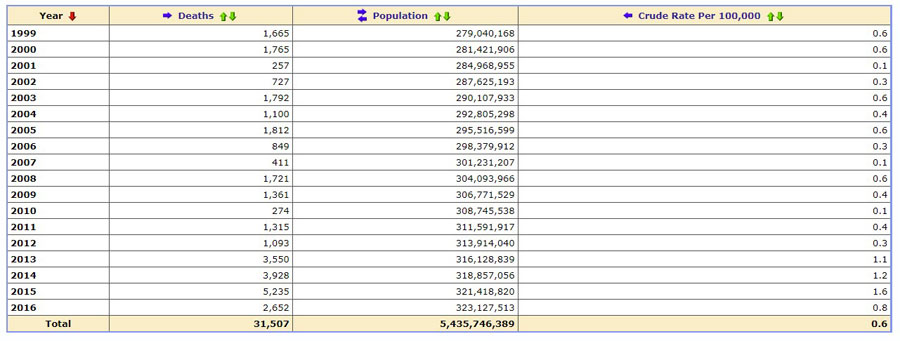
The data show that the average annual number of deaths in the US over that 18-year period attributed to lab-confirmed and suspected influenza infection combined was just 1,750.
Thus, approximately 3 percent of deaths within the broad category of “influenza and pneumonia” deaths are attributed to influenza infection each year, according to death certificate data.
Again, that includes suspected cases of influenza, which is difficult to diagnose without a lab test since there are hundreds of known viruses that can cause what are called “influenza-like illnesses” (ILI).
In fact, it is estimated that only about 7 percent to 15 percent of “influenza-like illnesses” are actually caused by influenza viruses.
If you go back to the WONDER database and repeat the exercise with only the death certificates where the underlying cause of death was lab-confirmed influenza, you’ll get this result:
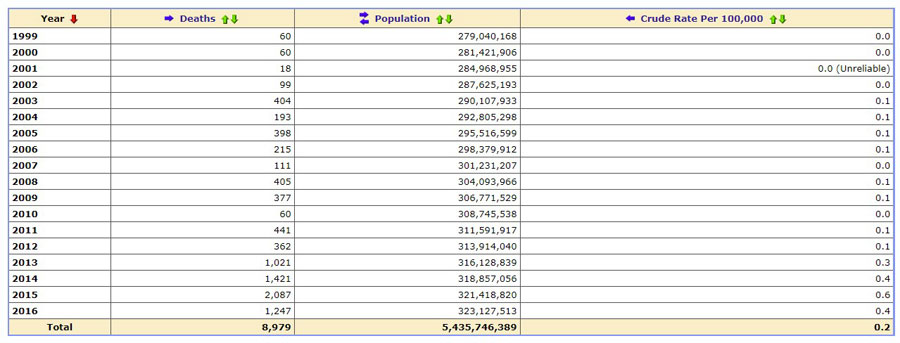
The average number of annual deaths for which lab-confirmed influenza was identified as the underlying cause is just 499, which is less than 1 percent of the total number of deaths in the category of “influenza and pneumonia”.
So how does the CDC get from 499—or, if we are generous, from 1,750—to at least 35,000?
The New York Times doesn’t disclose the answer, but I’ll let you in on the secret: the estimated number of “flu deaths” that the CDC tells us occur each year is derived from a mathematical model that generates the desired outcome based on the assumptions input by the CDC.
On its face, the description of the model’s output as representing “flu deaths” is deceptive because it’s really an estimate of influenza-associated deaths.
This is similar to how the term “COVID‑19 deaths” is commonly used by government officials and the mainstream media to refer to “COVID‑19-associated” deaths, which term not limited only to those deaths for which COVID‑19 was determined to be the underlying cause of death. Rather, the term also includes deaths for which COVID‑19 was confirmed or presumed to be a contributing factor, regardless of the underlying cause.
As Peter Doshi explained in The BMJ in 2005, “US data on influenza deaths are a mess.” The CDC “acknowledges a difference between flu death and flu associated death yet uses the terms interchangeably. Additionally, there are significant statistical incompatibilities between official estimates and national vital statistics data.
The CDC knows that when it describes its model’s output as an estimate of the number of “flu deaths” that it is misleading the public. As William Thompson of the CDC’s National Immunization Program acknowledged to Doshi, the estimate represents “a statistical association” that does not necessarily mean causation. “Based on modelling,” Thompson admitted, “we think it’s associated. I don’t know that we would say that it’s the underlying cause of death.”
A study published just last month in the International Journal of Clinical Skills illuminates some of the problems with the CDC’s estimates.
One problem is that the CDC doesn’t provide enough information about its model for independent scientists to be able to completely understand how the estimate is even arrived at, much less to be able to reproduce the results.
A reasonable assumption that the CDC makes is that looking at only lab-confirmed cases of influenza will result in an underestimation of influenza cases since most people who present with influenza-like illness never get tested.
Problematically, though, “the CDC appears to attribute most pneumonia deaths where, historically, pneumonia was listed as the ‘underlying cause of death,’ to the influenza virus—even though laboratory tests frequently fail to confirm influenza or even detect other viruses or bacteria as the cause of death instead of influenza.”
In other words, the CDC’s model appears to reclassify deaths attributed to pneumonia from other causes to “influenza” deaths.
As explained in the recent study, the CDC’s model “is used to adjust the reported deaths with laboratory confirmed influenza by a large multiplier”.
To that end, the CDC assumes that people who show up at the hospital with influenza illness are no more likely to be tested for influenza than people who show up with respiratory illness due to other causes.
As the CDC acknowledges, “If physicians were more likely to recognize influenza patients clinically and select those patients for testing, we may have over-estimated the magnitude of under-detection.”
In other words, the CDC assumes that doctors are incapable of accurately diagnosing influenza based on clinical symptoms alone, and the odds that they will order an influenza test for a patient who actually has influenza is no greater than the odds that they will order the test for patients whose symptoms are due to some other cause.
Thus, on one hand, the CDC makes the reasonable assumption that lab-confirmed influenza infections represent only a small proportion of illnesses caused by the influenza virus. On the other hand, the CDC appears to unreasonably assume that most deaths under the “influenza and pneumonia” category were caused by influenza infection, even if lab testing was negative or the medical professionals familiar with the actual circumstances of death judged that there was some other underlying cause.
It is true, as already noted, that many other viruses can cause “influenza-like illness”—which in vernacular is called simply “the flu”. But the study authors note the irony of how the CDC in its public relations messaging communicates the opposite message that “flu” can be distinguished from other respiratory viral infections based on its symptoms. The researchers provide this example graphic from the CDC:
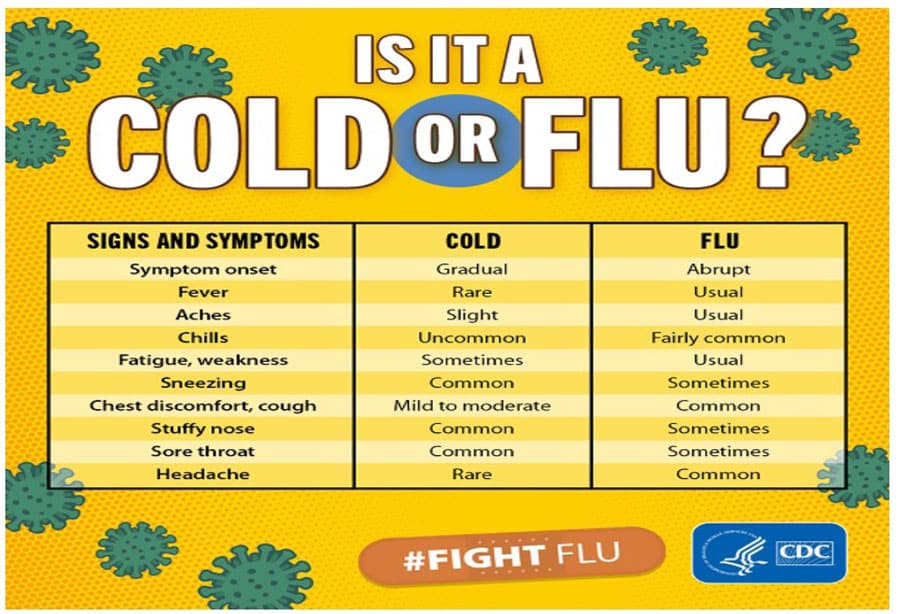
The CDC’s acknowledgment that doctors are at capable of reasonably distinguishing between respiratory viral infections caused by common cold viruses (including endemic coronaviruses), and those caused by “flu” viruses directly contradicts its assumption that doctors would be no more likely to order an influenza test for patients presenting with “flu” symptoms than they would for patients with a cold.
Aside from its implication regarding the CDC’s “flu deaths” estimate, the graphic is also misleading because the CDC is implicitly claiming that flu shots reduce the risk of getting the “flu”—the colloquialism for “influenza-like illness”. The CDC knows perfectly well that most people will misinterpret “flu” to mean “influenza”.
In fact, we can see this is precisely what the CDC wants people to think from the hashtag it used for this public relations campaign: “#FIGHTFLU”. Here’s a recent example of a CDC Twitter post including the “#FightFlu” hashtag:
Here’s a “#FightFlu” campaign graphic found on the CDC’s website that the agency encourages people to share on social media to communicate the message that getting a flu shot will give your immune system superhero powers:
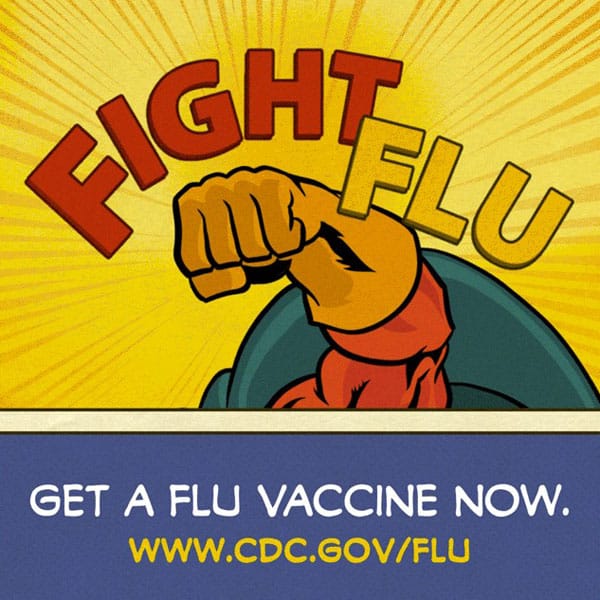
Of course, the CDC says nothing about natural approaches to supporting proper functioning of your immune system, such as by doing common sense things like maintaining vitamin D sufficiency to reduce your risk of severe influenza illness.
The CDC’s proposed solution to the public health burden of influenza disease is instead 100 percent synonymous with the financial interests of the pharmaceutical industry.
Now why would that be, do you think, if the CDC was really concerned with public health as opposed to serving the industry?
The CDC’s “#FightFlu” campaign is intended to persuade people to get an annual flu shot, which provides no protection against “flu” due to other causes that are so commonly mistaken for influenza that the CDC has built into its “flu deaths” model the underlying assumption that doctors are incapable of providing an accurate diagnosis of influenza absent a laboratory test to confirm the presence of the virus.
The CDC thus implicitly claims that flu shots reduce the risk of influenza-like illnesses, whereas scientific evidence indicates that this is untrue. We’ll come back to that.
Keeping our attention for now on its “flu deaths” model, the CDC also essentially second-guesses the judgment of attending physicians, coroners, and medical examiners who are responsible for filling out death certificates. The CDC is effectively arguing that, with respect to influenza deaths, medical professionals responsible for completing death certificates routinely misattribute influenza deaths to other underlying causes and get it wrong more than they get it right by orders of magnitude.
However, there isn’t an obvious scientific basis for that assumption. On the contrary, according to the CDC itself in a guidance document published in April 2020, “Appropriate completion of death certificates yields accurate and reliable data for use in epidemiologic analyses and public health reporting.”
Intriguingly, the “notable example” immediately provided by the CDC of “the utility of death certificates” is “the ongoing monitoring of pneumonia and influenza deaths.”
This raises the question: If death certificates provide reliable data for epidemiologic analyses of annual flu deaths, then why does the CDC have to resort to a mathematical model that employs a “multiplier” to produce an estimate of annual “flu deaths” supportive of its policy aim of higher uptake of influenza vaccines?
Why doesn’t the CDC just report the numbers of deaths that occur annually that are attributed to lab-confirmed or suspected influenza on death certificates?
The most parsimonious explanation is that if the CDC were to treat influenza the same as other causes of death by relying on death certificate data, it simply would not serve its policy goal of increasing demand for influenza vaccines.
Naturally, the New York Times does not disclose to its readers the controversial nature of the CDC’s estimate of what are deceptively called “flu deaths”. Instead, the Times deceptively presents the CDC’s estimate as though it were equivalent to the number of deaths attributed to influenza annually on death certificates.
Ignoring the Opportunity Cost of Annual Flu Shots
Moving on to the second paragraph of the Times’ ostensible “guide” to influenza vaccination, it states that “the flu’s toll would be lower if more people got a vaccine shot.”
No citation is provided by the Times to support that claim, so it is impossible to evaluate the supporting evidence, if any. But another fact that the Times does not disclose to its readers is that studies have found receipt of an annual flu shot to be associated with an increased risk of novel strains of the influenza virus.
As reported in the journal PLoS Medicine in April 2020, four studies in Canada had found that receipt of the seasonal flu shot was associated with an increased risk of illness due to the 2009 pandemic influenza A(H1N1) “swine flu” virus.
The study authors attributed this finding to the opportunity cost of vaccination, which is the superior protection afforded by natural immunity.
As the authors put it, repeated vaccination “effectively blocks the more robust, complex, and cross-protective immunity afforded by prior infection.” People who’ve annually received the influenza vaccine “may have lost multiple opportunities for infection-induced cross-immunity.”
To reiterate the hypothesis presented to explain the findings, when unvaccinated people are infected with the seasonal influenza virus, in addition to humoral immunity, which refers to protection from antibodies, they have an opportunity to develop a robust cell-mediated immunity that not only protects against the infecting strain of the virus but also provides cross-protection against other strains.
The vaccines, on the other hand, are narrowly aimed at producing antibodies capable of neutralizing just the three or four strains selected for targeting each fall by the CDC in collaboration with the World Health Organization (WHO).
So, what happened was that people who’d skipped the annual flu shot and were infected with the seasonal influenza virus had superior protection against the pandemic H1N1 virus compared to individuals who opted to follow the CDC’s recommendation.
One of the CDC’s own studies published in Clinical Infectious Diseases in 2014 uniquely looked at the long-term effects of repeated annual vaccination by examining data from the 2004 – 2005 through the 2012 – 2013 flu seasons.
The study found that the more people had been vaccinated in prior years, the less effective the most recently administered vaccine was at preventing that season’s predominantly circulating strain (which was an H3N2 influenza virus).
As the CDC-funded researchers put it, “vaccine-induced protection was greatest for individuals not vaccinated during the prior 5 years.”
Another way of putting it would be to say that people who in the prior five years had depended on natural immunity but who then shifted to following the CDC’s recommendation were less likely to become sick from influenza than people who had consistently followed the CDC’s recommendation.
The question this finding naturally raises is how unvaccinated individuals would have fared compared to either those who consistently got the flu shot over the five-year period or those who only got a single shot during that most recent season.
Despite obviously having access to the data to be able to answer that critically important question, the CDC-funded researchers opted not to do that comparison.
This is a good example of the CDC not seeing what it doesn’t look for.
Apart from potentially increasing the risk of influenza illness, particularly when received year after year, other studies have found flu shots to be associated with an increased risk of non-influenza respiratory virus infections.
For example, a randomized placebo-controlled trial published in Clinical Infectious Diseases in March 2012 found that children who received the flu shot had “an increased risk of virologically-confirmed non-influenza infections”.
Moreover, the study found “no statistically significant difference” between children who received the flu shot and those who didn’t “in the risk of confirmed seasonal influenza infection”.
In other words, the study found no significant benefit of vaccination in terms of reducing the risk of influenza illness, only a significantly increased risk of illness due to other viral infections.
A study published in the journal Vaccine in 2018 similarly found that, in the two weeks after getting the shot, while vaccinated children were no less likely than unvaccinated children to develop influenza, they were at higher risk of developing non-influenza respiratory infection.
This is indicative of the flu shot having detrimental “non-specific effects”, a term used in the literature to describe long-term unintended consequences of vaccination that are distinct from the types of anticipated acute adverse events that scientists look for in short-term safety studies that are used to obtain vaccine licensure.
For example, studies have found the diphtheria, tetanus, and whole-cell pertussis (DTP) vaccine to be associated with an increased rate of childhood mortality. As leading researchers into the field of vaccines’ non-specific effects concluded in a study published in 2017 in the Lancet journal eBioMedicine:
It should be of concern that the effect of routine vaccinations on all-cause mortality was not tested in randomized trials. All currently available evidence suggests that DTP vaccine may kill more children from other causes than it saves from diphtheria, tetanus or pertussis. Though a vaccine protects children against the target disease it may simultaneously increase susceptibility to unrelated infection.
The CDC perpetually fails to factor the opportunity costs of vaccination into its decision-making, just as it perpetually ignores the potential for detrimental non-specific effects.
The New York Times, however, does not want you to understand this, and so it simply repeats official dogma from the CDC that “the flu’s toll would be lower if more people got a vaccine shot.”
Following the example set by the CDC, the Times also offers no advice to its readers about how to support their immune systems naturally.
The Rapidly Waning Immunity from Flu Shots
The third and final paragraph included in the New York Times’ “guide” to fall vaccinations is illuminating for what it admits as opposed to what it withholds from readers.
While formulations of this year’s flu shots were already available, the Times advised that people “wait until late September or October to get one” because flu season peaks between December and February. “If you wait,” the Times explains, “the shot’s protection against severe illness will still be near its strongest level during those months.”
That’s the New York Times’s way of saying that the immunity provided by flu shots wanes very rapidly.
A study published in September 2018 in Clinical Infectious Diseases found that “effectiveness of inactivated influenza vaccine” against influenza infection “wanes during the course of a single season.”
A study published in the same journal in January 2021 found a decline in flu shot effectiveness against influenza-associated hospitalization of 8 percent to 9 percent per month.
In effect, by getting an annual flu shot, people are giving up the opportunity to acquire the broader long-term protection afforded by natural immunity in exchange for the narrower short-term protection afforded by the vaccine.
The short duration of protection and opportunity cost of vaccination might help to explain why the vaccine for the 2018 – 2019 flu season had negative effectiveness among adults against the influenza A(H3N2) strain that emerged in the latter part of the season. That negative finding did not reach statistical significance, but it was clear that the vaccine “did not significantly reduce medically attended influenza illness due to A(H3N2) virus infection.”
The CDC’s Debunked Claims about Flu Shots’ Effect on Mortality
This also comes back to the assumptions underlying the CDC’s flu shot recommendation and the New York Times’ assumption that “the flu’s toll would be lower if more people got a vaccine shot.”
As already noted, the 2010 Cochrane review found that the fundamental assumptions underlying the CDC’s policy, that flu shots prevent transmission and reduce the risk of complications from influenza infection, were unsupported by scientific evidence.
Another central claim that the CDC has made is that flu shots, by preventing complications, greatly reduce flu deaths among the elderly.
But that claim, too, was unsupported by scientific evidence. Mortality outcomes had never been studied in clinical trials. And while the CDC has cited observational studies to support its claim, the scientific community has since shown those studies to be fatally flawed, suffering from what is sometimes known as a “healthy user” bias (or in this case a “healthy vaccinee” bias).
Researchers from another government agency, the National Institutes of Health (NIH), started catching on in 2005 when they noticed that the considerable increase in vaccination coverage among the elderly between 1980 and 2001 coincided with a significant increase in rates of influenza hospitalization and mortality.
That is not the outcome one would expect if the CDC’s assumption were correct.
As a result of mortality rates going the wrong way despite the effective annual public relations campaigns pushing people to get vaccinated, scientists began to more critically analyze the studies that the CDC was relying on to support its policy.
They quickly realized that the study findings were simply not credible.
For example, one meta-analysis of observational studies that the CDC had relied upon concluded that vaccination was associated with a 50 percent reduction in the number of flu-season deaths from any cause.
That was not plausible, NIH scientists pointed out, since influenza-related deaths were on average only about 5 percent and always less than 10 percent of the total number of deaths among the elderly during winter.
What researchers realized was that the studies were plagued with a selection bias. It wasn’t that elderly people who got the flu shot were less likely to die during that flu season but that elderly people who were so sick or frail that they were very likely to die soon were less likely to get a flu shot.
Notwithstanding NIH researchers’ own observation that the studies the CDC was citing were fatally flawed due to this healthy user bias, the CDC and NIH subsequently published a joint statement claiming that the seasonal flu shot was the best way to protect old people from dying.
This illustrates the critical distinction between claims made in the government’s public relations messaging and the scientific literature.
A systematic review and meta-analysis published in Lancet Infectious Diseases in 2012 determined that evidence that influenza vaccines protect elderly people against lab-confirmed influenza “is lacking.”
A study published in the Open Respiratory Medical Journal in 2015 noted that “the effectiveness of influenza vaccine in older individuals has come under question” and sought to determine outcomes among people with lab-confirmed influenza infection by vaccination status. The researchers found that those who had been vaccinated had significantly higher rates of ICU admission and need for mechanical or non-invasive ventilation. They also had a higher rate of mortality, although that finding was not statistically significant.
As the authors generously concluded, “The data suggest that there was no protective effect from prior vaccination in preventing hospital admission, respiratory failure, and mortality in this population of older men admitted to the hospital with influenza.”
A study published in Annals of Internal Medicine in 2020 found “no evidence” that influenza vaccination reduced the risk of hospitalization or mortality among the elderly.
Coming back to the claim made in the CDC’s “#FightFlu” campaign that getting a flu shot will reduce your risk of getting “the flu”, this is not only deceptive because most influenza-like illnesses are not caused by influenza but also because flu shots do not appear to reduce the risk of getting “the flu”.
“The reduction by vaccination in the number of cases caused by influenza virus infections is offset by a rise in the number of cases caused by infections by other pathogens.”
If flu shots worked the way the CDC says they do, one would expect an overall reduction in the incidence of influenza-like illness, or ILI. But that’s not what was observed in a study published in the Journal of Infectious Diseases in 2017. Instead, what researchers found was that “The reduction by vaccination in the number of cases caused by influenza virus infections is offset by a rise in the number of cases caused by infections by other pathogens.”
It appears that, while offering some protection against influenza infection (at least assuming that the circulating strains are well-matched to the antigens selected that year for inclusion in the vaccine), flu shots might at the same time increase the risk of other respiratory illnesses.
Conclusion
The New York Times and the rest of the mainstream media habitually cite the CDC’s estimate of influenza-associated deaths as though this represented an official count from death certificates. They just as habitually fail to inform readers that the estimate is instead derived from a mathematical model that uses a “multiplier” to inflate those numbers by assuming that most deaths within the “influenza and pneumonia” category were caused by influenza.
The Times also repeats the CDC’s claim that “the flu’s toll would be lower” if more people got flu shots, but much scientific evidence indicates that the opposite could be true.
There is an opportunity cost to vaccination due to the inferiority of vaccine-induced immunity compared to natural immunity. Some studies have indicated that receipt of an annual flu shot can increase one’s risk of illness from novel strains. Furthermore, even the CDC’s own researchers have shown that the more an individual gets vaccinated year after year, the less effective the shots are over time.
Additionally, there is evidence that flu shots have detrimental non-specific effects so that even if offering some protection against influenza, they might increase the risk of non-influenza respiratory virus infections. This increased risk of other flu-like illnesses appears to completely offset any public health benefit of vaccination.
The Times advises its readers to wait until late September or October to get a flu shot so its protection “will still be near its strongest”, thus leaving reader to deduce that the effectiveness of the vaccine against influenza infection wanes rapidly.
The death toll from influenza is highest among the elderly, yet the CDC’s claims that flu shots reduce mortality among those aged 65 and up have been thoroughly discredited, with the studies it has relied on to support that claim suffering fatally from healthy user bias. In fact, the increasing vaccination rate among the elderly during the 1980s and 1990s coincided with an increase in influenza-related mortality. Evidence of a mortality benefit of the vaccines is lacking.
The New York Times’ “guide” to influenza vaccines hardly suffices to empower its readers to make an informed choice, and the simple reason for that is that it is not the Times’ purpose to provide people with the information they need to be able to do that; rather, the Times’ aim is to manufacture consent for vaccination in service to the state and, by extension, to the pharmaceutical industry.
By deceiving the public about flu shots, of course, the New York Times is just following the CDC’s example. As ever, what the government and media say science says about vaccines and what science actually tells us are two completely different things.




It’s simple, get rid of the fear by informing the masses that viruses are not the bad guys! Blow big pharma open wide! We have been conned for a very long time to believe that viruses are outside invaders. We have been conned into testing for the common cold! Testing labs made 50% more during the craze of testing, testing, testing, and test manufacturers and jab makers are bringing in the cash! All the while folks are guinea pigs/lab rats, being kept $ick and di$ea$ed in the medical and pharma cartel$ by their drugs/meds/vaccines/antibiotics/poor care, etc.
Viruses do not fly around in the air. They are non-living, made by YOUR cells to break down tissue toxins wherever they may reside after your lil bacteria/parasites (living) could not get the job done w/o dying themselves. YOUR viruses are not compatible with others’ viruses (RNA/DNA that they are imbedded with in creation is not compatible with your RNA/DNA). FEAR not! And don’t get any jabs either!!! ?
The jab/vaccines are the way for big pharma/medical/gov’t to get contrived/man-made viruses into you, via injection! If it were possible to create a virus to wipe out the world, you wouldn’t need a rabid (fascist) vaccination program. The FLU vaccination campaign was failing, so let’s scare the people about coronaviruses, most have not heard of, and voila a pan coronavirus vaccination campaign! $$$
Just slow down and think about it… IF viruses were contagious, we ALL should be sick ALL the time!!! Or extinct by now! We are being kept in fear of germs, nature, ourselves…how convenient for the cartels of big medical/pharma/gov’t…
More explanation:
Each body produces an individually tailored coronavirus to suit their needs (or other viruses such as Influenza A/B, RSV, Adenovirus, Coronaviruses, Rhinovirus, Enterovirus, etc.), even though it is the same overall type of virus, it is not 100% identical to others due to the individual’s RNA/DNA (embedded in their own viruses in creation by one’s own cells) which also is why they are not contagious as they are not compatible with someone else’s RNA/DNA.
People will have a similar coronavirus if they all began to produce viral load due to some toxin they are all being exposed to but they are not completely identical, again due to differences in each person’s RNA/DNA. And around the globe people will produce coronaviruses due to differing toxins they are exposed to in their respective areas (yet each body will produce a slightly different variation of the overall viral type AND as many times as is needed to rid of the toxin, more difficult with inorganic toxins in our environment) and in time with their seasonality. Thus the number of variants is endless! Still the same virus but ever so slightly modified by our cells to continue work on the toxin of issue… we are wonderfully made. ?
(I think gov’ts know of the various pollutions they put out and use viral infection as cover, blame the virus)
BTW, super excellent piece you have written!
I too recall from a few years ago finding on the CDC website that only 1700-1800 deaths were lab confirmed influenza deaths (not the total P&I they really want to deke you with) but could not find it again as it is such a convoluted site! But today following your directions, I got to the info again. Thanks!
Thanks for the positive feedback! Glad you enjoyed the article.