

Israeli Prime Minister Benjamin Netanyahu said on Thursday that Israel’s intention with its ongoing genocidal assault on the civilian population of the Gaza Strip is to militarily control the entire territory.
On Friday, Netanyahu’s security cabinet, against the recommendations of the Israeli military, which has already placed 86% of Gaza under a “militarized zone” or displacement orders, approved a plan to complete the takeover of northern Gaza by controlling Gaza City and forcibly evacuate tens of thousands of Palestinians remaining there.
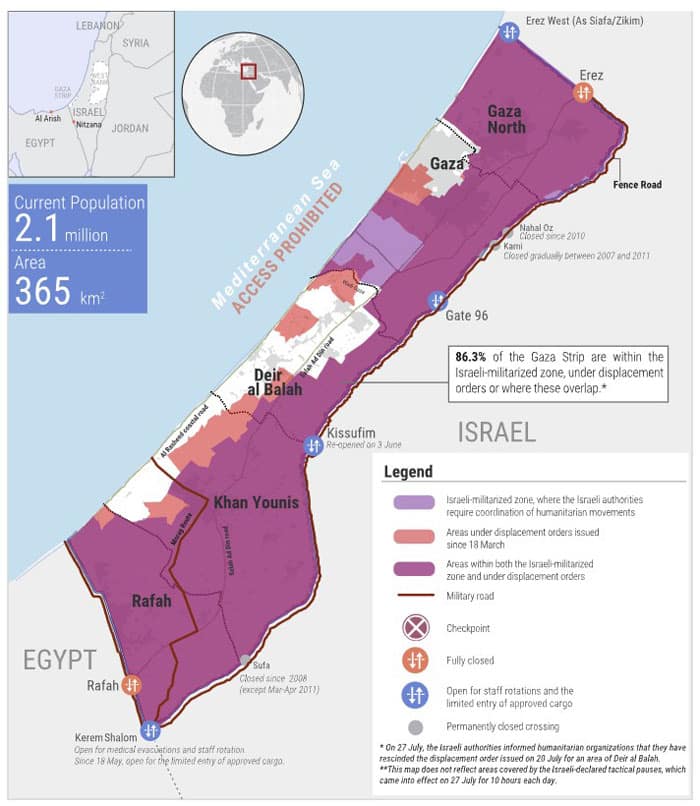
IDF Chief of Staff objected to the plan on the grounds it would endanger the lives of Israeli hostages and exhaust the military.
In an interview with Fox News, when asked whether Israel would take control of all of Gaza, Israeli Prime Minister Benjamin Netanyahu answered, “We intend to.”
He went on to say that Israel did not aim to permanently control Gaza but instead to overthrow Hamas, which has been the governing authority there since 2006, and to replace it with some other government.
The 58-Year Occupation of Gaza
From the start, Netanyahu has opposed the idea of the Palestinian Authority (P.A.) governing the Gaza Strip.
For years prior to the Hamas-led attacks in Israel on October 7, 2023, Netanyahu maintained a policy of utilizing Hamas as a strategic ally to prevent any movement toward peace negotiations with the Palestinians.
After a Hamas-led government was democratically elected in 2006, Israel responded by imposing a siege to collectively punish the civilian population and colluded with the U.S. government and Fatah, the party of P.A. President Mahmoud Abbas, to overthrow the legitimate leadership.
That effort resulted in violent clashes leading ultimately to Fatah being expelled from Gaza and a divided Palestinian leadership, with Hamas continuing to rule there while the P.A. continues to rule in the West Bank under Abbas despite his legal term having ended in 2009.
The P.A. was established under the Oslo Accords to essentially serve as Israel’s collaborator in enforcing its occupation regime, which is one of the key reasons why Hamas fared so well politically in municipal and legislative elections.
Israel has been the Occupying Power in Gaza since June 1967, when it launched what Israelis call the “Six Day War” with a surprise attack on Egypt. During that war, Israel invaded and occupied the Palestinian territories of the Gaza Strip and West Bank, including East Jerusalem.
A common refrain among apologists of Israel’s occupation regime is that it withdrew from Gaza in 2005. However, while it’s true that Israel withdrew military forces and dismantled illegally constructed Jewish settlements, Israel has remained the Occupying Power in Gaza by virtue of its control over its borders, territorial waters, and airspace, in addition to continued administrative management.
The unit within the Israeli Ministry of Defense responsible for implementing the Israeli government’s civilian policies within the Occupied Palestinian Territories is known as the Coordinator of Government Activities in the Territories, or COGAT.
While Netanyahu denied any intention to establish a permanent military presence in Gaza, effective annexation is precisely what members of his governing coalition have been aiming at from the start.
