

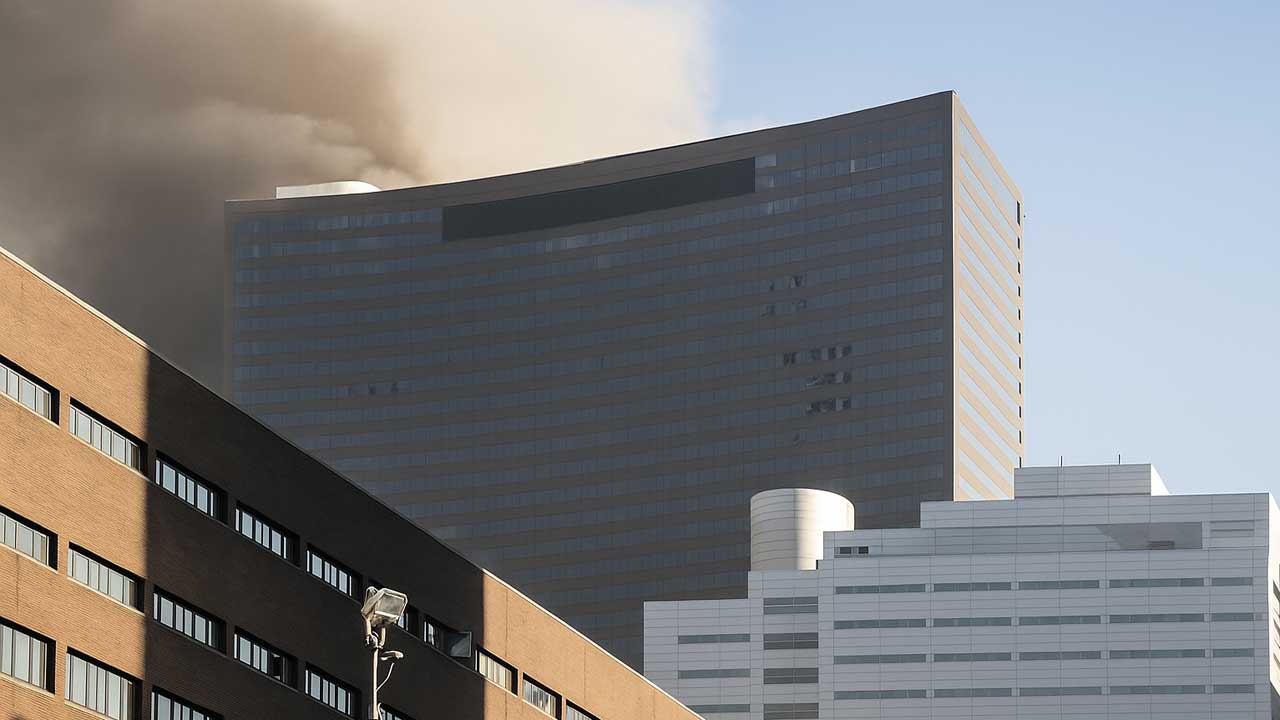
At the International Hearings on the Events of September 11, 2001, held in Toronto, Canada, in September 2011 (The Toronto Hearings), high school physics teacher David Chandler gave a presentation explaining how the National Institute of Standards and Technology (NIST) resorted to scientific fraud to obfuscate the implication of free fall acceleration in the collapse of World Trade Center Building 7 (WTC 7).
During his talk, Chandler cited a paper I published in July 2011 titled "Video Analysis of NIST’s Claim of a 5.4 s Collapse Time Over 18 Stories for WTC 7", in which I showed how NIST fraudulently attempted to obfuscate the implications of the admitted free fall acceleration of the building.
I first blogged about his presentation in this post from September 16, 2011, but with the recent 24th anniversary of the 9/11 attacks, it occurred to me to excerpt the clip for readers unfamiliar with my past work on that topic. Here it is with subtitles:
Of course, questioning the official narratives about that day gets you automatically labelled a "conspiracy theorist", but let me be clear: neither Chandler nor I proposed any conspiracy theory. Rather, we took a scientific approach to the question of the building's collapse. The acceleration of the building is measurable. And if it follows from the observation that free fall occurred that there must have been a conspiracy, then that's just dictated by logic. Draw your own conclusions!
The point is we must allow our conclusions to be premised on the facts rather than distorting facts to conform to predetermined beliefs.
As Arthur Conan Doyle's character Sherlock Holmes says, "When you have eliminated the impossible, whatever remains, however improbable, must be the truth."
Here's the crux of the issue, scientifically speaking:
The free fall collapse of WTC 7 means that all the building's potential energy was converted to kinetic energy, which means that there was no energy available to do the work of buckling columns as required by NISTS's fire-induced collapse hypothesis.
As Chandler accurately observes in the above clip, NIST elevated its computer model over real-world observations because observations falsify the hypothesis its model was designed to support.
That bears repeating: NIST's admission that the building achieved free fall acceleration was a tacit acknowledgment that its hypothesis could not be true, and yet it proclaimed its hypothesis to be true anyway. That is scientific fraud.
NIST's report is riddled with other examples of fraud, but they are all superfluous given measurable free fall.
Now, again, I'm not proposing any conspiracy theory here. I am simply observing that to support its hypothesis for the collapse of WTC7, NIST relied on demonstrable scientific fraud. Draw your own conclusions!
The Context
For background, NIST in its August 2008 draft report, stemming from its "investigation" into the collapse of WTC 7, denied free fall acceleration through obfuscation, calculating that it took 5.4 seconds to fall 18 stories and averaging the "descent speed" over that duration. It stated that an object falling at gravitational acceleration would take 3.9 seconds to travel the same distance, and so the collapse was 40% longer than "free fall time". This was "consistent with physical principles", the draft stated, evidently meaning that it was consistent with idea that the building's load-bearing columns would offer measurable resistance. (See pages p. 595-596.)
But David Chandler had already published a video on YouTube using software to measure the velocity over time and showing that acceleration occurred that was indistinguishable from the acceleration of gravity (9.8m/s²), within the margin of error introduced by the resolution of the video.
After NIST published its draft report, Chandler submitted a public comment noting how NIST's analysis was scientifically invalid because it assumed uniform acceleration instead of properly measuring the the instantaneous acceleration at numerous data points by plotting velocity over time.
Citing his own analysis, he submitted that there were approximately 2.5 seconds in which "the acceleration was indistinguishable from free fall to the resolution of the video evidence." He called on NIST to acknowledge that free fall occurred.
Consequently, NIST was compelled to do a proper calculation, and in its final report acknowledged that for approximately 2.25 seconds, the downward acceleration of the building was "equivalent to the acceleration of gravity". The wording that this was "consistent with physical principles" was removed, replaced with the wording that the overall "collapse time"—which was "40 percent longer than that of free fall for the first 18 stories of descent", by NIST's measurement—was "consistent with the results" of its computer modelling. (See pages 600 - 603.)
The reason for this change of wording becomes obvious when you simply compare the observed collapse with their computer simulation, which failed to reproduce free fall and otherwise looked nothing like the actual collapse.
Here is a compilation I made of videos of the observed collapse:
And here is NIST's computer simulation of the collapse:
And here's a helpful video from Architects & Engineers for 9/11 Truth comparing reality with NIST's model side-by-side:
Even just on the face of it, NIST's hypothesis, represented by its computer model, is false.
Here's a video Chandler later made about how NIST first tried to deny but then was forced to acknowledge free fall:
In the instances when I have been confronted by individuals who choose to believe NIST's fire-induced collapse hypothesis and I've pointed out that this is inconsistent with the observation of free fall acceleration and the laws of physics, the only response I've received is the denial of free fall.
The problem with such denials is that the downward acceleration of the building is measurable. It's observable. And it's been measured, and even NIST—which initially also tried to deny it for the obvious reason—was finally forced to admit that it happened.
So, if anyone wants to dispute that free fall occurred, it isn't enough to simply declare so a priori based on the premise that the columns must have offered resistance. That is the fallacy of begging the question (presuming the proposition to be proven, or the petitio principii fallacy).
If it isn't true that free fall occurred, then some error in the published measurements—including NIST's own calculations—must be shown, and a more valid calculation presented in their place.
It has been 17 years since NIST admitted free fall. In all that time, I have never seen anyone dispute their calculation scientifically—only a priori denials. Chandler's and NIST's analyses have withstood the test of time and public scrutiny. The collapse of WTC 7 at a rate indistinguishable from the acceleration of gravity within the margin of error introduced by the video resolution is an observable fact.
So, whatever explanation there is for the building's collapse, it must account for this observed free fall while remaining consistent with the laws of physics.
I'm open to suggestions and do not claim to be able to explain it. All I'm saying is that free fall is observable, so people have to deal with that fact.
Chandler's full presentation at The Toronto Hearings can be viewed on YouTube or Odyssey. Watch it here:
And here is the abstract from my paper that Chandler cites:
ABSTRACT
NIST, in its draft report for public comment, initially denied that WTC 7 collapsed at the acceleration of gravity with the claim that an overall collapse time of 5.4 seconds was 40 percent longer than a free-fall time of 3.9 seconds for the first 18 stories. After being confronted with analysis of the collapse clearly demonstrating that free-fall had occurred, NIST acknowledged this fact in its final report, yet still maintained that the overall collapse time was 5.4 seconds. NIST explained in the final report that this measurement was obtained by examining a single pixel of a video towards the center of the roofline. It is argued in this paper that NIST’s chosen methodology for determining the point in time representing the onset of global collapse is not merely fallacious, but indicative of a willful and deliberate effort to deceive the public and obfuscate the implications of free-fall through scientific fraud.

I’ve seen film of the head honcho at WTC saying, “Let’s pull it.” which is the terminology for controlled demolition. Where is that film?! Not only was it controlled demolition, it was the most perfect one I’ve ever seen! ??♂️
Yes, I’m familiar. Larry Silverstein said in that interview that they’d made the decision “to pull it” and then watched the building collapse. At about 1:08 in this documentary, America Rebuilds:
https://www.youtube.com/watch?v=aUzHoHqhEoA
He later said he’d meant they decided to pull the firefighters from the building. The fire department had evacuated the area around WTC 7 at around 2:30 pm, according to NIST (p. 655):
https://web.archive.org/web/20090509013048/http://wtc.nist.gov/NCSTAR1/PDF/NCSTAR%201-9%20Vol%202.pdf
From https://www.ae911truth.org/wtc7 — On March 25, 2020, researchers at the University of Alaska Fairbanks issued the final report of a four-year computer modeling study on the collapse of World Trade Center Building 7…Contrary to the conclusions of NIST, the UAF research team found that the collapse of WTC 7 on 9/11 was caused not by fires but by the near-simultaneous failure of every column in the building.
Thanks, Scott. I’m aware of that report but am sure most others are not!