
Table of Contents
Audio and PDF Versions of This Article
Crépeaux et al. Challenge Andersson et al.
On July 15, 2025, a study was published that the media hailed as conclusively proving that aluminum-adjuvanted vaccines do not cause chronic illnesses in children.
Written by Niklas Worm Andersson and coauthors and published in Annals of Internal Medicine, the study was titled “Aluminum-Adsorbed Vaccines and Chronic Diseases in Childhood: A Nationwide Cohort Study”.
Immediately upon publication, it was met with criticisms by independent researchers, including myself, for fatal flaws in study design that systematically biased its findings in favor of finding no association.
Articles criticizing the study include the following:
- “Designed to Fail: Brand New Hailed Study Exonerating Aluminum Has a Fatal Flaw” by Dr. James Lyons-Weiler (July 15)
- “Circling The Wagons” by Dr. Chris Exley (July 15)
- “How the Danish Study on Aluminum in Vaccines Was Designed to Find No Harm” by Jeremy R. Hammond (July 16)
- “Study Claiming No Link Between Aluminum in Vaccines and Autism Riddled with Flaws, Critics Say” by Suzanne Burdick, The Defender (July 17)
- “Hiding the Signal: The Danish Aluminum Study” by Dr. Madhava Setty (July 23)
- “Aluminum-Adsorbed Vaccines and Chronic Diseases of the Medical Establishment” by Tomas Fürst and Vibeke Manniche, Brownstone Institute (July 30)
- “Flawed Science, Bought Conclusions: The Aluminum Vaccine Study the Media Won’t Question” by HHS Secretary Robert F. Kennedy, Jr., Trial Site News (August 1)
- “HHS Sec. Kennedy Calls for Retraction of Bogus Study on Aluminum in Vaccines” by Jeremy R. Hammond (August 2)
- “Secretary of Human Health Services Robert F. Kennedy, Jr. Calls Out Statistical Shamwizardry Published by the Annals of Internal Medicine” by Dr. James Lyons-Weiler (August 2)
Additionally, a correction to the study’s supplement was issued, which was analyzed by Dr. Karl Jablonowski and Dr. Brian Hooker in a paper at PrePrints.org titled “Neurodevelopmental Disease Associated with Aluminum-Absorbed Vaccines: A Nationwide Cohort Study”.
The preprint paper observed that the corrected data showed statistically significant associations between the highest exposure group and some neurodevelopmental disorders, including autism.
Now a peer-reviewed paper has been published criticizing Andersson et al. for “major methodological and conceptual flaws” that “prevent meaningful conclusions” about the safety of aluminum-adjuvanted vaccines.
The paper is titled “Aluminium adjuvants and childhood health: a call for science”, published in the Journal of Trace Elements in Medicine and Biology on December 29.
The lead author is Dr. Guillemette Crépeaux, and the senior author is Dr. Christopher Exley. The other coauthors are Jonathan B. Handley, Dr. Brian Hooker, Dr. Karl Jablonowski, Dr. Lluís Luján, Dr. James Lyons-Weiler, Dr. Marika Nosten-Bertrand, Dr. Christopher A. Shaw, Dr. Yehuda Shoenfeld, and Lucija Tomljenovic.
(My name also appears in the byline, and I am honored to have been invited to work with the team Dr. Crépeaux assembled for this important effort to set the record straight. My contribution was modest, but a few observations from my own analysis were incorporated.)
The paper describes “major concerns that critically undermine” the conclusions of Andersson et al., which fall into three main categories: (1) a “striking lack of knowledge” regarding aluminum adjuvants; (2) “critical shortcomings” in study design and statistical analysis; and (3) “insufficient transparency and potential conflicts of interest.”
I encourage you to read the paper, but here is my own layperson summary.
No Established ‘Safe’ Limit for Aluminum Adjuvant Exposure
Crépeaux et al. point out that aluminum-based adjuvants (ABAs) have been used in vaccines since the 1920s, and they have regulatory approval still today “without any scientifically established safe limit”.
This refers to how the limit of 0.85 mg per dose used by the US Food and Drug Administration (FDA) was based on immunogenicity and not safety data, as documented in a paper published in Environmental Toxicology and Pharmacology in October, for which Dr. Crépeaux was senior author.
(I reported on that paper for The Defender in an article that also briefly summarized key problems with the Danish study by Andersson et al.)
As noted by Crépeaux et al., this regulatory status quo for aluminum adjuvants remains “despite burgeoning experimental evidence in animals and humans concerning the biopersistence and neurotoxicity of ABAs and their links to chronic inflammatory conditions such as neurodevelopmental disorders and Auto Immune/inflammatory Syndrome Induced by Adjuvants (ASIA).”
Concerns about biopersistence include animal studies showing translocation of aluminum into the brain and findings of aluminum accumulation in human brain tissue.
Citing an Outdated and Discredited FDA Study
The new paper notes how Andersson et al. “seemingly disregard” this body of scientific literature, which is a “glaring omission” that starkly contrasts with their referencing of “outdated and largely irrelevant studies.”
Most specifically, to support the claim of adjuvant safety, they cite a 2011 FDA study by Mitkus et al. that is “outdated” and “discredited”.
One core problem is that the FDA researchers inappropriately adopted a “minimal risk level” (MRL) defined for daily oral intake of soluble aluminum in mice—not the insoluble particulate form of aluminum injected into children.
Apart from being an irrelevant comparison, the MRL was also by that time already outdated, with animal studies having shown adverse effects at much lower levels of exposure.
And the FDA researchers considered only the amount of aluminum absorbed into the bloodstream as contributing to the body burden of aluminum toxicity, whereas studies have indicated that particulate aluminum can be taken up by macrophages and transported into tissues and organs throughout the body, including the brain, where it accumulates and can cause neuroinflammation.
Studies exposing the reckless inadequacy and scientific invalidity of the Mitkus et al. FDA analysis include:
- Guillemette Crépeaux et al., “Non-linear dose-response of aluminium hydroxide adjuvant particles: Selective low dose neurotoxicity”, Toxicology, January 2017
- Jean-Daniel Masson et al., “Critical analysis of reference studies on the toxicokinetics of aluminum-based adjuvants”, Journal of Inorganic Biochemistry, April 2018
- James Lyons-Weiler and Robert Ricketson, “Reconsideration of the immunotherapeutic pediatric safe dose levels of aluminum”, Journal of Trace Elements in Medicine and Biology, July 2018
- Grant McFarland et al., “Acute exposure and chronic retention of aluminum in three vaccine schedules and effects of genetic and environmental variation”, Journal of Trace Elements in Medicine and Biology, March 2020
Ignoring Batch Variability in Aluminum Adjuvant Content
Andersson et al. also assumed that the amount of aluminum adjuvant in each vaccine dose is as advertised by the manufacturer. But that assumption had already been disproven by research showing “significant variability between vaccine batches”.
Consequently, “data given by manufacturers of vaccines on their Al content is at best random and in any case does not allow an accurate evaluation of ABA exposure.”
For reference, see:
- Emma Shardlow et al., “The measurement and full statistical analysis including Bayesian methods of the aluminium content of infant vaccines”, Journal of Trace Elements in Medicine and Biology, July 2021
Failure to Consider Exposure Timing and Child Body Weight
Crépeaux et al. continue:
In addition, the authors made no dose adjustment relative to recipient body weight, a critical parameter in neurodevelopmental toxicology.
In the same way, the exact exposure timing was ignored as the cumulative Al dose over 24 months was treated uniformly, masking potentially critical windows of susceptibility in early life, especially considering the role of the immature blood-brain barrier. . . . This is wholly inconsistent with toxicological principles, which emphasize timing over cumulative quantity, especially concerning early exposures and neurodevelopmental risk assessment.
Inadequate Consideration of Relevant Exposures
No consideration was given to potential aluminum exposure from other sources, such as maternal vaccination during pregnancy and infant formula.
No consideration was given for “a potential Al-booster injection at 5 years of age”, including for children followed in a secondary analysis up to age 8.
“No consideration was given for potential co-administered vaccines such as Measles Mumps Rubella (MMR),” which does not contain aluminum but remains “immunologically relevant” and can induce “a chemokine shown to facilitate cerebral translocation of previously administered ABA in mice.”
Willful Ignorance of Healthy User Bias
As I pointed out in my own analysis, Andersson et al. also failed to control for a known selection bias, often called a “healthy user bias” (or in this case healthy vaccinee bias), whereby children at higher risk of the measured outcome are less likely to be vaccinated.
This results in children at higher risk being pooled into the “unvaccinated” or “undervaccinated” cohort, thus biasing findings in favor of the null hypothesis, or no association.
As explained by Crépeaux et al., children who experience early adverse reactions to aluminum-adjuvanted vaccines may be less likely to remain up-to-date on the recommended schedule and therefore remain in the “low exposure” group, thereby “introducing misdirection in the dose-response modeling.”
In other words, it may be precisely because some parents of children at higher risk avoid further vaccinations that these children are rescued from receiving a diagnosis for the measured disease outcomes.
The risk of this selection bias was certainly known by Andersson et al. The senior author, after all, is Anders Hviid, who was lead author of a 2019 Danish study purporting to show that the MMR vaccine is not associated with autism even in genetically susceptible children, but which similarly failed to control for this bias despite acknowledging its potential to invalidate their findings.
That and other indications of the Hviid et al. study being systematically biased in favor of finding no association are detailed in the following paper for which I was lead author:
- Jeremy R. Hammond, Jeet Varia, Brian Hooker, “Hviid et al. 2019 Vaccine-Autism Study: Much Ado About Nothing?”, Journal of Biotechnology and Biomedicine, May 2025
As noted by Crépeaux et al., the firm conclusions of Andersson et al. “precisely rely on the absence of such biases”.
In my own analysis, this is strong evidence that both Danish studies were designed to find no association.
Implausible Findings
While the mainstream media reported the Andersson et al. study as having found no association between aluminum-adjuvanted vaccines and allergic diseases, autoimmunity, or neurodevelopmental disorders such as autism, that’s actually untrue.
In fact, the study found statistically significant negative associations for numerous outcomes, including asthma, food allergies, and autism.
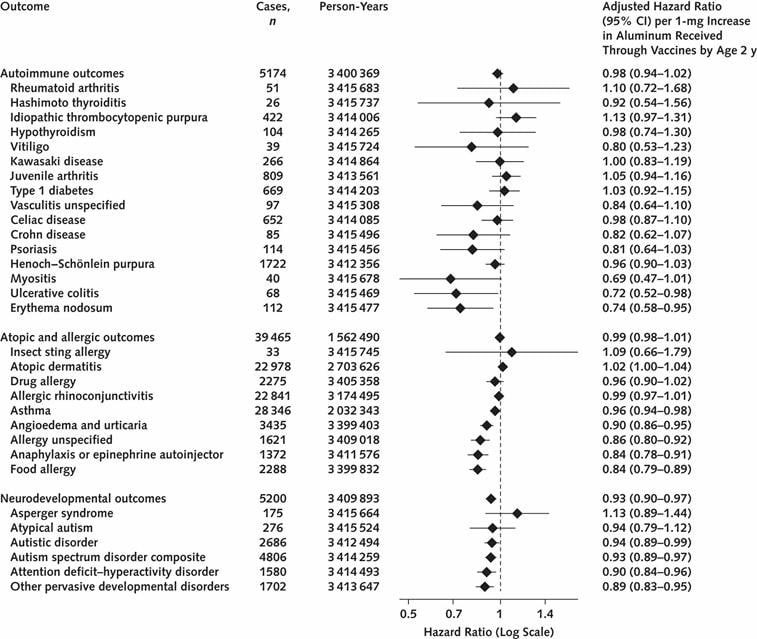
As Crépeaux et al. point out, these “implausible protective effects” of aluminum exposure indicate “systemic data bias” in the study’s design. They further comment,
To our knowledge and understanding, this is the first time in medical literature where exposure to Al has been shown to be beneficial. Bearing in mind what is known about human exposure to Al these unlikely benefits seriously challenge the validity of the whole study and its conclusions, and this fails to meet Hill’s criterion of biological plausibility.
The Bradford Hill criteria are guidelines scientists use to judge whether a statistical association is likely to reflect a real cause-and-effect relationship rather than coincidence or bias.
As I told The Defender for an article covering the publication of the response by Crépeaux et al., if the findings of Andersson et al. are to be believed, then “injecting infants with a known neurotoxin protects them from chronic symptoms known to be associated with aluminum toxicity.”
Absence of an Unexposed Control Group
The mainstream media characterized the Danish study as having shown that children who receive aluminum-adjuvanted vaccines aren’t at higher risk of developing chronic illnesses than children who receive none.
However, the study was not actually designed to answer the question of whether that is so. Instead, the authors only compared health outcomes between various levels of exposure to aluminum adjuvants.
That is, it was not the type of study so many parents have long been demanding but instead just another vaccinated versus vaccinated study.
This was so even though there were over 15,000 children in the study population classified as unexposed who could have been used as a control group but weren’t.
As Crépeaux et al. point out, especially given the considerable batch variability in quantity of aluminum adjuvant, “the only verifiable comparison authors could have made is between infants never receiving an Al-adjuvanted vaccine and infants receiving at least one Al-adjuvanted vaccine.”
Exclusion of Children at Highest Risk
From the outset, Andersson et al. essentially ensured that only children at lowest risk of harm from aluminum-adjuvanted vaccines would survive their exclusion criteria.
They excluded children whose exposures were considered implausibly high, thus deeming the registry they relied on as inaccurate for those children, while ignoring an earlier study indicating under-ascertainment of vaccination status in that same registry.
(Hooker, Varia, and I pointed out this under-ascertainment in our critique of Hviid et al. 2019.)
The levels deemed implausibly high, incidentally, would be typical for American children following the CDC’s schedule.
They excluded children who died before reaching age 2, even though studies have found non-live vaccines, which generally are those containing aluminum adjuvants, to be associated with an increased rate of childhood mortality. Death should have been included among the measured outcomes but wasn’t.
The authors also excluded children who were diagnosed with any of the measured outcomes before the age of 2, thus ensuring a generally healthy population for evaluation, eliminating those most likely to have suffered observable adverse effects of vaccine exposure early in life.
Additionally, the follow-up period was limited to the age of 5 years, even though some outcomes are generally not diagnosed until later in life. Although a secondary analysis extended follow-up to age 8, that also “remains inadequate for detecting numerous relevant outcomes.”
Besides ignoring the known risk of healthy vaccinee bias and otherwise excluding those at highest risk, “no subgroup analyses were performed for known biologically vulnerable groups such as preterm infants, children with low birth weight, or those with familial or genetic susceptibility to neurodevelopmental or autoimmune disorders.”
They also failed to stratify analyses by sex “despite well-known sex differences in immune responses and neurodevelopmental outcomes.”
“Taken together,” Crépeaux et al. summarize, “all these exclusions almost certainly mask or underestimate specific and potentially serious risks, rendering the study far too weak to support any reliable conclusions.”
Assumption of Linear Dose-Response
The study design of comparing groups of children based on estimated aluminum adjuvant exposure is problematic not only because of batch variability, but also because it assumes a linear dose-response relationship.
Andersson et al. assume that each additional unit of aluminum causes a proportional biological increase in effect despite contrary evidence in the literature for selective low-dose toxicity.
In other words, the common saying that “the dose makes the poison” isn’t true. Some substances can disrupt development at low doses in ways that higher doses do not.
Introducing Collider Bias
Andersson et al. employed a study methodology involving mathematical “adjustments” to the raw data. One such adjustment was to ostensibly “correct” for the number of general practitioner visits, thus treating doctor visits as an independent variable that “confounds” their analysis.
But the number of doctor visits is not independent. It can be influenced by both the exposure and the outcome. More vaccinations may cause more health symptoms and thus more doctor visits. Avoidance of vaccination may lead to fewer visits.
There’s also a negative feedback loop whereby doctor visits could influence both exposure and outcome. More visits might lead to more vaccinations and hence to more symptoms and diagnoses.
“Controlling” for such a variable as though it were independent introduces what’s known as “collider bias”, which can mask real associations or even make harmful intervention appear statistically beneficial.
In effect, this data adjustment assumes away the possibility that children may have fewer doctor visits precisely because they are healthier due to avoiding exposure to aluminum-adjuvanted vaccines.
Andersson et al. did not just fail to control for healthy user bias. They guaranteed it.
Assuming No Causal Relationship
During the study period, children’s exposure to aluminum-adjuvanted vaccines increased as additional doses were added to the schedule. Over the same period, rates of chronic childhood disease diagnoses also rose.
The natural hypothesis to test, therefore, is whether this reflects a causal relationship.
Yet the authors presumed otherwise, treating birth year as an independent variable and “adjusting” the data in a way that effectively nullifies any real effect of increasing aluminum exposure over time on disease rates.
As I noted in my own analysis, this is the petitio principii fallacy, or “begging the question”: the authors presupposed the absence of causality in their model when causality was the very issue under investigation.
Findings of Increased Risks
The study was published with a supplement that was subsequently corrected to restore missing data, and as Crépeaux et al. note, contrary to what is stated in the main paper, the updated supplement shows “an increased risk of certain disorders with the highest ABA doses.”
While Andersson et al. did not directly analyze a zero-exposure group, the supplemental data infer that “children who did not receive any Al-containing vaccines in their first two years were 25.7% less likely to develop atopic dermatitis and 49.6% less likely to develop allergic rhinoconjunctivitis between ages 2 and 5, compared with exposed children”.
The supplement also shows a positive association between Asperger’s syndrome and aluminum exposure, with statistical significance “for children born after 2006 and those exposed to 0–1.5 mg compared with 3–4.5 mg cumulative Al dose.”
The data also show “significantly higher risks for multiple neurodevelopmental outcomes” among children in the highest exposure group compared to those with moderate exposure. For every 10,000 children with higher exposure, compared to children who received moderate exposure, there were about 10 additional diagnoses for a neurodevelopmental disorder.
Analyzing Away the Association
When the positive associations were pointed out in public comments on the study at Annals of Internal Medicine, the authors responded by doing a reanalysis that excluded children born before 2002 and thus removing 38% of the moderate-dose group, “which erased statistical significance.”
In their response on the journal’s website, Andersson and colleagues rationalized this as follows:
The supplementary analysis presented in Supplement Figure 11 was included as a supplement to provide some idea of the corresponding absolute numbers to these relative risks. Notably, as can also be appreciated from Table 1, the pairwise comparisons in Supplement Figure 11 violated the positivity assumption, as children born from 1997 to 2001 could not belong to the >3.0-4.5mg reference group. This implies that the risk differences should be interpreted with caution, as they may be unstable or biased.
The positivity assumption means that, to fairly compare exposure groups, people must actually have had a real chance of being in each group.
In response to that reanalysis, Crépeaux et al. state, “Though possible, this would require early-birth moderate-dose children to have much lower risk than later-birth peers, a pattern not supported by Supplementary Figure 4.”
In other words, excluding earlier birth cohorts could only be justified if those children were inherently much healthier than later-born children—but the authors’ own data show no such pattern.
Applying the positivity assumption to Figure 11 serves the same function as adjusting for birth year in the primary analysis: both presume that temporal differences in exposure and disease are non-causal and must be neutralized rather than tested for potential causation.
Conflicts of Interest
In our critique of Hviid et al. 2019, Hooker, Varia, and I pointed out conflicts of interests of the authors as well as editors of Annals of Internal Medicine.
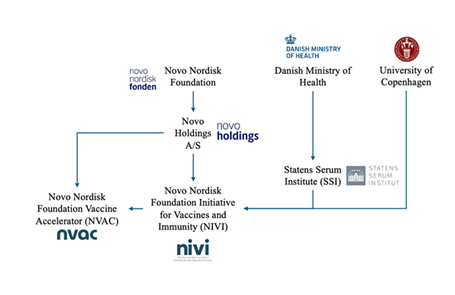
Crépeaux et al. summarize,
Briefly, several authors are affiliated with the Statens Serum Institut, a national entity involved in vaccine production. One of the authors reported affiliations to VAC4EU, a European vaccine surveillance consortium, and funding from Novo Nordisk Fonden and Lundbeckfonden, both closely linked to Danish health policy and biomedical interests. The Novo Nordisk Foundation, through its wholly owned subsidiary Novo Holdings A/S, maintains a controlling interest in Novo Nordisk A/S, the largest pharmaceutical company in Denmark. Consequently, the foundation providing research funding is also the controlling shareholder of a major pharmaceutical manufacturer.
Conclusion
As Crépeaux et al. conclude:
That such a limited and internally inconsistent study was not only published in a high-impact medical journal, but also presented as reassurance in media coverage, raises uncomfortable questions. In a scientific climate where vaccine hesitancy is often framed as a crisis of misinformation, there may be institutional incentives—whether explicit or implicit—to produce and promote studies that accentuate claims of safety while minimizing uncertainty. However, science built on convenience rather than rigor does not serve public health.
They appropriately end with a call for “independent, rigorous and honest science.”