

Yesterday, I posted about how I was deceived by Al Gore in his famous film An Inconvenient Truth. Presenting a graph showing a clear correlation between atmospheric carbon dioxide (CO2) levels and temperature, he claimed that CO2 levels drive temperature changes.
I later learned that, actually, the changes in CO2 levels lagged behind changes in temperatures, and so it was the temperature changes that was rather driving CO2 levels (due to the temp-dependent absorption or release of CO2 by the oceans).
I do not like being deceived, so I have been reasonably skeptical about climate-related claims ever since.
Over the years, therefore, while I have never made it a major focus of my research, I have spent a fair amount of time learning about the various debates that exists about the role of human activity in the temperature changes observed during the industrial era.
We're told, of course, that there is no debate, that "the science is settled", that there is a "consensus" that human activity is driving climate change, but such claims just create even more reason for skepticism because they are so totally contrary to the whole idea of scientific inquiry.
It has always been unfathomable to me that with a topic so extraordinarily complex as Earth's climate there is no room for debate, that there are no legitimate questions to be raised from a skeptic's point of view, and that we should accept the absurd idea of drawing firm conclusions based on "consensus" in the scientific community.
And there is also the obvious political agenda of using climate change as a pretext for ushering in more authoritarian governance.
Anyhow, I recently watched a new documentary titled Climate the Movie: The Cold Truth that presents a counter-narrative to the climate alarmism we are so typically inundated with from the mainstream media.
The full film is available on YouTube and Rumble. The official website is ClimateTheMove.net, a Twitter account is here, an FAQ about the movie is here, and the video can be downloaded from here.
Watch it right here, and read my overview and further thoughts below:
Warranted Skepticism
The film features numerous skeptics of the official narrative that human CO2 emissions have the primary cause of increasing temperatures during the industrial era, and it's worth watching to learn about arguments that we are never exposed to by the mainstream media.
And since the media never inform us about the existence of these arguments, they naturally also never address them, either to confirm or correct the information presented.
I see many parallels between the mainstream discourse on climate and the discourse on vaccines or COVID-19, both of which are topics I have researched and written about extensively. One clear lesson from my deep dives into those topics is that what we are told science says and what science actually tells us are two completely different things.
I haven't dug nearly as deeply into the scientific literature on climate as I have on those other topics, but I have researched it enough to have already been familiar with most of the key arguments presented in Climate The Movie. It is probably the best source I've come across, though, in terms of bringing all those arguments together into an easily consumable format.
Needless to say, I haven't fact-checked all the claims made, but following is a brief overview of the video's contents along with screenshots of many of the graphs presented showing climate data.
The film begins by noting that fossil fuels have enabled the greatest economic growth in human history, the corollary of which is that you can't implement policies that increase energy costs without greatly harming the economy, with the burden of those harms falling disproportionately on the poor.
There is a governmental agenda to assume ever more power for the purpose of controlling the population, and to speak out against the narrative that serves this political agenda is career suicide, with the stupid label of "climate denier" being utilized to dismiss skeptics as "anti-science" (much like how advocating the right to informed consent will get you stupidly labeled an "anti-vaxxer" or criticizing US support for Israel's crimes against the Palestinians will get you stupidly labeled an "anti-Semite").
We are urged in the film to check the data rather than simply believing what we're told, with the example cited that the UN's International Panel on Climate Change (IPCC) draws conclusions that are unsupported by its own cited data. We are also reminded that science is not done by "consensus".
The Past Compared to Our Current Ice Age
The counternarrative begins by taking a broad look at Earth's climate, presenting this graph showing CO2 levels over the past 500 million years, which reveals that current levels are actually low in that historical scale:
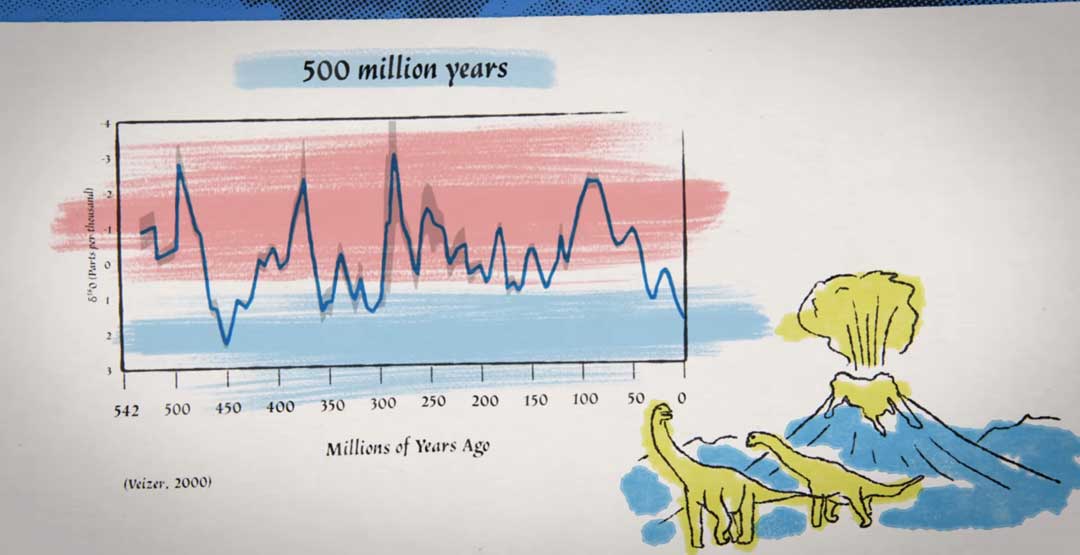
The point is that today's CO2 levels are hardly unprecedented in the grand scale of things. The next point made is that neither are today's temperatures, as indicated in this graph showing temperatures over the past 50 million years:

Then another graph is presented that zooms in to the past 5 million years, which shows a general cooling trend:
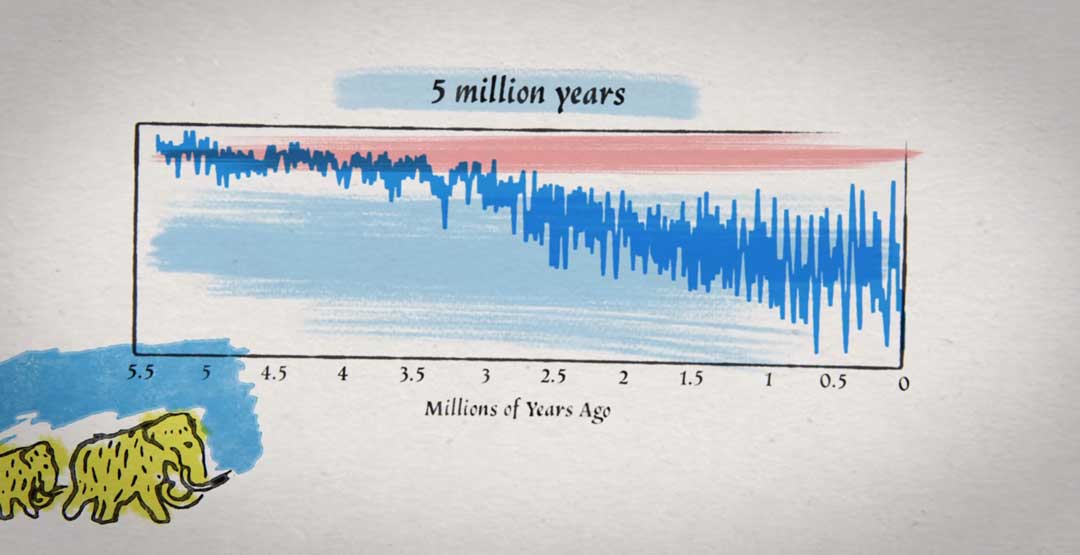
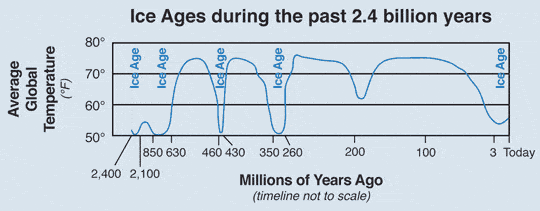
Indeed, we are currently still living in an ice age that began 3 million years ago, according to the website of the Utah Geological Survey (UGS). Within this ice age have been periods of relative warmth known as "interglacial" periods, and there is a popular misconception that the end of the last period of glaciation, known as the Pleistocene, marked the end of the ice age. (That's what I always thought because, well, we were always told growing up that "the ice age" was a thing of the past!)
The UGS provides this helpful graph showing a simplified overview of when ice ages have occurred during the past 2.4 billion years:
The UGS also provides this graph looking at the past 450,000 years within the current ice age, which shows the swings between glacial and interglacial periods:
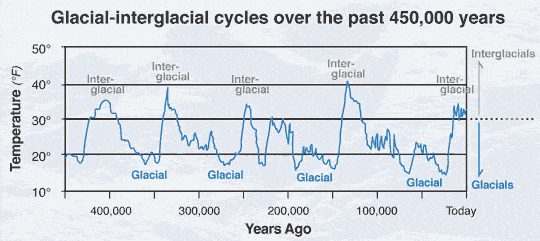
The film presents the following similar graph showing a slightly more zoomed-out view of the "glacial maxima" and "glacial minima" periods within the current ice age:

We are currently in the interglacial period known as the "Holocene", which has been abnormally long, having lasted now for nearly 11,000 years. The Energy Education website from the University of Calgary credits "human induced climate change" with delaying the anticipated return of glaciation!
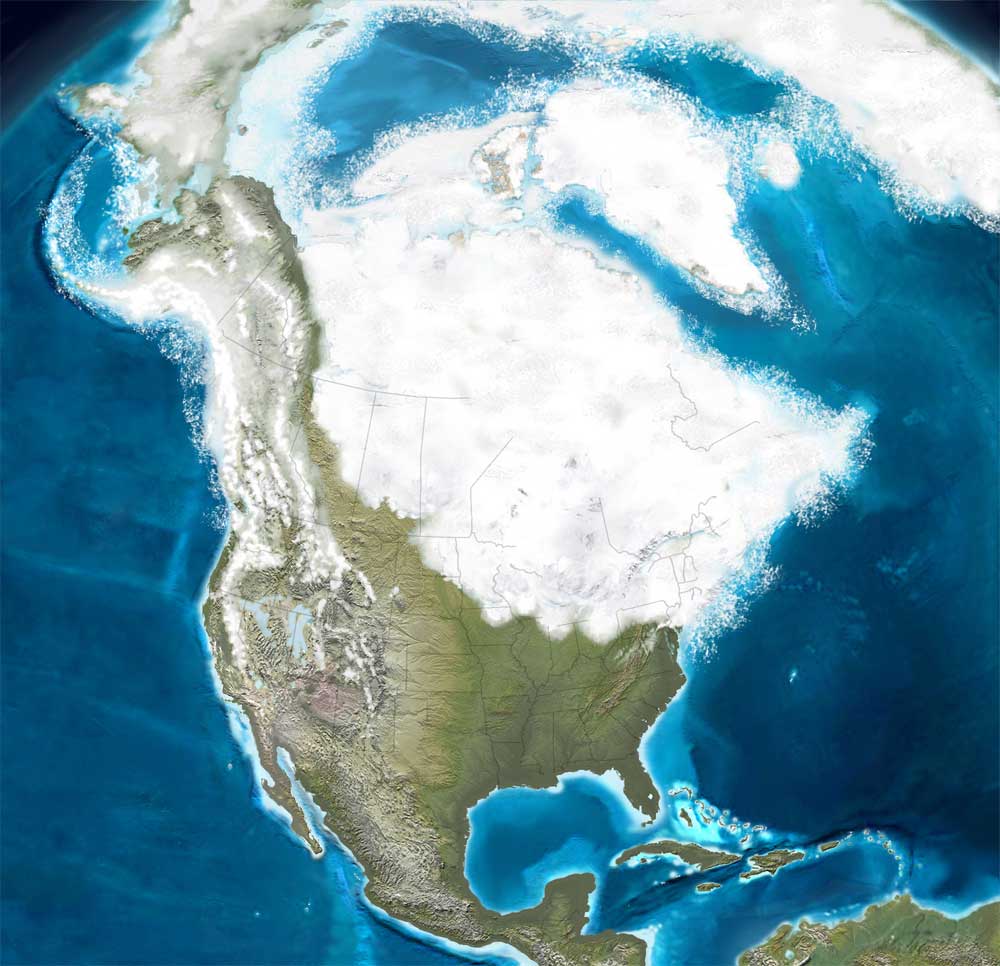
I don't know about you, but as a resident of "the Great Lakes State" of Michigan, I'd rather see continuing warming temperatures than this (from the National Oceanic and Atmospheric Administration [NOAA] under the US Department of Commerce):
The film also points out how Al Gore deceived his audience in his famous film An Inconvenient Truth by claiming that the correlation between temperature and CO2 levels was because the former is driven by the latter, when in truth it was temperature changes that were driving CO2 levels.
One of the featured guests additionally argues, "Ice ages start when carbon dioxide is at its maximum, and ice ages end when carbon dioxide is at its minimum, which is the exact opposite of what would occur if carbon dioxide was controlling the temperature."
Another says, "CO2 has never driven temperature changes in the past. Never!"
A Closer Look at the Historically Recent Warming
Now, none of this is to say that human CO2 emissions are not contributing to warmer temperatures, so let's keep zooming in. Next, the film presents the following graph looking at temperatures over the past 2,000 years, showing the "Roman Warm Period", the "Cold Dark Age", the "Medieval Warm Period", and our current retreat from the "Little Ice Age":
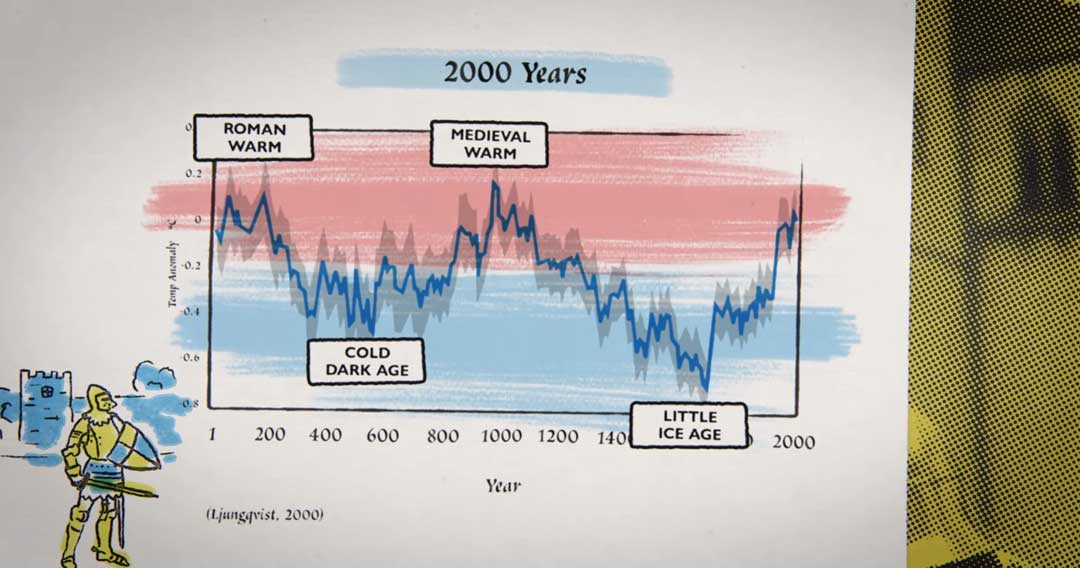
I looked for and found the source for this one, which is this study of temperatures in the northern hemisphere (PDF file accessible here).
Next, data from the Goddard Institute for Space Studies (GISS) under the National Aeronautics and Space Administration (NASA) is presented showing the general increase in temperatures over the past 140 years:
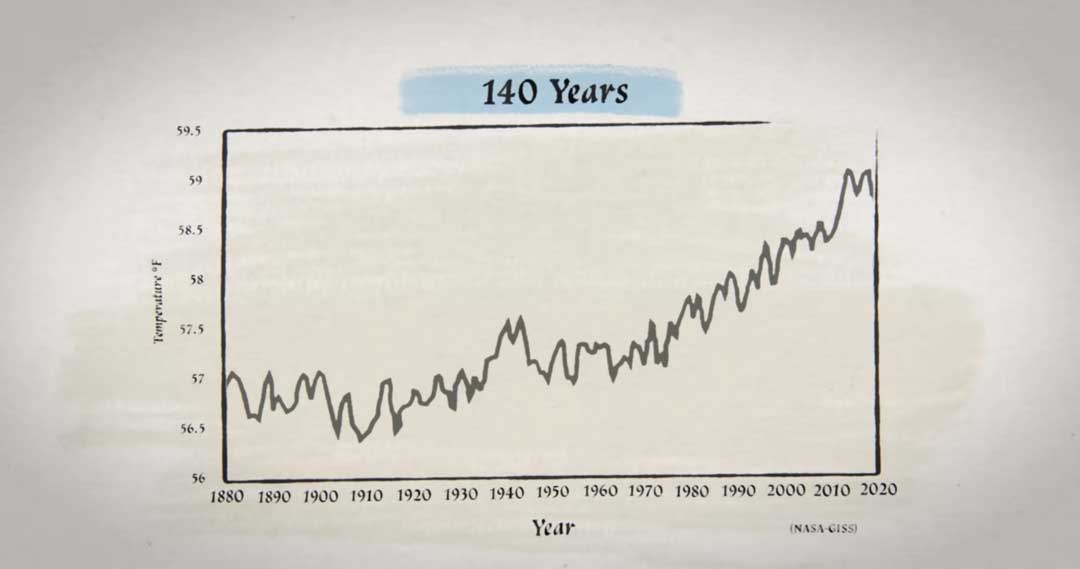
This, the film notes, is the typical graph we are shown that is supposed to invoke fear and alarm.
We hear the silly label "climate deniers", which evidently is supposed to mean "climate change deniers", but nobody denies that the climate is changing, just as it always has. It perhaps means "global warming deniers", but, then, I have never seen any of the scientists who dissent from the "consensus" view deny that warming has occurred.
The questions among dissenters, rather, are about how much warming has actually occurred and the extent to which human activities have contributed to that warming.
These seem like reasonable questions to me, but we're supposed to think anyone who might ask them must be some kind of ignorant lunatic -- a "climate denier"! (Kinda like all those "anti-vaxxers" out there who -- Gasp! -- actually believe that individuals have a right to decide for themselves whether or not to use any given pharmaceutical product.)
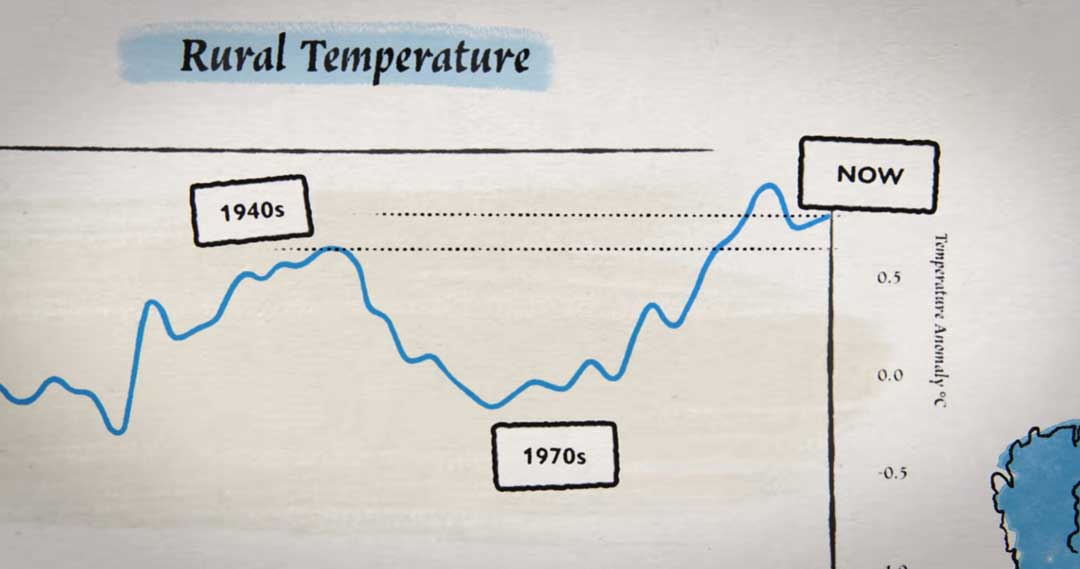
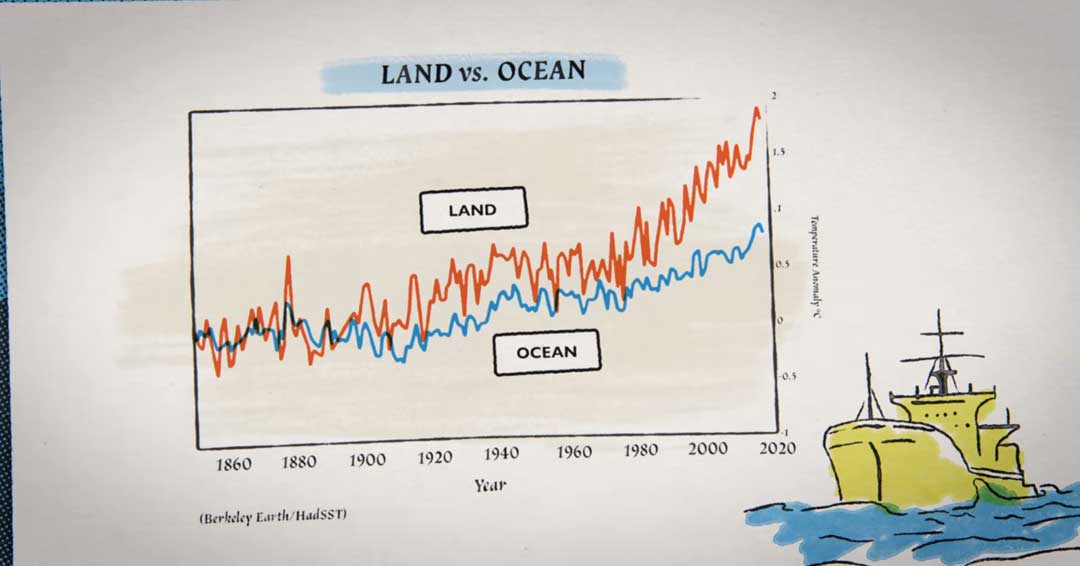
A considerable portion of the film is then spent focusing on the contribution of land-based thermometer stations, with the argument being that the "urban heat island" effect artifactually biases the data in favor of more dramatic temperature increases.
Temperature stations set up in the past outside of urban centers later became swallowed by urban growth, and they therefore recorded artifactually high temperatures due to the increased heat in urban areas compared to greener surroundings.
Here's a graph shown of rural temperatures showing a cooling period through the 1970s followed by more recent warming barely higher than the peak reached in the 1940s:
Ocean measurements have also shown warming but less than the land measurements, thus supporting the hypothesis that the urban heat effect has biased land data:
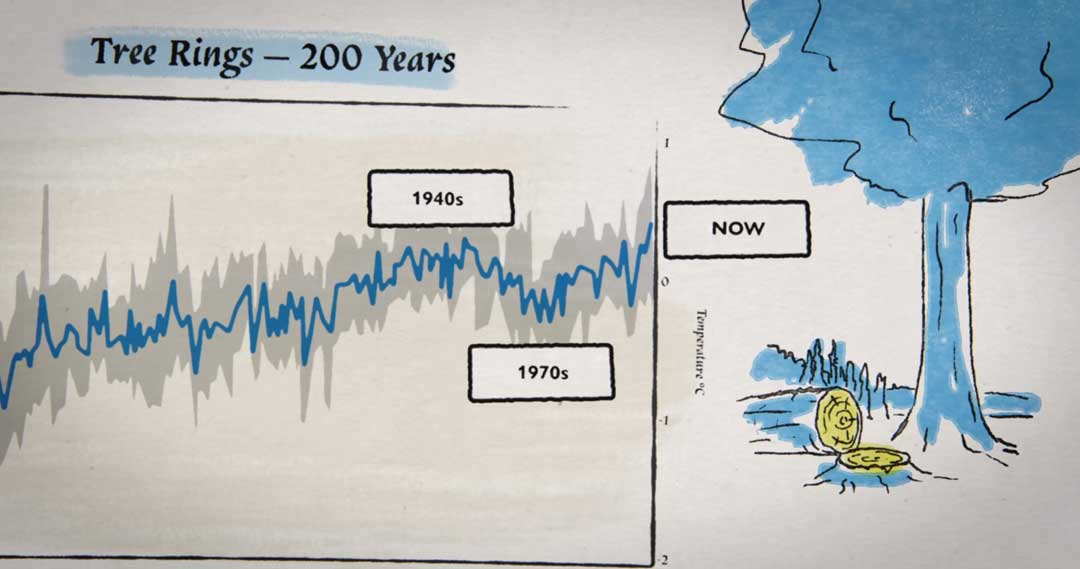
Another graph meant to illustrate the point is of temperatures reconstructed from tree ring data, similarly showing a less dramatic increase since the cooler 1970s:
Next, the point is made that a higher concentration of CO2 in the atmosphere is great for plant life, and the point is reiterated that the atmosphere is currently starved of CO2 in the grand historical scale of things (later, the film says that CO2 currently makes up just 0.04% of our atmosphere):
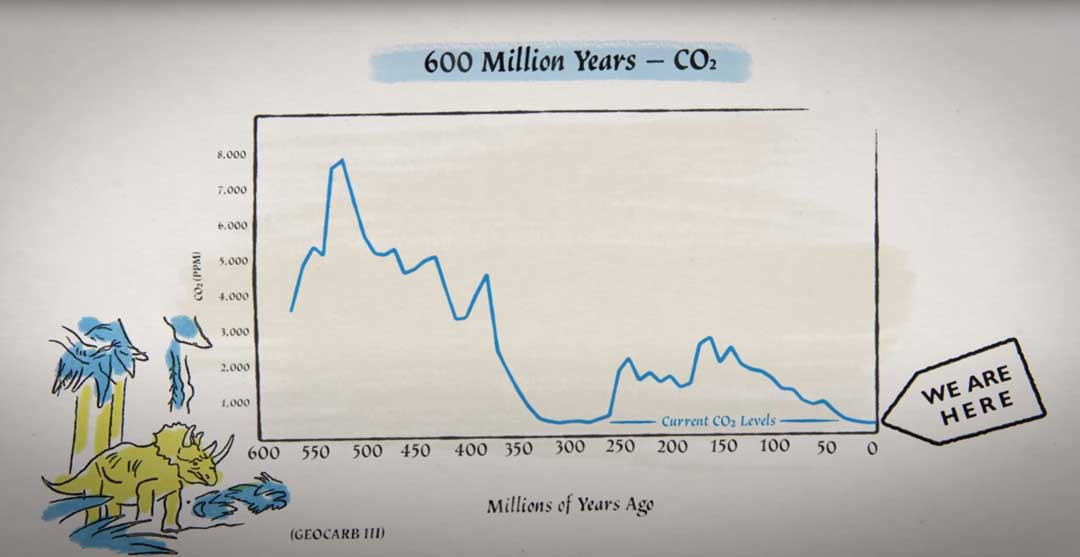
Obviously, more CO2 in the atmosphere is not going to threaten the existence of life on Earth.
The point is also made that the cooldown of the 1970s is not what one would expect if human CO2 emissions were the principle driver of the historically recent temperature increase.
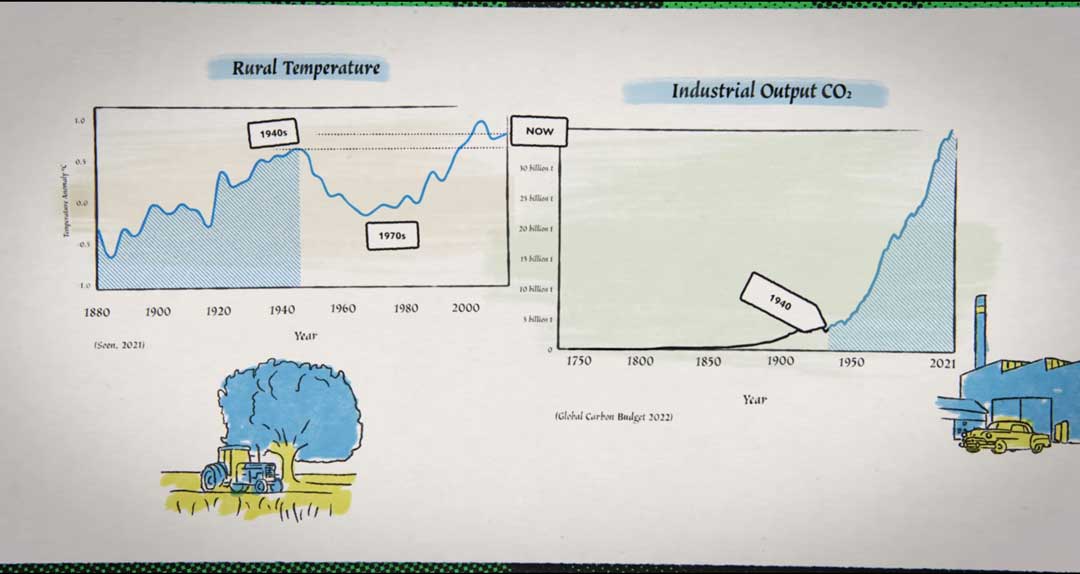
The explanation I've seen for that from the climate alarmist side is "natural variability", which is eminently ironic for the obvious reason.
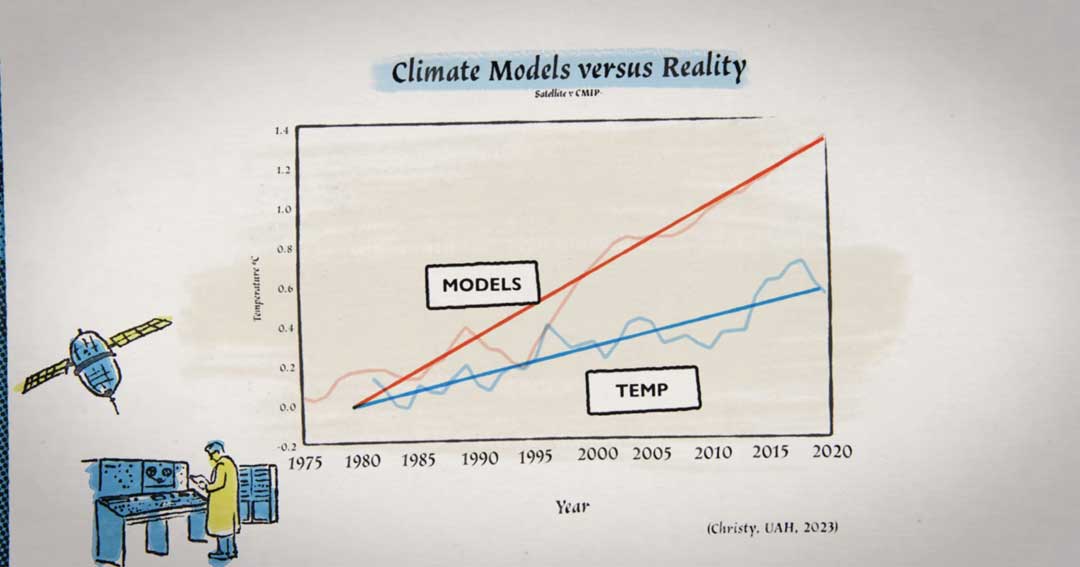
Additionally, the computer models projecting increasing temperatures that we are told would result in catastrophic harm have been falsified by observations. The actual temperature increases over the past 40 years have been much lower than the models have projected.
Natural Factors Affecting Climate
The question arises: If global temperature is not primarily driven by atmospheric CO2 levels, then what does drive it? One obvious place to look for an answer is that giant nuclear reactor at the center of our solar system. The film next shows this graph showing what is said to be a correlation between solar activity and a proxy measure of temperature:
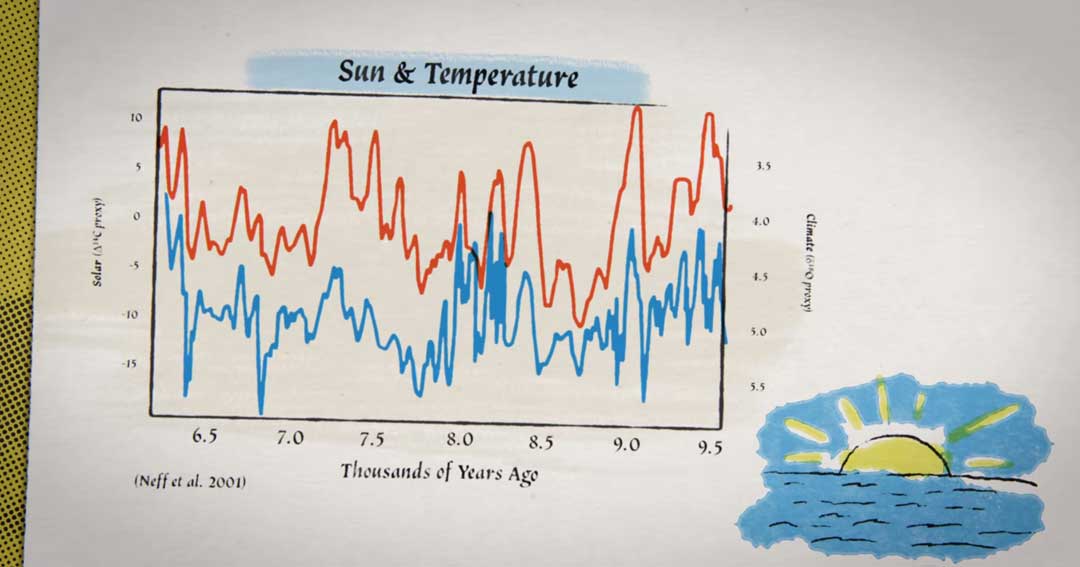
However, I found the source for that data, which is this study, and while it's written in largely unintelligible technical language, I gather that it rather compares solar activity with monsoon rainfall, and the authors do not describe that measurement as a proxy for temperature. So, I am left wondering about the validity of this particular argument.
This graph is presented from a 2021 paper by Willie Soon, a featured guest in the film, showing what appears to be a correlation between solar activity and temperature:
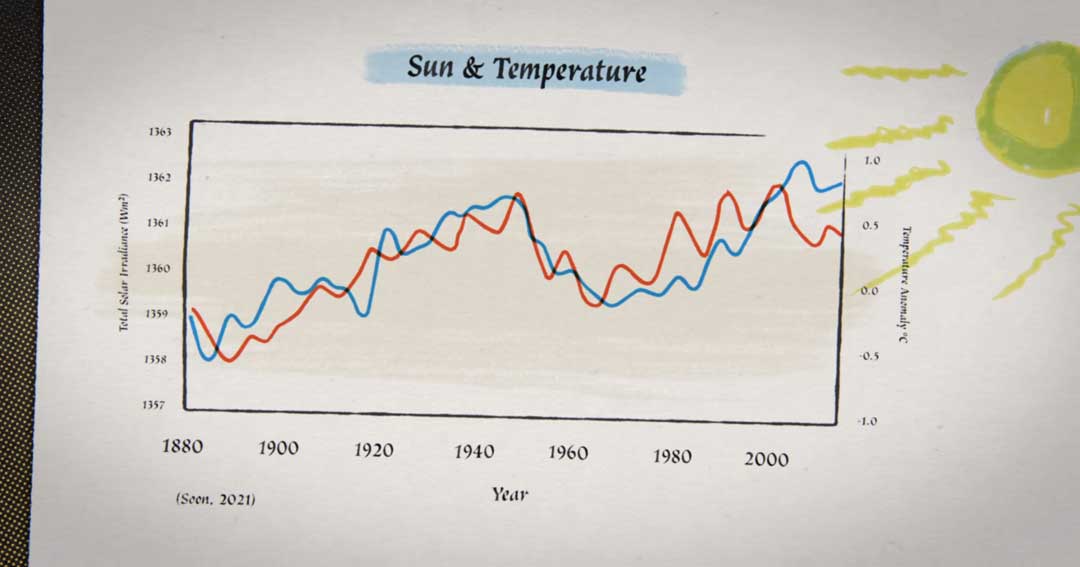
I couldn't find that paper, but I did find this graph from NASA showing no apparent correlation between solar activity and temperature since 1880, so this is another claim I'd like to gain greater clarity about:

A more important factor than CO2 is cloud cover, the film argues, which is affected by cosmic rays from supernovas. As these charged particles hit Earth, they form nuclei around which water vapor condenses to create clouds. Curious about this idea, I did a quick search and found, for example, this abstract from a paper in Space Science Reviews:
A correlation between a global average of low cloud cover and the flux of cosmic rays incident in the atmosphere has been observed during the last solar cycle. The ionising potential of Earth bound cosmic rays are modulated by the state of the heliosphere, while clouds play an important role in the Earth's radiation budget through trapping outgoing radiation and reflecting incoming radiation.... The droplet distribution of a cloud will then depend on the number of aerosols activated as cloud condensation nuclei (CCN) and the level of super saturation. Based on observational evidence it is argued that a mechanism to explain the cosmic ray-cloud link might be found through the role of atmospheric ionisation in aerosol production and/or growth. Observations of local aerosol increases in low cloud due to ship exhaust indicate that a small perturbation in atmospheric aerosol can have a major impact on low cloud radiative properties. Thus, a moderate influence on atmospheric aerosol distributions from cosmic ray ionisation would have a strong influence on the Earth's radiation budget. Historical evidence over the past 1000 years indicates that changes in climate have occurred in accord with variability in cosmic ray intensities.
The film proposes that as Earth passes through the spiral arms of our Milky Way galaxy, it affects the amount of cosmic rays hitting the planet, which affects the climate.
Another argument presented is that increased average temperatures over time are more due to winter and nighttime temperatures increasing as opposed to summer and daytime temperatures. In other words, the climate is getting milder rather than hotter.
"There's no such thing as a climate emergency happening on this planet now," one of the speakers says. "There's no evidence of one."
What about Extreme Weather Events?
The focus then shifts to the claims we hear about every extreme weather event being caused by "climate change", by which, of course, the media mean anthropogenic global warming. The media's message to us is that human-caused warming is creating a more dangerous climate.
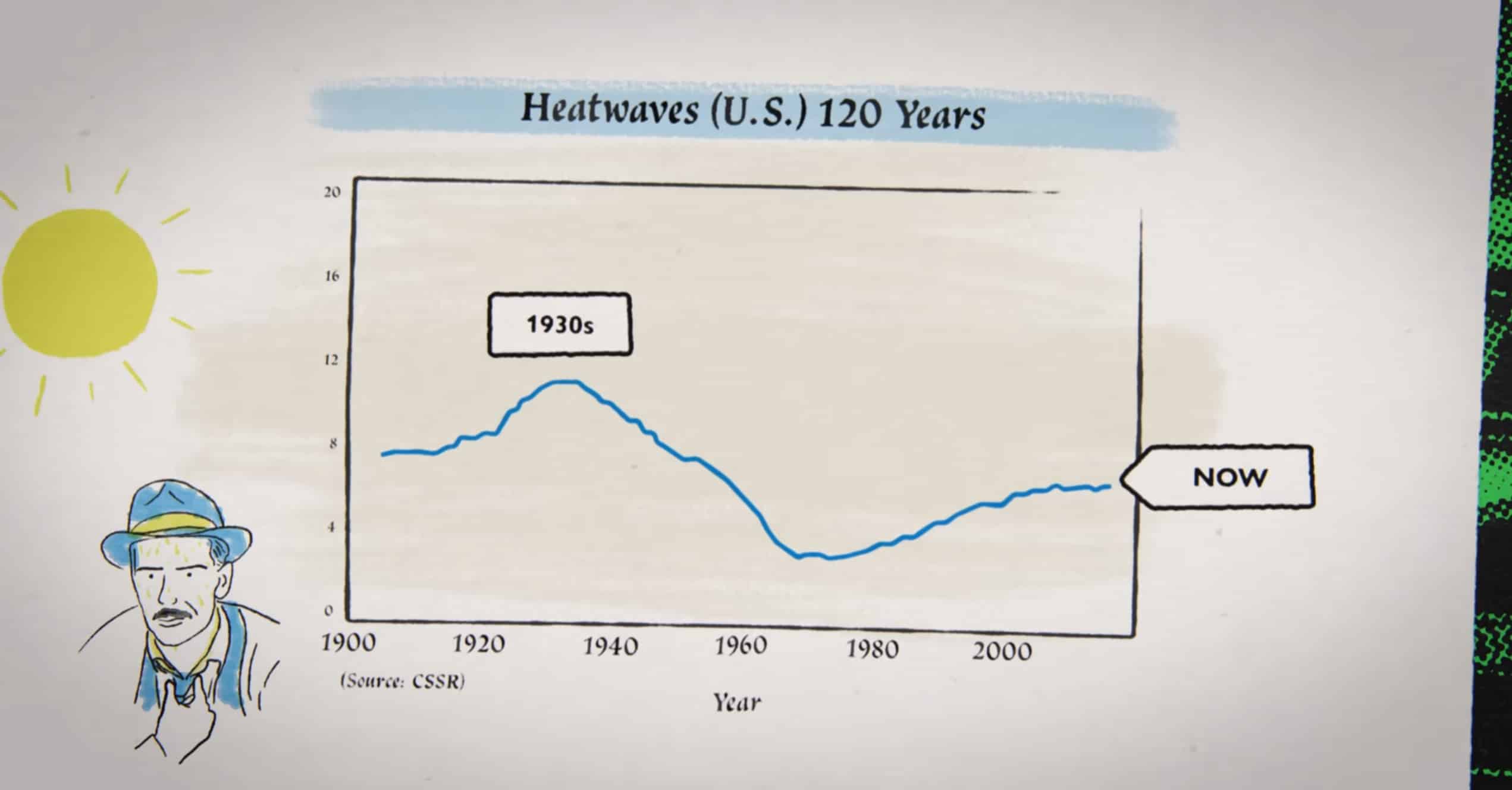
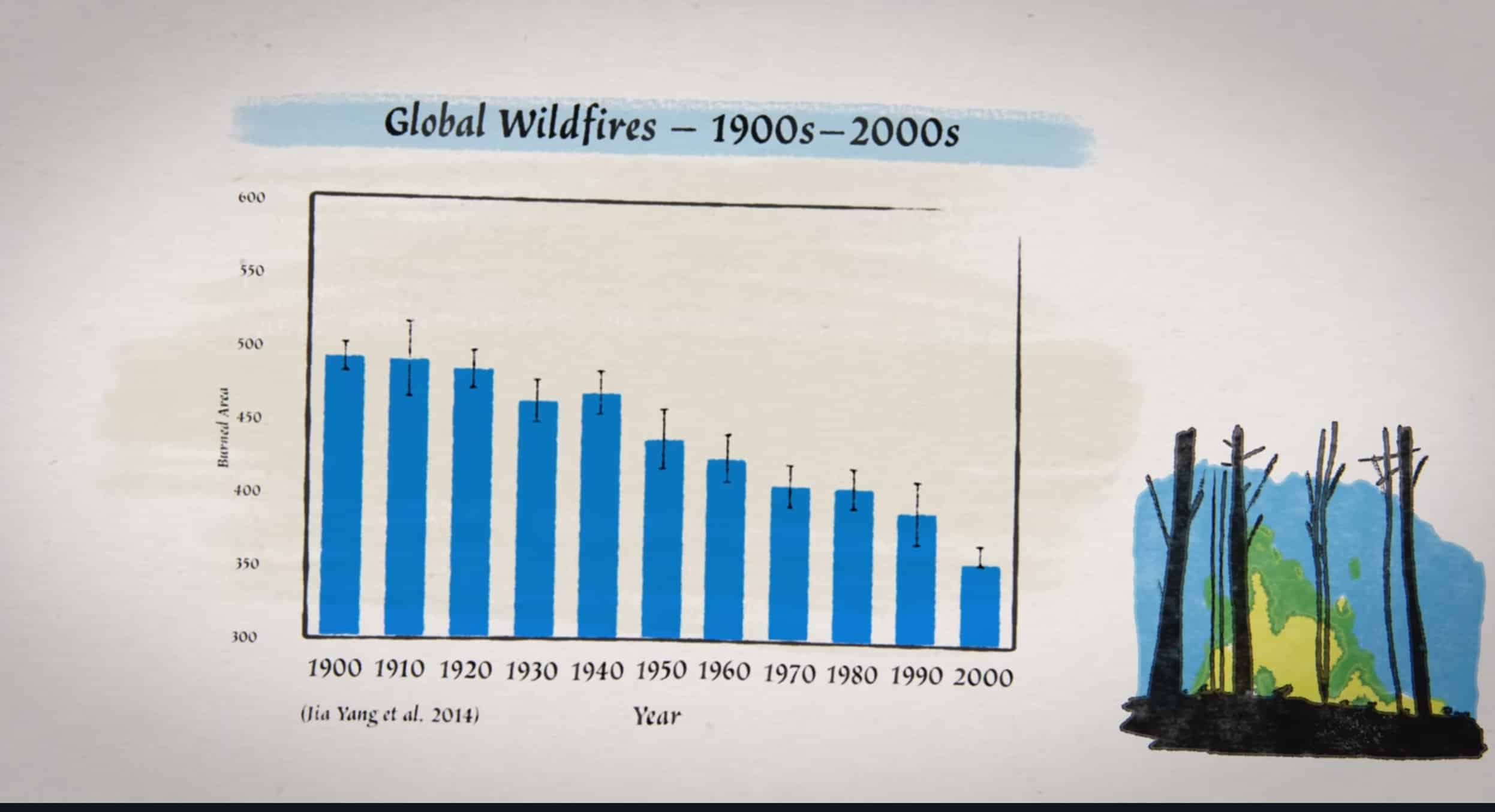
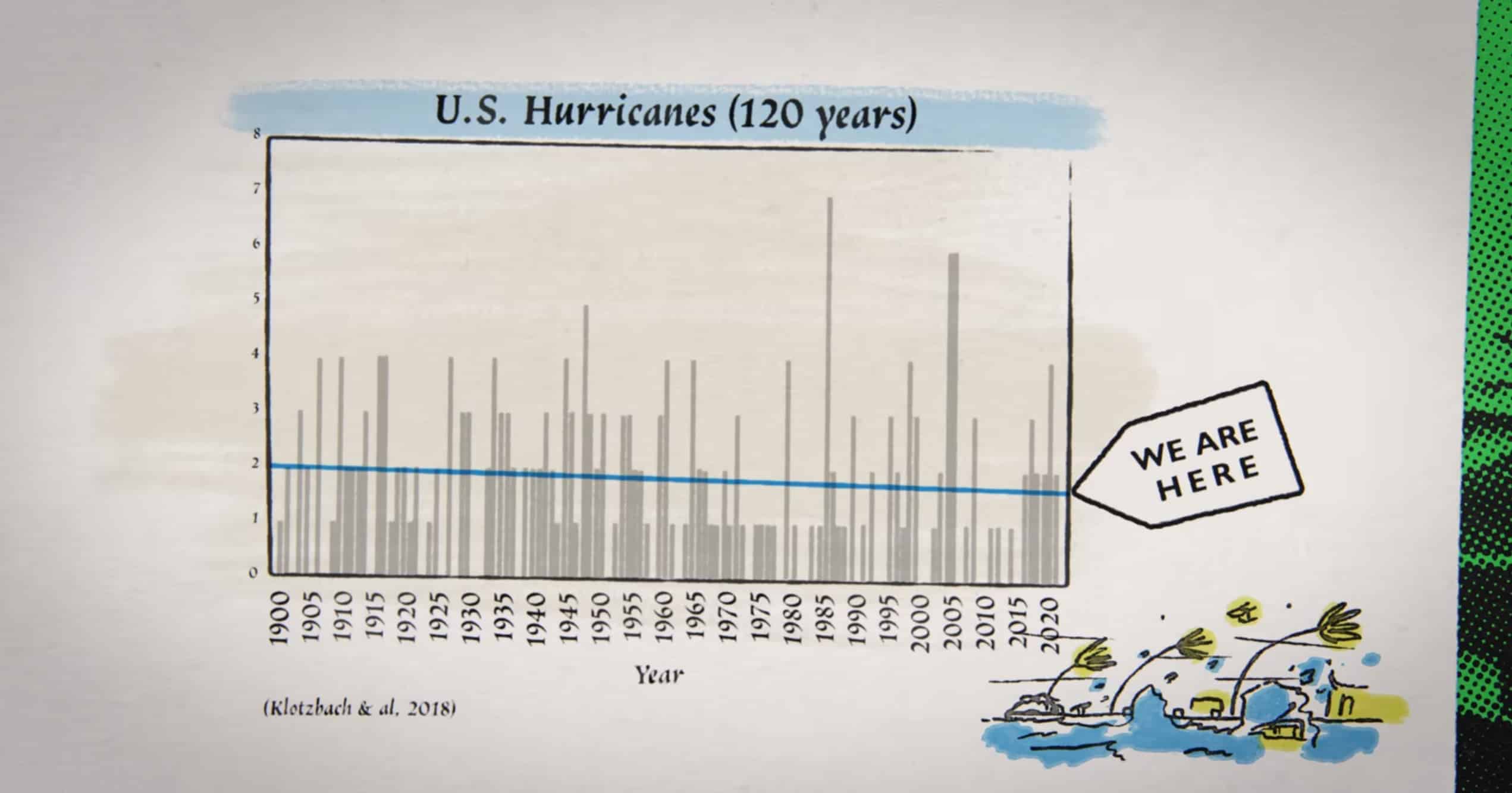
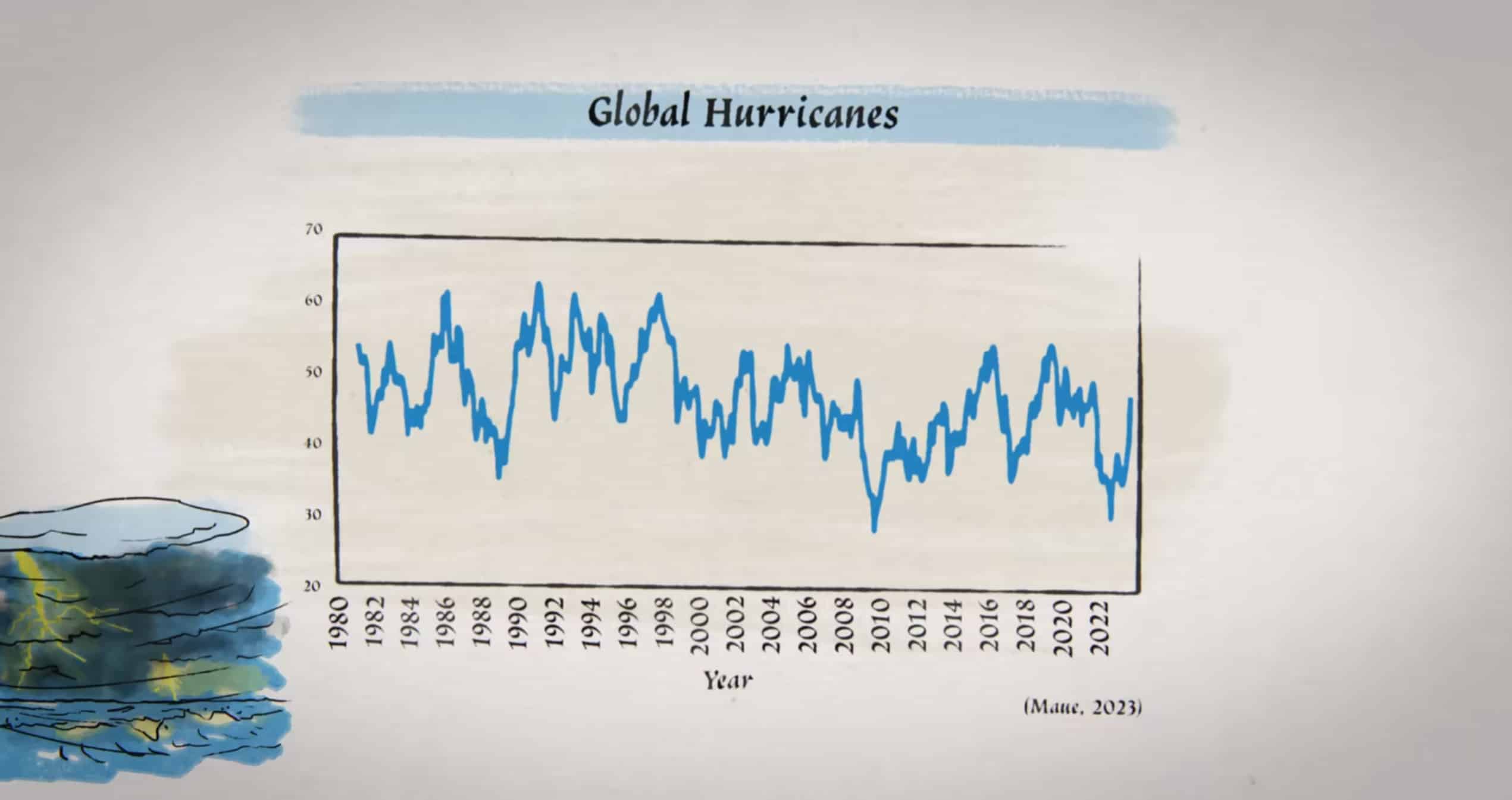
"The extreme weather events story is just absurd," an interviewee contends in the film. "There's no basis to it at all. It's just based on propaganda. The actual data shows the opposite."
The following graph is presented showing that heatwaves were more extreme in the 1930s than in recent years:
Here is data on global wildfires:
And hurricanes in the US since 1900:
Global hurricanes since 1980:
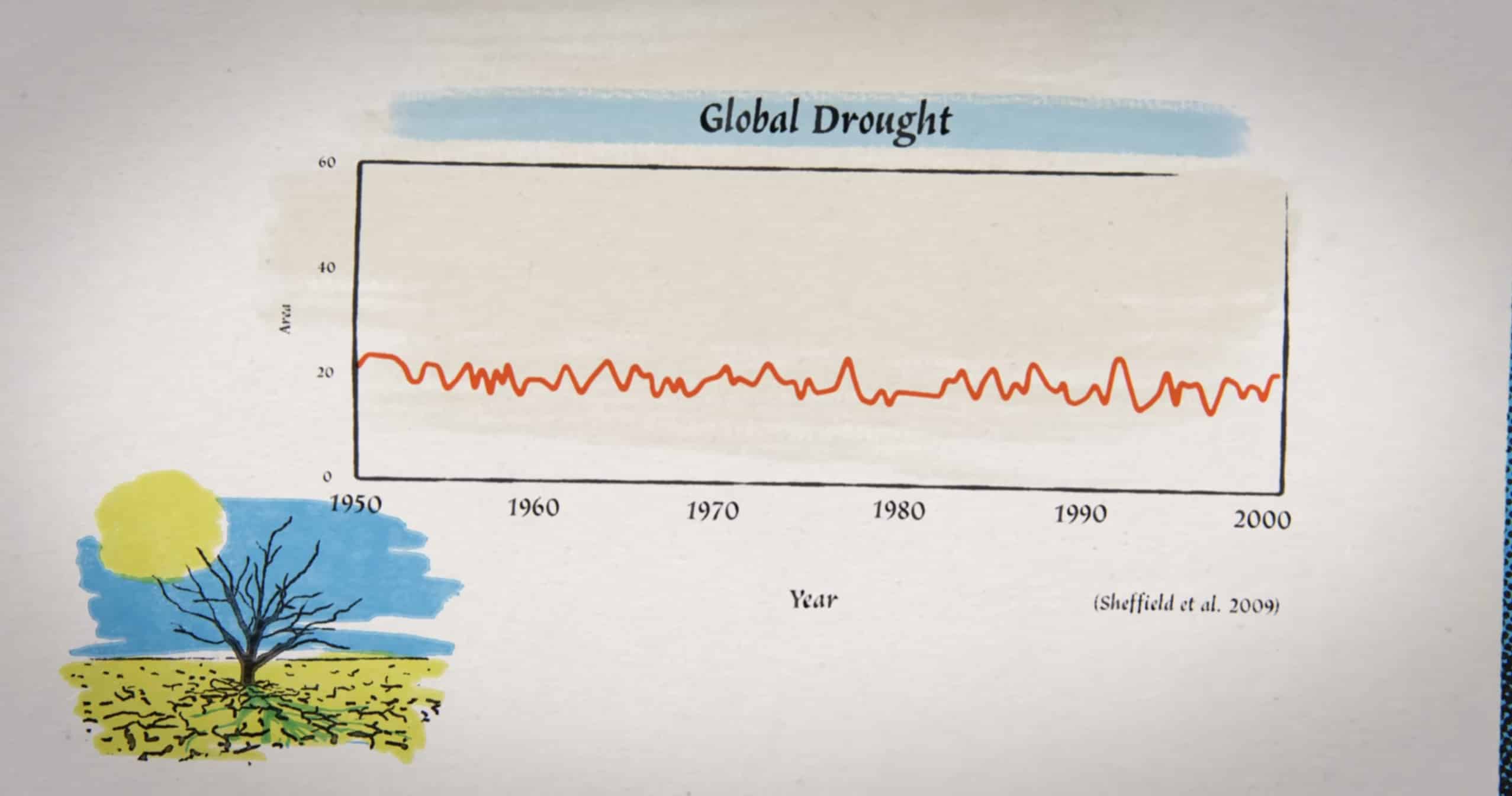
Global drought since 1950:
Government Corruption of Science
Most of the remainder of the film discusses the corruption of science through government funding.
It should come as no surprise that the same corruption we see on topics like childhood vaccines, COVID-19 vaccines, and the authoritarian lockdowns has long been occurring in the area of climate science.
After all, there is just as clear a political agenda. When governments implemented disastrous "lockdown" measures with their coerced mass vaccination endgame, they claimed to be "following the science", but that was an outrageous lie, and it came as no surprise to me (or my readers who were following my work) that the claimed benefits of lockdowns never manifested in the data -- while their predictable harms proved disastrous.
It was never about "public health". It was always about power, control, and profits for the pharmaceutical industry.
The basic formula that Anthony Fauci's NIAID applied in the area of "public health" is at work in the area of climate: researchers who publish results that the government is looking for get funded while those who publish results that don't align with the political agenda do not.
The government thus creates an incentive for researchers across many different fields to find ways to incorporate fears about climate change into their published findings. Whole new fields of study have been created as a result. As one guest in the film put it, "You've become a 'climate scientist' now even though you know nothing about the physics of climate."
Illustrating the institutionalized bias, one guest remarks that if there was no climate crisis, the IPCC would have no reason to exists; it's a huge big-money scam.
"Green" subsidies and grants create business opportunities for giving government what it wants. While the film doesn't get into the economics of it, much could be said about how this totally distorts market prices, which are the signals that entrepreneurs and investors use to determine how to direct resources.
Simply stated, government bureaucrats making decisions at best arbitrarily (assuming no ulterior motives and corruption) do not know better than the market with its pricing system how to efficiently direct scarce resources toward productive ends as determined by the will of consumers, which is to say by all of us.
Numerous researchers in the film describe their own experience facing the obstacle of institutionalized bias. One described how when looking to study natural background variability, the response, indirectly stated through funding decisions, was that we can't have natural changes as an effect because the question was begged that it has to be caused by human activity.
The climate movement was political from the start, it is argued, and came from the same mindset that views free market economics as a problem that needs to be solved by having the government interfere in every aspect of our lives and dictate to us our behaviors. The bigger the government the better, according to this twisted ideology, and what better way to usher in global authoritarianism than by using the ostensible global threat of climate change as a pretext?
Just like how the threat of "weapons of mass destruction" was fabricated to convince the public of the necessity of invading Iraq in 2003. Or how the lockdowns and then the COVID-19 vaccines were sold to the public on the basis of lies.
Any scientists who dare to speak out can't get funding, can't get published, and are despised by their colleagues. But as one guest astutely points out, when we are are told, "You're not allowed to have that idea!", we have left the realm of science.
Ironically, the complaint about free market capitalism is not that it has inhibited progress but has led to too much prosperity. The political agenda is an assault on our freedom and prosperity. Since the market is the vehicle for economic growth and the means by which the societal standard of living rises, the climate agenda is ipso facto an assault on the poor.
As economist Robert P. Murphy has pointed out, even the analysis of William Nordhaus, who was awarded the Nobel Prize for his work on the economics of climate change, shows that implementing the IPCC's policy goal to limit warming "would make humanity poorer than doing nothing at all about climate change."
And that, to me, is the bottom line.
What do you think? Share your thoughts in the comments below!

In respect to the correlation between solar activity and global temperatures, solar irradiance is not the only (nor the most profound) influence on global temperatures. There are many solar forcing effects that impact global temperatures and are not included in the IPCC models.
Thanks for your comment!
Nothing in this film is new. It’s all fairly old arguments. It seems imperitive that you research and report the attempts to refute each of the arguments made in the film. Entire books have been written to refute Soon and others. That’s NOT to say you or the film is wrong. Somehow the argument must be settled.
You are welcome to identify any claims made in the full that you think are wrong and explain why so.
Big government is the same problem as Big Business. They both seek more power over people and to enhance their size and power. If the power of Government is curtailed without an equally balancing limitation of the power of huge accumulations of wealth, then Government will decline and wealth will be the governing power.
It does not make sense to say that if a big business operated in a free market, it would become a governing power. It would have no power over us. The whole principle of a free market is that consumers enter into VOLUNTARY exchange with businesses for mutual benefit.
I interpreted R.B. to say that issues like corruption, waste, inefficiency, etc are everywhere – business, labor, government, military, and it is true, there is no escaping that today. And sorry Jeremy, you are never going to convince me about the benevolence of the “free market” at this stage in human evolution. It is firmly locked up in the US led example of individualism, greed and arrogance. If a true free market was in place, that incorporated all the costs/externalities of doing business, 90% of global corps would be out of business overnight. Every day we bear the rotten fruit, nothing to do with not being in a “free market”. Today:
Band-Aid, Walmart and CVS among bandage brands containing toxic PFAS
The Guardian TOM PERKINS April 5, 2024
AMhttps://www.aol.com/news/band-aid-walmart-cvs-among-130007580.html. If we started the country over perhaps, say dividing up into bioregions with community sanctioned ecologically sustainable free enterprise, maybe.
Yes, certainly, but we do not have free markets, and in a free market, if a business engaged in corrupt, wasteful, or inefficient practices, it would soon be out of business because the market’s pricing system enables investors and entrepreneurs to direct scarce resources towards more productive ends.
All you are saying is that the market is locked up in human behavior, which is of a tautology. What’s wrong with individualism? Nothing that I can see. Greed? Well, there’s greed and then there’s just plain old self-interest, which I also don’t attach any negative value to. We all have to do what is in our own best interests, and there is nothing wrong with that, provided that we are not infringing on any other individuals’ equal rights. Profit motive, for example, is a great thing. It’s what drives people to improve our standard of living by creating goods and services that we desire and competing with each other to provide those things to us the most efficiently (which translates into most inexpensive).
That assumption is not inconsistent with my view that we should free ourselves from government interference into every aspect of our lives, including our activities of engaging in voluntary exchange for mutual benefit (i.e., operating in a free market).
You are assuming that the massive problem of PFAS contamination would exist if we had always had a free market, without the government’s massive interventionism in every industry. But assuming that would be true, this also is not an argument against having greater freedom in our voluntary exchanges with others for mutual benefit. I am not claiming that everything would be the Garden of Eden if only we had a free market; I am just saying that freedom is better than authoritarianism.
What’s so wrong with freedom?
Subscribe http://www.youtube.com/@TonyHeller/videos . His display of historical documents is impressive. You can thank me later.
Thanks for the suggestion.
Not just paid scientists but media hacks like this slovenly knight: https://www.youtube.com/watch?v=IatVKZZcPG0
Netflix, Attenborough and cliff-falling walruses: the making of a false climate icon
From the guy that was ousted from university work because of his views
https://youtu.be/QbKa015q4cI?si=NZ8QUpiTp1lFxgak