

Prior to the COVID-19 pandemic, I had been documenting how social media platforms like Facebook were censoring true information about vaccines in service to the government and, by extension, the pharmaceutical industry.
The censorship regime was greatly expanded throughout the lockdown madness with its coerced mass vaccination endgame, becoming so brazen that discussion about the existence of this censorship broke through into the mainstream discourse.
On Twitter, now “X”, I somehow managed to get by without facing any overt censorship (although shadow banning may have occurred). Never have I had a post removed or otherwise flagged for “misinformation”, and my account was never threatened.
Many other users were banned, though, for the offense of doing journalism to combat the government’s incessant disinformation, and it was a very positive development when Elon Musk took over Twitter and proceeded to end and publicly expose the censorship that had resulted in many other users getting banned for the offense of doing journalism to combat the government’s incessant disinformation.
On Facebook, I was highly selective in the information I shared, ensuring only to provide links to factually accurate content, and yet numerous of my posts were either removed or plastered with a bogus “fact check” with one of Facebook’s partners from the faux “fact checker” industry.
I had a group on Facebook that was heavily throttled, and Facebook tried to outsource its censorship to me as the group administrator by threatening continued penalization if I did not act to delete posts it had flagged as “misinformation”. I refused to do this, so the result was that group members were unlikely to see group posts because of the manipulation of Facebook’s algorithm to prevent them from seeing information they wanted to see.
The true nature of Facebook’s fraudulent “fact checking” was illuminated by its explicit prohibition against informing people of the fact that the mRNA COVID-19 vaccines were not approved and licensed by the US Food and Drug Administration (FDA) but instead were being distributed under Emergency Use Authorization (EUA)—a regulatory status for products still considered “investigational” or “experimental”.
At the time Facebook’s policy was prohibiting the “claim” that the vaccines were “not approved” by the FDA, the FDA’s own Fact Sheets for Recipients and Caregivers” explicitly stated that there were no FDA approved vaccines for COVID-19!
Of course, Facebook was just doing the government’s bidding. White House press secretary Jen Psaki went so far as to say that anyone who told the truth that the vaccines were not FDA approved on one platform should be banned from all social media platforms.
(That was before the vaccines finally received FDA approval in August 2021.)
Last year, Mark Zuckerberg, the CEO of Meta, which owns Facebook, Instagram, and Threads, admitted in a letter to Congress that his company had censored truthful information under pressure from the Biden administration.
Just a few weeks ago, Meta announced that it is ending its partnership with the faux “fact check” industry on the explicit grounds that these partners had demonstrated extreme political bias, and Zuckerberg once again emphasized how Facebook had censored factually accurate information under pressure from the US government.
That is a very positive development, and it is great to see first X and now Facebook refusing further collusion with the government and industry to prevent their users from learning the truth in order to facilitate the propagation of unchallenged government disinformation (like the scientifically fraudulent claim that two doses of an mRNA COVID-19 vaccine would confer durable sterilizing immunity that would stop infection and transmission of the virus).
LinkedIn, however, was even worse than Facebook, in my own personal experience, and has continued to censor truthful information.
At one point, I was even “permanently” banned from LinkedIn for exposing disinformation from the US Centers for Disease Control and Prevention (CDC). Specifically, I documented how the CDC’s August 2021 claim that natural immunity was inferior to the protection conferred by COVID-19 vaccines was contradicted at the time by virtually all the non-CDC-originating medical literature and subsequently falsified by the CDC’s own data as reported by its own researchers in its own MMWR journal.
Until my “permanent” ban, I had repeatedly tried to utilize LinkedIn’s so-called “appeal” process, which proved completely illegitimate.
Their bogus “appeal” process instead consists of you clicking a button to request an appeal and them coming back to you to say, yep, we stand by our decision.
On the occasions when I managed to get a support ticket created to address this problem by communicating with a LinkedIn representative, I requested LinkedIn to specify what information in my post it was claiming to be false or misleading, and in every single instance, LinkedIn refused.
Consequently, it was logically impossible for me to actual present a case to appeal their decision.
In every instance, LinkedIn cited the same paragraph of its Professional Community Guidelines, which prohibits “misinformation”, meaning information that is “false or misleading”, including any information that is contrary to that from “public health authorities”.
LinkedIn’s censorship therefore was premised on a bad-faith interpretation of its own guidelines whereby “misinformation” is euphemistically defined to mean any information, no matter how factual, that does not align with the adopted political agenda, such as achieving a high vaccination rate.
At one point in my efforts to get LinkedIn to reason with me, I specifically asked: Do the LinkedIn Professional Community Guidelines prohibit me from reporting factually accurate information to correct misinformation from public health authorities?
The reply I received to that question provided me with the key insight into how to combat its censorship: LinkedIn responded by saying it “does not provide interpretations of its Professional Community Guidelines”!
How can LinkedIn expect users to comply with its guidelines when it refuses to explain what they mean? There is only one logical explanation for this response, which is that the answer to my question was “yes”, but for them to admit that would expose their essential contract fraud.
After I received a “permanent” ban, I could no longer log access my account in any way, but I would check back periodically to see whether I could at least access their appeals or support ticket systems, and at one point, I indeed was able to log in to at least access that area of their site.
So here’s what I did: I put LinkedIn on notice that it was violating its User Agreement with me by removing my posts and banning me on false pretexts and by misleading its own users by doing so based on a bad faith interpretation of its own Professional Community Guidelines as a basis for prohibiting journalists from reporting factually accurate information to correct false or misleading information from “public health authorities”.
And do you know what happened next?
I got my account back!
Yep, I actually succeeded. And while I cannot say with absolute certainty that this was due to my strategic approach, I have no better explanation for how I recovered from a “permanent” ban.
I have also just had another experience with LinkedIn that supports my conclusion that my strategy is an effective way to combat its censorship.
On January 8, I reported yet another new instance of LinkedIn removing a post containing factually accurate information, in my article titled “LinkedIn Censors Science to Serve the State and Big Pharma”. The next day, I reported about Meta’s announcement that it was ending its partnership with the faux “fact check” industry, and at the end of that piece, I also summarized the experience I’d just had with LinkedIn:
In the latest example, just yesterday, I was notified by LinkedIn that it had removed a post of mine from the day before, which it did on the verifiably false grounds that my post violated their prohibition of “misinformation”. My true offense was having accurately reported the easily verifiable fact that a study done in an FDA lab had confirmed that mRNA COVID‑19 vaccines are contaminated with DNA from the manufacturing process at levels exceeding the FDA’s own safety limit.
Similarly, in September 2023, LinkedIn censored a post of mine for containing the link to a factually accurate report by Maryanne Demasi, PhD, about the finding of DNA contamination in COVID‑19 vaccines.
. . . In essence, LinkedIn has repeatedly penalized me for the crime of heresy against the vaccine religion.
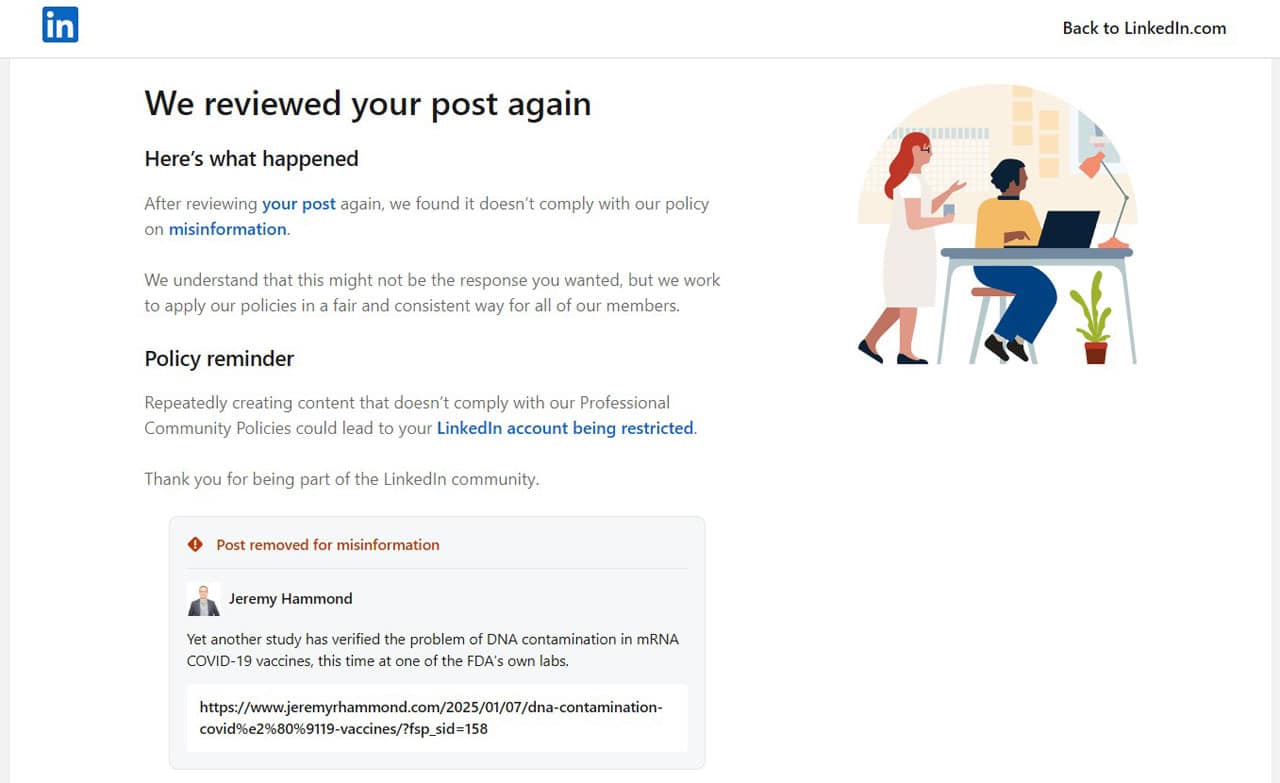
My January 8 article documents my “appeal” attempt, which was the usual illegitimate process of just requesting an “appeal” only to have LinkedIn come back and say, yep, it’s “misinformation”. Below is a screenshot of that response I received to my “appeal”, accompanied by the warning that if I persist in reporting facts, my account could be suspended (again).
Following that, I accessed the LinkedIn support ticket system and left the following message:
Cease and desist from violating the LinkedIn User Agreement with me and perpetrating contract fraud by removing my content on false premises.
LinkedIn has repeatedly removed posts of mine that contained only factually accurate information on the demonstrably false grounds that the posts contained “misinformation”.
However, LinkedIn has habitually interpreted the word “misinformation” euphemistically to mean any information, no matter how factual, that does not align with certain political agendas, such as the government’s policy goal of achieving a high vaccination rate.
Thus, LinkedIn is not acting in good faith to honor its User Agreement with me, including its promise to honor my choice to enable my content to be seen by other LinkedIn users.
Instead, LinkedIn is acting in demonstrable bad faith to remove my posts arbitrarily rather than because my posts contained misinformation.
Furthermore, LinkedIn promises and “appeal process” but provides no legitimate process for appealing its decision to remove my posts.
LinkedIn in every instance has refused to specify what information it is claiming to be false or misleading much less to explain how the determination was made that the information is false or misleading.
Consequently, I am never given an opportunity to explain why the information is factually accurate or how LinkedIn has made a mistake.
This failure to provide a legitimate appeal process, too, constitutes contract fraud and a violation of the LinkedIn User Agreement with me.
Please cease and desist from removing my posts on the false pretext that they contain false or misleading content.
That was met initially with an evidently automated response that was totally irrelevant, simply explaining to me how to report it if I spot abusive content or misinformation.
So, yesterday, I followed up with the comment: “I was not inquiring about how to report inappropriate content. I need to speak with someone from LinkedIn about LinkedIn repeatedly violating its User Agreement with me by removing my content on false pretexts.”
And lo and behold, this morning, I received an email to my inbox with the subject “An update on your post”. Curious, I opened it and was pleasantly surprised to read the bolded words “Your post is back on LinkedIn”.
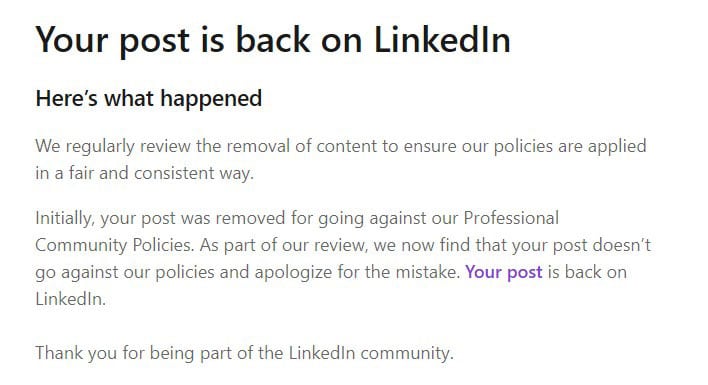
The link in the email led to a page confirming that the post in question was the one in which I reported the verification of DNA contamination in mRNA COVID-19 vaccines at an FDA lab.
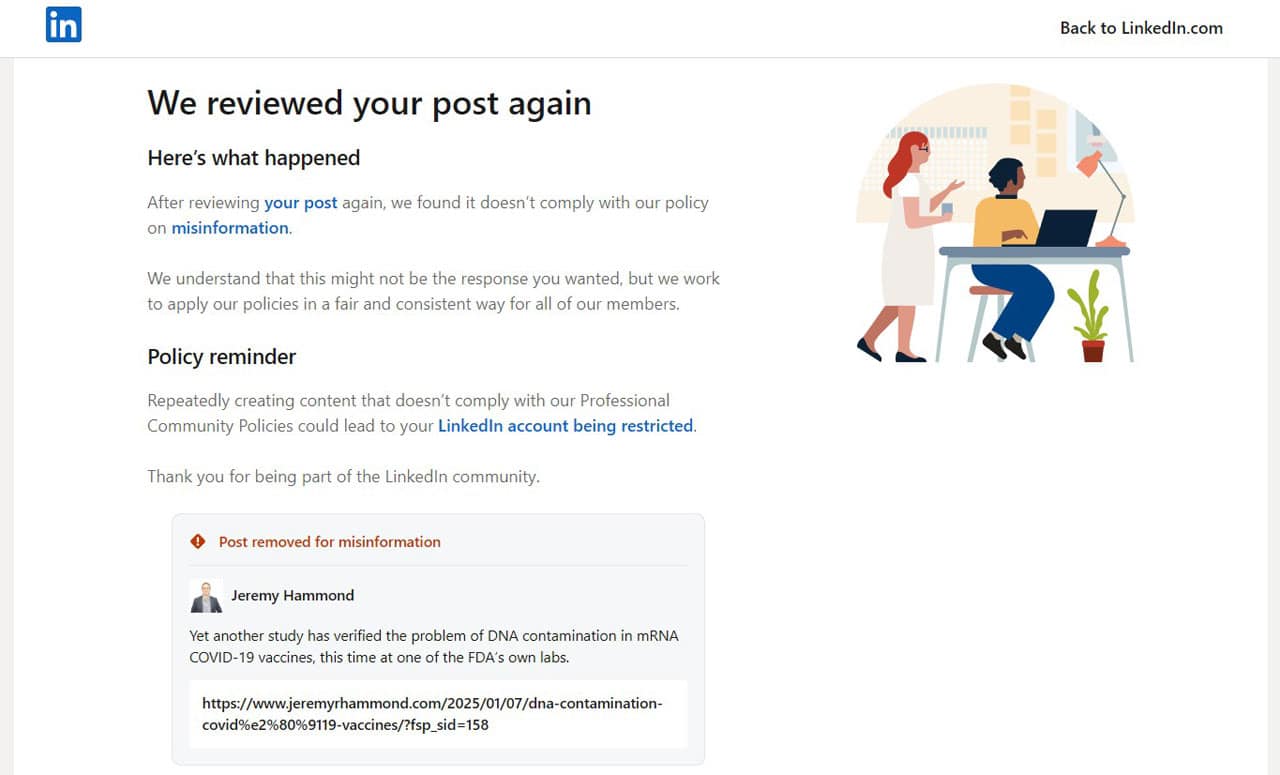
Again, I cannot be certain that this reversal was a consequence of the strategy I used, but what I can say for certain is that this is only the second time LinkedIn has backed down, and both times the reversal was preceded by me putting LinkedIn on notice that it was violating its User Agreement with me.
So, this might be an effective strategy for others to start employing when facing censorship of factually accurate information. I’d be interested to learn the outcomes if others start using this approach.
Together, we can put more pressure on LinkedIn to follow in X’s and Meta’s footsteps to end this ridiculous pretense of “protecting” us from “misinformation”.
Share any of your own experiences dealing with this type of censorship in the comments below!
And here is a collection of articles and interviews on the topic of censorship and the faux “fact check” industry:

I’m shocked a reasonable and factual argument worked but their actions begged for litigiousness and your response must have made that obvious. Well done!
Facts and logic don’t seem to matter too much to most people these days.