

Table of Contents
Introduction
As you can learn more about in my article “Censorship and the Legacy Media’s Misinformation Monopoly”, I was previously banned by LinkedIn for sharing factually accurate information to correct misinformation from “public health authorities” and the mainstream media.
I managed to regain access to my account, but the censorship continues, with a slightly new twist. LinkedIn is now advertising how it uses artificial intelligence (AI) to identify posts to censor.
Most recently, LinkedIn removed a post I shared providing factually accurate information about DNA contamination in mRNA COVID‑19 vaccines.
I have no intent to put up with LinkedIn’s duplicitousness and violation of its user agreement with me, so I’m going to document the dispute procedure and give you an inside look at how LinkedIn’s “fact checking” works—and how it violates its own User Agreement by denying a legitimate appeal process to victims of its censorship whose only offense is having shared facts that the “public health authorities” don’t want us to know about.
Accurately Reporting DNA Contamination in COVID-19 Vaccines
I use a social media management tool to schedule posts to go out to my Facebook, Twitter, and LinkedIn accounts, and on September 18 at about 9:30 p.m., I shared an article by the superb journalist Maryanne Demasi titled “Researchers ‘alarmed’ to find DNA contamination in Pfizer covid-19 vaccine”.
Incidentally, the only other social media post of mine that has recently been censored included the link to another of Demasi’s articles about a study looking at “non-specific effects” of mRNA COVID‑19 vaccines in children. Facebook penalized me for sharing that article even though its own “fact check” source didn’t fact check Demasi’s article and, to the contrary, actually confirmed the accuracy of her report. To learn more about that, read my September 26 case study on Facebook’s similar censorship of truth, “Facebook Censors ‘Non-Specific Effects’ of mRNA COVID-19 Vaccines in Children”.
In her article on DNA contamination, Demasi provided the context of how, earlier this year, genomics expert Kevin McKernan discovered in his lab that Pfizer’s COVID‑19 vaccine is contaminated with DNA from the manufacturing process.
You can learn more about that background information in my June 10 article “DNA Contamination and Scientific Fraud in Pfizer’s mRNA COVID-19 Vaccine Trial” (which includes a debunking of a supposed debunking of McKernan’s finding).
McKernan’s explosive finding, Demasi reported, has since been verified by Dr. Philip Buckhaults, a cancer genomics expert and professor at the University of South Carolina who recently testified before a South Carolina Senate committee about the serious health implications of this DNA contamination in mRNA COVID‑19 vaccines.
As Demasi reported:
Buckhaults is most concerned about the “very real theoretical risk of future cancer in some people, depending on where this foreign piece of DNA lands in the genome, it can interrupt a tumour suppressor gene or activate an oncogene.”
“I’m kind of alarmed about this DNA being in the vaccine… DNA is a long-lived information storage device. It’s what you were born with, you’re going to die with and pass on to your kids. … So alterations to the DNA…well, they stick around,” he said.
Paraphrasing Buckhault, Demasi further reported:
Normally, low levels of naked DNA in a vaccine would not be a problem because the bits of DNA are chewed up by tissue enzymes before they’ve had a chance to get inside cells. However, the DNA in Pfizer’s vaccine is not “naked.”
It is wrapped up in lipid nanoparticles (LNPs)—essentially fat globules—that help transport the genetic material (mRNA and plasmid DNA) inside the cells where the DNA can migrate to the nucleus and insert itself into the genome.
Feeling that Demasi had provided a valuable and accurate report on a matter of great public importance, I decided to share it on social media. In addition to the link, I chose an excerpt to share from the article that I felt was particularly relevant and that didn’t exceed Twitter’s character limit. I settled on this quote, which comprised the entire text of my post:
“However, the DNA in Pfizer’s vaccine is not ‘naked.’ It is wrapped up in lipid nanoparticles...that help transport the genetic material (mRNA and plasmid DNA) inside the cells where the DNA can migrate to the nucleus and insert itself into the genome”
I never had a chance to see that post live on LinkedIn, but here is a screenshot of the preview that my social media tool provided me for how it would look on that platform:
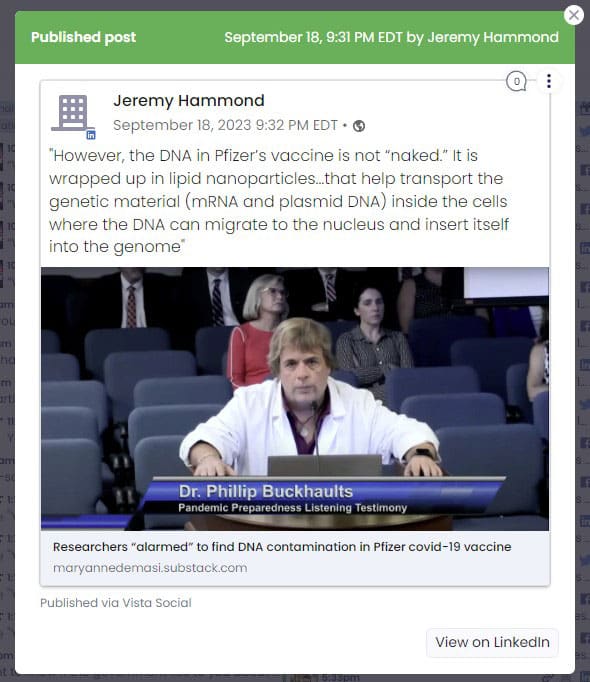
‘Post Removed for Misinformation’
That post, as I’m writing this, is still up on Facebook and on Twitter. However, at 12:50 p.m. on September 22, I received an email from LinkedIn saying that there is “A problem with your post”. It goes on to say:
Your post doesn’t comply with our Professional Community Policies. It’s been removed from LinkedIn and only you can access it.
Please visit the notice page below for additional details and resources.
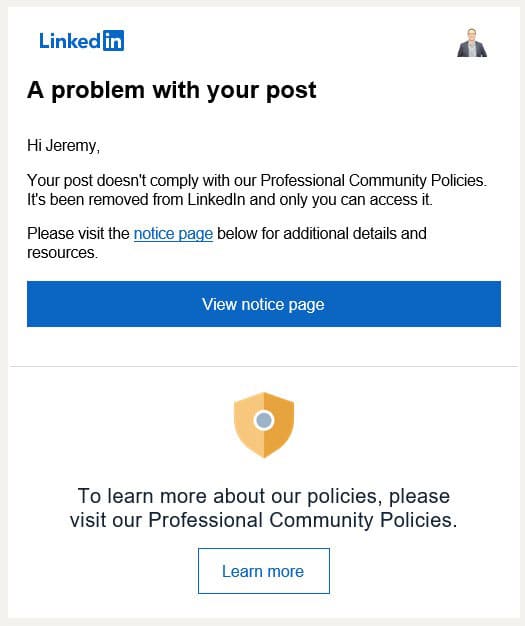
The email provided a link to a page stating:
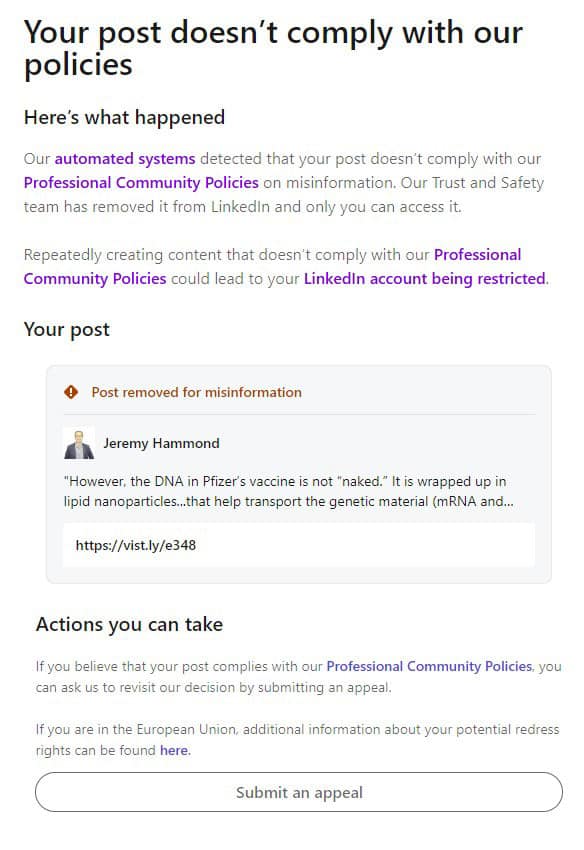
Your post doesn’t comply with our policies
Here’s what happened
Our automated systems detected that your post doesn’t comply with our Professional Community Policies on misinformation. Our Trust and Safety team has removed it from LinkedIn and only you can access it.
Repeatedly creating content that doesn’t comply with our Professional Community Policies could lead to your LinkedIn account being restricted.
It then shows me that the post it is referring to is the one in which I shared Demasi’s article, and it further states:
Actions you can take
If you believe that your post complies with our Professional Community Policies, you can ask us to revisit our decision by submitting an appeal.
Then there’s a button to “Submit an appeal”.
Intrigued by the mention of “automated systems”, which I hadn’t encountered the last time I went through this process, I clicked the link to learn more. That led me to a page titled “How LinkedIn handles abusive content”. It explains that:
Artificial Intelligence (AI) plays a key role in helping LinkedIn proactively filter out potentially harmful content. LinkedIn uses content (like certain key words or images) that has previously been identified as violating its Professional Community Policies to help inform AI models and better identify and restrict similar content from being posted in the future.
LinkedIn measures its preventive defense services regularly to improve accuracy in the filtering process.
The AI censorship is described as the “First layer of protection”, with the “Second layer of protection” being a human review:
LinkedIn’s second layer of moderation detects content that’s likely to be violative but for which the algorithm is not sufficiently confident to warrant automatic removal. This content is flagged by our AI systems for further human review.
It isn’t clear to me whether my post has already gone through this “second layer of protection” involving human review or was removed due to AI only.
Another page titled “How we enforce our Professional Community Policies” states (italic emphasis added):
Violating our User Agreement and our Professional Community Policies can result in action against your account or content. Depending on the severity of the violation, we may limit the visibility of certain content, label it, or remove it entirely. When we do this, we also generally send you a notice that your content violates our policies, how your content violates our policies, and the action we’re taking. If you believe your content has been removed in error, you’ll have the opportunity to submit an appeal.
As I have learned through numerous past experiences, LinkedIn is here lying to its users. There is no meaningful and legitimate appeal process, as I will demonstrate for you by further documenting the process.
More on that later, but to further contextualize what the real problem is with my post, LinkedIn’s “Professional Community Policies” page has a section explaining that by using LinkedIn, you agree to “Be Trustworthy”. It is under this section that you can find its “misleading content policy”, which is as follows (italic emphasis added):
Do not share false or misleading content: Do not share content that is false, misleading, or intended to deceive. Do not share content to interfere with or improperly influence an election or other civic process. Do not share content that directly contradicts guidance from leading global health organizations and public health authorities; including false information about the safety or efficacy of vaccines or medical treatments. Do not share content or endorse someone or something in exchange for personal benefit (including personal or family relationships, monetary payment, free products or services, or other value), unless you have included a clear and conspicuous notice of the personal benefit you receive and have otherwise complied with our Advertising Policies.
Learn more about our false or misleading content policy.
Thus, LinkedIn effectively defines “misinformation” as any information, regardless of factual accuracy, that doesn’t align with policies and claims from “leading global health organizations and public health authorities”, such as the World Health Organization (WHO) and US Centers for Disease Control and Prevention (CDC).
But while LinkedIn treats the WHO and CDC as infallible institutions, trustworthy arbiters of truth that disseminate nothing but good information, we have all seen for ourselves how “public health” authorities have been the top spreaders of misinformation and disinformation about COVID‑19 and vaccines.
To cite one of the most obvious examples, the COVID‑19 vaccines were sold to the public based on the lie that two doses would confer durable sterilizing immunity that would end the pandemic by stopping infection and transmission of SARS‑CoV‑2.
My chief sin cited previously by LinkedIn to justify banning me altogether was that I had tried numerous times to share an article I’d written titled “The CDC Finally Admits That Natural Immunity to SARS-CoV-2 Is Superior to the Immunity Induced by COVID-19 Vaccines”.
In that article, which I published on February 10, 2022, I explained how the CDC’s August 2021 claim that the mRNA COVID‑19 vaccines confer immunity that is superior to that conferred by infection was contradicted by virtually all the non-CDC-originating scientific literature and was later falsified by its own data as reported by its own researchers in its own MMWR journal.
The fact that I was literally citing the CDC and quoting the CDC’s own researchers—who admitted that natural immunity provided superior protection compared to being “fully vaccinated”—didn’t stop LinkedIn from repeatedly blocking my posts and ultimately suspending my account.
Another link from the community guidelines page leads to a page with more information about “False or misleading content”. It states:
It is a violation of LinkedIn’s Professional Community Policies to post false or misleading content. We remove specific claims, presented as fact, that are demonstrably false or substantially misleading and likely to cause harm.
Prohibited content includes (emphasis added):
- Content that promotes harmful remedies or miracle cures, or otherwise discourages individuals from seeking or heeding professional medical advice
- Claims or statements that directly contradict medical guidance from local health authorities or the World Health Organization (WHO)
Evidently, since it is the advice of the CDC for everyone to get vaccinated, LinkedIn’s “fact checking” process determines that if you share true information that might lead someone to the conclusion that getting a COVID‑19 vaccine is not right for them, then you are guilty of spreading “false or misleading content”—LinkedIn’s euphemism for facts that the “public health authorities” don’t want you to know.
What ‘Misinformation’ Did My Post Contain?
Now that you’ve seen how LinkedIn removed my post “for misinformation” even though Demasi’s article simply reported how an expert who confirmed that COVID‑19 vaccines are contaminated with DNA from the manufacturing process testified about why this is a problem to a South Carolina Senate committee, and even though I merely quoted an excerpt from the article accurately explaining that the mRNA and DNA in the vaccine is encapsulated in a lipid nanoparticle that enables the genetic material to get inside the cells.
That’s hardly controversial. It is the purpose of the lipid nanoparticle, without which the mRNA that is intended to get into the cells would be rapidly broken down. Once in the cells, the mRNA instructs the cells to produce the SARS‑CoV‑2 spike protein. This is how the vaccines are designed to work. But the DNA, which unlike the mRNA can potentially enter the cell nucleus and become integrated into human DNA, isn’t supposed to be there.
So, obviously, LinkedIn’s AI made a mistake, right?
We can reasonably speculate that LinkedIn’s AI thought that my post was claiming that the mRNA in COVID‑19 might enter the nucleus and integrate into human DNA, which the government and the media’s “fact checkers” from the start have claimed is biologically impossible.
As it so happens, the claim that this is theoretically impossible is itself an example of official disinformation. The CDC’s argument, for example, is that since the mRNA doesn’t enter the cell’s nucleus, where the DNA resides, it cannot possibly be integrated into host DNA.
However, that is a non sequitur fallacy. The CDC’s conclusion does not follow from the premise since there is a process called “reverse transcription” whereby mRNA can be converted into DNA, which can then potentially enter the cell’s nucleus, where it can then potentially integrate into host DNA.
Scientists have actually demonstrated reverse transcription of vaccine mRNA into DNA in human liver cells. While they did not go further to determine whether the DNA then entered the cell nucleus to integrate with cellular DNA, and they used more ideal conditions for reverse transcription to occur in the lab than would be typical in the living body, the study did highlight the fallacy underlying the CDC’s reasoning.
Additionally, the CDC has falsely claimed that the vaccine mRNA and spike protein are rapidly eliminated from the body. In October 2021, the CDC’s “Understanding mRNA COVID-19 Vaccines” webpage stated that the mRNA is eliminated “within a few days”, and the spike protein within “a few weeks.”
Notably, the CDC has since removed its claim that the spike protein is eliminated within a few weeks, although it continues to misinform that the mRNA is eliminated immediately after instructing the cells to produce the spike protein.
In fact, studies have shown persistence of both mRNA and spike protein for months. A study published in Proteomics Clinical Applications in August 2023 found persistence of spike protein in the blood of people who received mRNA COVID‑19 vaccines at a time point of six months after vaccination.
The authors proposed three hypotheses to explain this persistence of spike. One they deemed highly unlikely. The remaining two both involved integration of vaccine mRNA into host DNA—either into human cellular DNA or into bacteria that reside in the human body.
While LinkedIn and other social media companies rely on CDC information to determine whether its users are spreading “misinformation” about COVID‑19 vaccines, the reality is that there is no greater purveyor of vaccine misinformation than the CDC.
But setting aside what we know from the scientific literature and taking the CDC at its word, we can reasonably assume that LinkedIn’s AI mistook me for incorrectly claiming that the vaccine mRNA directly enters the cell nucleus and integrates into human DNA.
So, all I need to do is to use LinkedIn’s appeal process to explain how its AI got it wrong, and then LinkedIn will reinstate my post, right?
As I’m writing this paragraph, I haven’t yet done so. I’m about to. And based on my past experiences, I anticipate that LinkedIn will persist in its false claim that my post contained misinformation because, while LinkedIn promises users an “appeal” process, in fact, there is no legitimate appeal process available to its users.
Here we go . . .
Submitting an ‘Appeal’
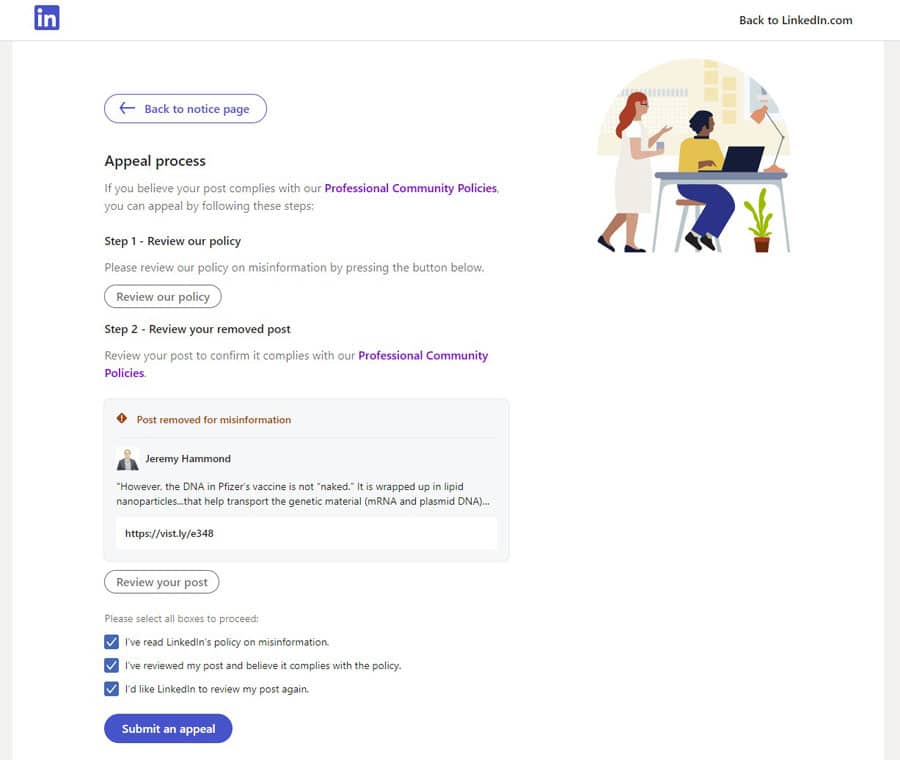
I clicked on the “Submit an appeal” button. It takes me to a page asking me to review the Professional Community Policies, which I’ve already done. But to proceed, I clicked on the “Review our policy” button, which took me directly to the “misleading content policy” section of the community guidelines.
The “Appeal process” page also asks me to review my post “to confirm it complies” with the guidelines, which I’ve also already done. Yes, I confirm that my post contains no misinformation! My post accurately reports how an expert scientist has verified DNA contamination in mRNA COVID‑19 vaccines and testified to a state senate committee about the risks this poses to human health.
I clicked the “Review your post” button. Here is how my removed post appears to me, with a message from LinkedIn letting me know that others cannot see it:
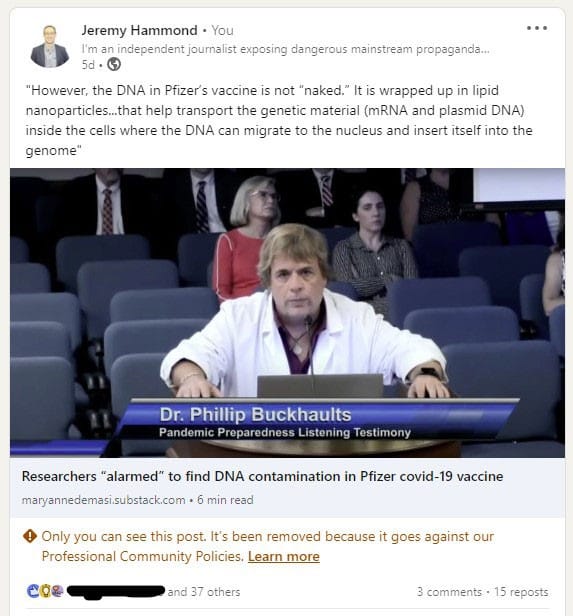
Coming back to the “Appeal process” page, I am required to select three checkboxes:
- “I’ve read LinkedIn’s policy on misinformation.”
- “I’ve reviewed my post and believe it complies with the policy.”
- “I’d like LinkedIn to review my post again.”
Until I check all three of those boxes, the “Submit an appeal” button appears grayed out and is unclickable. Once checked, I can proceed.
After clicking the “Submit an appeal” button, I’m taken immediately to a page that says, “We received your appeal”.
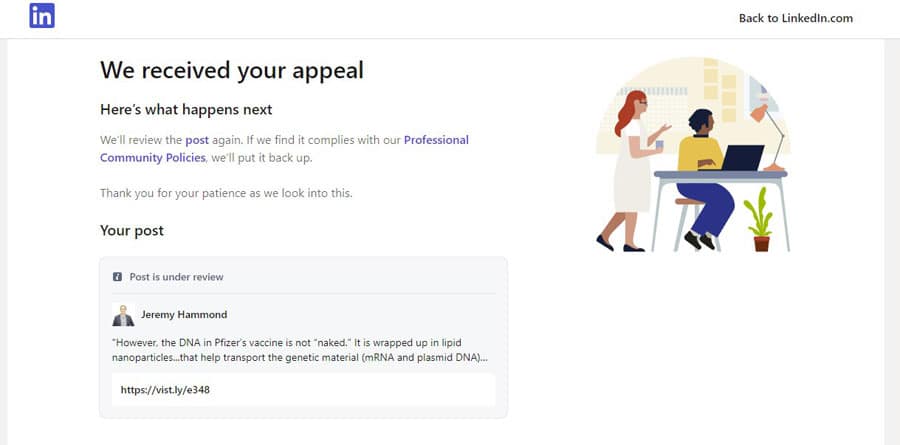
That was it. When LinkedIn accuses you of spreading “misinformation” and you “appeal” their decision, it doesn’t mean you get a chance to be told by LinkedIn what information it is claiming to be “false or misleading”, much less that you get a chance to explain to LinkedIn how they got it wrong.
Now all I can do is wait . . .
LinkedIn’s Response to My ‘Appeal’
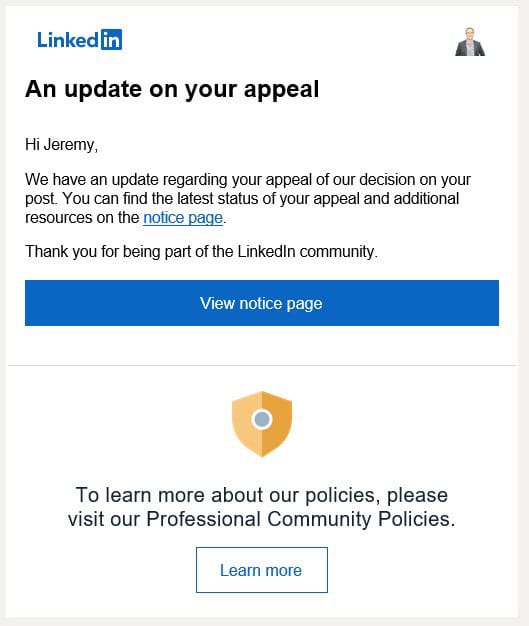
Okay, as I anticipated, LinkedIn’s response was to maintain its position that my post contains “misinformation”. On the morning of September 25, I received an email providing “An update on your appeal”. It links to a “notice page”.
Clicking that link brings me to a page saying, “We reviewed your post again”. The outcome is that LinkedIn “found it doesn’t comply with our policy on misinformation”. This is a “fair and consistent” application of LinkedIn’s policy, the page ludicrously asserts.
Of course, it is hardly fair of LinkedIn to falsely accuse me and then deny me a meaningful opportunity to explain to them why they are wrong, but it is at least consistent with my past experiences of being censored by LinkedIn for sharing true information that doesn’t align with the CDC’s policy goal of achieving high vaccine uptake.
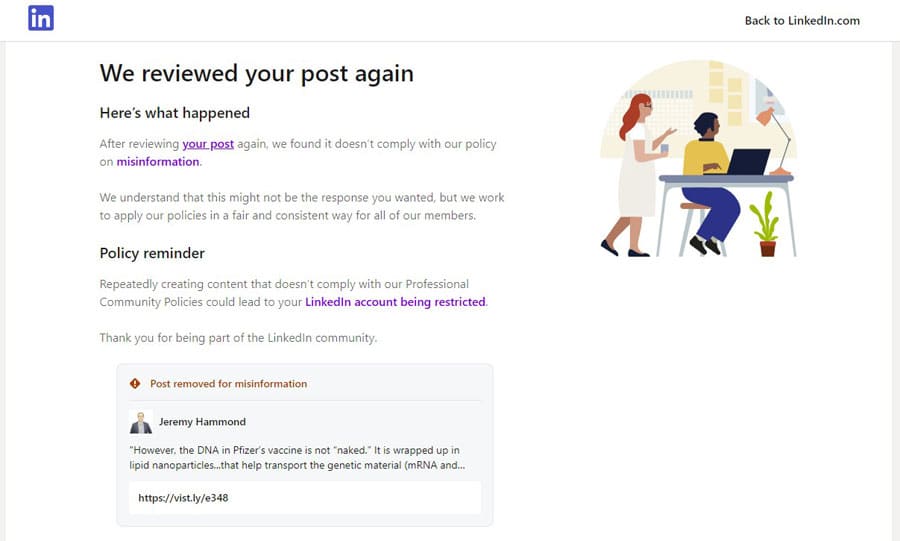
The page also warns me
Repeatedly creating content that doesn’t comply with our Professional Community Policies could lead to your LinkedIn account being restricted.
I don’t agree that my post violates the community guidelines because it doesn’t contain any misinformation, and I’m left to conclude once again that LinkedIn interprets its own guidelines as prohibiting factually accurate information that goes against CDC policy or corrects CDC disinformation.
Clicking the link for more information about account restriction, there’s nothing helpful on the page, but there is a “Contact us” link, so I clicked that and am presented with an option to “Create a support ticket”.
This is new to me. In prior attempts to combat LinkedIn’s efforts to combat true information, my “appeals” automatically resulted in a “case” being opened where I could message back and forth with a LinkedIn staff member, who in every instance refused to reason with me.
Invariably, when I would request the LinkedIn representative to specify what information was contained in my post that LinkedIn was claiming to be false or misleading, they would refuse.
Also, when I previously asked LinkedIn whether its Professional Community Policies prohibit me from sharing factually accurate information that doesn’t align with claims from “public health authorities”, the response I got was that
LinkedIn does not provide interpretations of the User Agreement and Professional Community Policies.
Ludicrously, I was also told,
We do not provide an interpretation and/or break down of the violative content. If you need to obtain assistance on how your content violated LinkedIn's Terms of Service, we would advise you to contact a legal counsel.
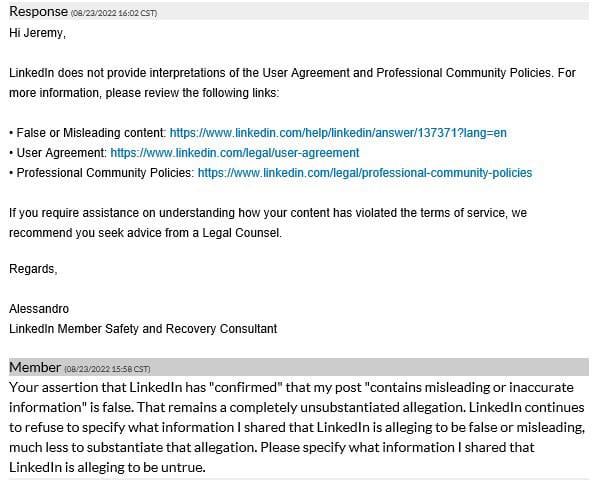
Logically, only LinkedIn can possibly explain to me why LinkedIn removed my post. No outside party has that knowledge.
So, you can see how LinkedIn previously denied me any kind of meaningful and legitimate appeal process, contrary to the promise it makes under its User Agreement to provide an appeal process in the event of a post removal or account suspension.
I have no hopes that my experience will be any different this time around, but I’m going to go ahead and create a ticket. I click the link and am presented with a few default options about what I need help with, none of which are applicable, so I’m selecting select “Other”. That opens up a text field where I can specify what I need help with, so I’m entering “LinkedIn censoring true information”.
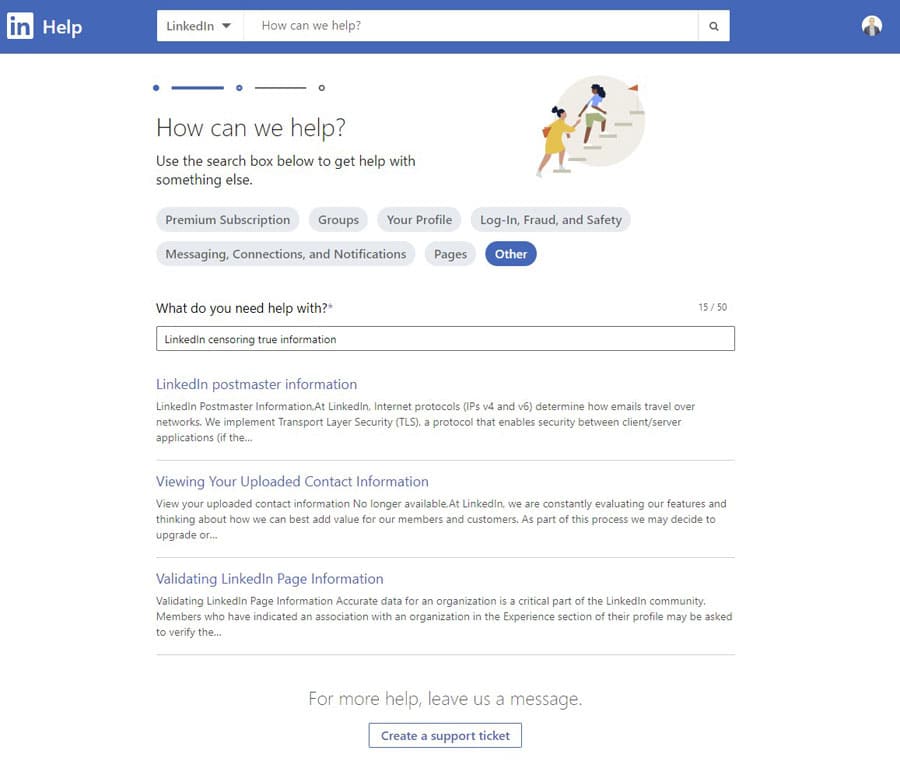
Clicking the button to “Create a support ticket” opens a form with more options. Under an “Issue Type” drop-down menu, the most applicable option I see is “Restrictions”, so I select that. Then there’s a text field prompting me to type my “Question”.
Here’s what I’m entering:
LinkedIn has removed a post of mine with the accusation that it contains “misinformation”. However, this is incorrect. My post does not contain any information that is false or misleading. My post contains factually accurate reporting on a matter of vital importance to the public interest. LinkedIn claims to offer me an “appeal” process, but I completed that process without LinkedIn ever specifying what information contained in my post LinkedIn is claiming to be false or misleading, much less giving me an opportunity to explain why the information in my post is true. The result is that LinkedIn insists that my post violates the Professional Community Policies.
This decision is incorrect unless LinkedIn interprets its Professional Community Policies to prohibit me from sharing factually accurate information that does not align with public relations messaging or claims from “public health authorities” like the US Centers for Disease Control and Prevention (CDC), which has routinely spread misinformation throughout the COVID-19 pandemic. I do not agree with that interpretation of the Professional Community Policies since it results in the absurd self-contradictory situation where true information is deemed “misinformation”.
By removing my post on a false pretext and denying me a legitimate appeal process, LinkedIn is violating its User Agreement with me. Under the User Agreement, LinkedIn agrees to “honor the choices you make about who gets to see your information and content”, which LinkedIn is violating by blocking other users from seeing the content that I want them to see.
Under the User Agreement, LinkedIn also promises, “We agree to provide you notice and an explanation if we believe your content violates our Contract and will provide you an opportunity to get a further review.” By maintaining its removal of my post without providing me with an explanation of how and why LinkedIn believes it to violate the Professional Community Policies and therefore without giving me an opportunity to appeal the basis for the removal decision, LinkedIn is violating its User Agreement with me.
LinkedIn is obligated to either (a) specify what information contained within my post it is claiming to be false or misleading and provide me with an opportunity to meaningfully respond to that accusation or (b) reinstate my post so that others whom I want to see the content can see it, in accordance with the User Agreement. Please comply with the User Agreement.
After clicking the “Submit” button, I’m taken to a page saying, “Thanks for contacting us”. It says my “question” was “successfully submitted” and that LinkedIn will get back to me as soon as it can. There are button options to return to the “Help home” or “View your case”, so I click to view the case.
This takes me to the help ticket system I’ve encountered previously, where trying to communicate with a LinkedIn staff member resulted in LinkedIn maintaining its position that removed posts of mine contained “misinformation” while refusing to tell me what information it was in the post that LinkedIn was claiming to be false or misleading and therefore also denying me an opportunity to meaningfully contest LinkedIn’s accusation.
At the time I am publishing this, I have not received a reply to my support request to have my factually accurate post reinstated.
I’ll provide an update if that effort goes anywhere. In the meantime, I’m stuck concluding that LinkedIn’s “fact checking” is a scam that results in the company systematically violating its own User Agreement by removing posts and suspending accounts for the offense of sharing facts that counter the government’s official disinformation.
Maryanne Damasi has since published an exclusive interview with Dr. Buckhaults, which you can read here—if you manage to have arrived here despite the ongoing regime of authoritarianism, propaganda, and censorship.

What Dr. Buckhaults has found is exactly why Yuval Noah Harari says, “humans are hackable animals.” IMO, he knew this information before Dr. Buckhaults did _because somebody told it to him_.
I “triage” my donation requests. When I knew your monthly fund-raising goals and your progress toward reaching them, I donated several times, based my belief that my donation would be both affordable and effective. Now that I don’t know those things, I am unable to apply triage and thus unable to donate.
Hi Harvey,
Thank you very much for that feedback. I wasn’t sure whether providing my fundraising goals and progress was useful to either me or my readers, so it’s very helpful to me to be informed of your own perspective. It’s encouraged me to return to that practice.