


On September 17, The Defender, a publication of Children's Health Defense (CHD), published an article I wrote about how the FDA's limit on the amount of aluminum adjuvant allowed in vaccines was based not on safety data but instead on immunogenicity data—to assure that the amount was sufficient to produce the desired immunologic effect.
Adjuvants are used in vaccines to produce a more inflammatory immune response and downstream production of antibodies.
The article was published under the headline "FDA’s Allowable Level of Aluminum in Vaccines Based on Decades-Old Tests — but the Tests Had Nothing to Do With Safety". I republished it on my own site according to CHD's terms and shared it to social media.
LinkedIn didn't like that.
I received an email saying that my post had been removed for "misinformation". Here is the exact same post shared to Facebook:
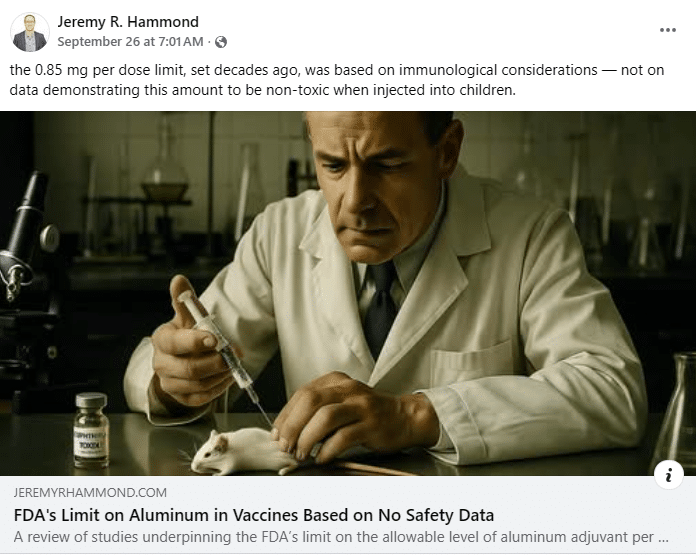
The title shows as "FDA's Limit on Aluminum in Vaccines Based on No Safety Data" because the title CHD gave it was too long and would get cut off when shared to social (or in web search results), so I used this shorter version for the title in the meta data for search engine optimization (SEO) purposes, which also determines the title that social media platforms will pull along with the meta description and featured image.
Both versions of the headline are accurate. When the 0.85 mg per dose limit was set by the NIH back in 1968, the key consideration was that, "In all instances, the amount of aluminum used shall be the minimum needed to accomplish the purpose intended."
There were no toxicological data supporting that it would be safe to inject children with amounts of aluminum up to that limit.
When regulatory authority for vaccines was transferred in 1972 to the FDA, the limit was kept, unquestioned.
If LinkedIn were to program it's AI to check the veracity of claims or just assign a human to look at it, they could see that my post contains true and accurate information. The article is mostly about a paper published recently in a peer-reviewed journal whose authors obtained the foundational documents via FOIA request.
I obtained the documents from the authors, and CHD published them along with my article. The first was from 1947 and related to the manufacture of the diphtheria toxoid, and the second was from 1952 and related to tetanus toxoid.
Those are the primary source documents that NIH used to set the limit still used by the FDA today. I welcome you to read those documents for yourself and see how the limit was set based on immunological and not safety considerations.
As I wrote, "The only safety references were requirements for the respective toxoid to be tested on mice and guinea pigs, at least two animals of each species, with at least one week of follow-up observation for immediately obvious symptoms or death, plus a 'detoxification' test involving 'at least 4 animals' observed for one month."
Again, there was no toxicological evaluation of the aluminum adjuvant—only a brief period of observation of a few lab animals to make sure they didn't die or develop immediately obvious symptoms of poisoning from the toxoid injection.
That's not an evaluation of the safety of injecting aluminum adjuvants into infants and children. There was no safety data to show that up to 0.85 mg of aluminum per dose would be non-toxic to humans.
If Linkedin wished to challenge me on that, it could produce the toxicological data it is implicitly claiming existed to support that amount as a safety limit—but of course LinkedIn won't do that.
It can't, for the obvious reason.
My article also quotes Dr. Norman Baylor, former Director of the Office of Vaccines Research and Review at the FDA, admitting in the journal Vaccine in 2002 that the 0.85 mg per dose limit “was selected empirically from data that demonstrated that this amount of aluminum enhanced the antigenicity and effectiveness of the vaccine.”
Note the period at the end of that sentence, which is Baylor's, not mine.
It was based on immunogenicity data. Period.
Baylor went on to explain that too much aluminum can be counterproductive strictly for immunological considerations:
Excessive amounts of aluminum compounds may suppress immunity by covering the antigen completely with mineral compounds or the aluminum compounds may be cytotoxic to macrophages.
Baylor and his coauthors went on to proclaim that aluminum adjuvants are safe but without citing any toxicological studies to support that assertion. Rather, they merely claimed that "vaccines using aluminum adjuvants have a demonstrated safety profile of more than six decades."
But what that really means is that aluminum adjuvants had been used in vaccines for more than six decades (more than eight decades now) with federal regulators presuming this to be safe—and refusing to do the studies required to make that determination because, hey, if there aren't studies showing how harmful it is, you can call it harmless!
As Dr. James Lyons-Weiler and Robert Ricketson noted in a 2018 reassessment of the available data, "The dosing of aluminum in vaccines is based on the production of antibody titers, not safety science."
They add, "At the current time, there are no known or published studies specifically defining levels of Al in any vaccine product based on safety studies of Al."
That study concluded,
Our calculations show that the levels of aluminum suggested by the currently used limits place infants at risk of acute, repeated, and possibly chronic exposures of toxic levels of aluminum in modern vaccine schedules
A 2017 study Masson et al. reviewed the studies used by the FDA and CDC to support the claim of aluminum safety and likewise noted that the 0.85 mg per dose limit was "based on results showing a good adjuvant effect at this concentration".
The authors observed,
To date, aluminum adjuvants per se have, perhaps surprisingly, not been the subject of any official experimental investigation, and this being in spite of the well-established neurotoxicity of aluminum.
The first study examined was by Priest et al. in 1995, which was basically irrelevant to the question of vaccine safety. A single adult received an intravenous dose of a soluble form of aluminum. About 85% of the aluminum in the blood was excreted within two weeks, but elimination slowed, and around 4% of the aluminum remained in the body after 3 years. A follow up study reported results in six other adults, each with varying rates of retention.
Masson et al. noted the key takeaway:
Multiple environmental exposures will thus favor the progressive accumulation of aluminum in the body during the life of an individual.
So, no, not "safe". Moreover, these preliminary studies were essentially irrelevant to the CDC's childhood vaccine schedule:
It is essential to take into account that in these preliminary toxicokinetic studies, neither the form of aluminum (soluble) nor the route of administration (IV) corresponded to the vaccine situation, where aluminum is subcutaneously (SC) or intramuscularly (IM) injected in nano/microparticle form. The point is crucial: the dynamics of Al adjuvants have very little relevance to any ‘normal’ exposure to Al in everyday life, and injection of Al citrate into the blood doesn't really tell you much at all about normal chronic exposure to Al via any route and including vaccination.
Flarend et al. in a 1997 study injected a few rabbits with two aluminum salts resembling those used in vaccines, but the rabbits were only monitored for 28 days, after which only a small percentage of the aluminum had been excreted in the urine, which Masson et al. remarked was "incompatible" with the claim of "rapid elimination" of aluminum from vaccines. Moreover, Flarend et al. ignored the uptake of aluminum particles by immune cells and transportation into tissues and organs, including the brain.
Keith et al. in a 2002 modeling study "estimated the accumulation in the body according to the age and weight of children" during their first year of life. But they wrongly assumed that 100% of the injected aluminum is absorbed into the bloodstream to be eliminated through urine and based their model on the toxicokinetic profile from the study by Priest et al. of soluble aluminum injected intravenously into an adult male.
Keith et al. then adopted a "minimum risk level" of 2 mg of aluminum per kilogram of body weight per day based on a study by Golub et al. in which, again, a soluble form of aluminum was administered orally to mice. Keith et al. also failed to account for the immature renal function and blood-brain barrier of human infants.
In other words, Keith et al., too, was basically irrelevant for determining the toxicokinetic profile of insoluble aluminum injected into infants.
That brings us to Mitkus et al., the key study by FDA researchers relied on today by the CDC to support its claim that injecting children with aluminum via routine vaccinations is "safe". It, too, was a modeling study that amounted to a garbage-in, garbage-out exercise.
Mitkus et al. similiarly based their model on an updated "minimum risk level" of 1 mg of aluminum per kilogram per day still based on Golub et al. and the oral ingestion of a soluble form of aluminum. As Masson et al., remark, this comparison is "nonsense".
Additionally, by that time, animal studies had already shown aluminum to be toxic at much lower levels of exposure. The level was over 17 times too high, Masson et al. point out, when taking into account the most recent study at the time.
Mitkus et al. also falsely assumed that only the amount of aluminum absorbed into the blood contributed to the body burden of aluminum toxicity, still ignoring the known uptake and transportation of aluminum particles by macrophages.
So, I reported accurately that the 0.85 mg per dose limit was set in the mid-1900s based on immunological and not safety considerations, and the only toxicological studies relied on today to support the claim of aluminum-adjuvanted vaccine safety are basically irrelevant to the CDC's childhood schedule, having been effectively retrofitted to justify the 0.85 mg/dose limit instead of seriously evaluating adjuvant safety.
To cite these junk studies as proof that aluminum-adjuvanted vaccines are "safe" ought rightly to be considered scientific fraud.
But LinkedIn doesn't care about what's true or not. It is rather concerned with helping the government and pharmaceutical industry to sustain the deception—an illusion that the limit is based on toxicological studies demonstrating aluminum up to the 0.85 mg/dose limit to be non-toxic in human infants.
The email I received notifying me of the post removal linked to a page where it warns that my account may be restricted if I continue sharing information LinkedIn doesn't like.
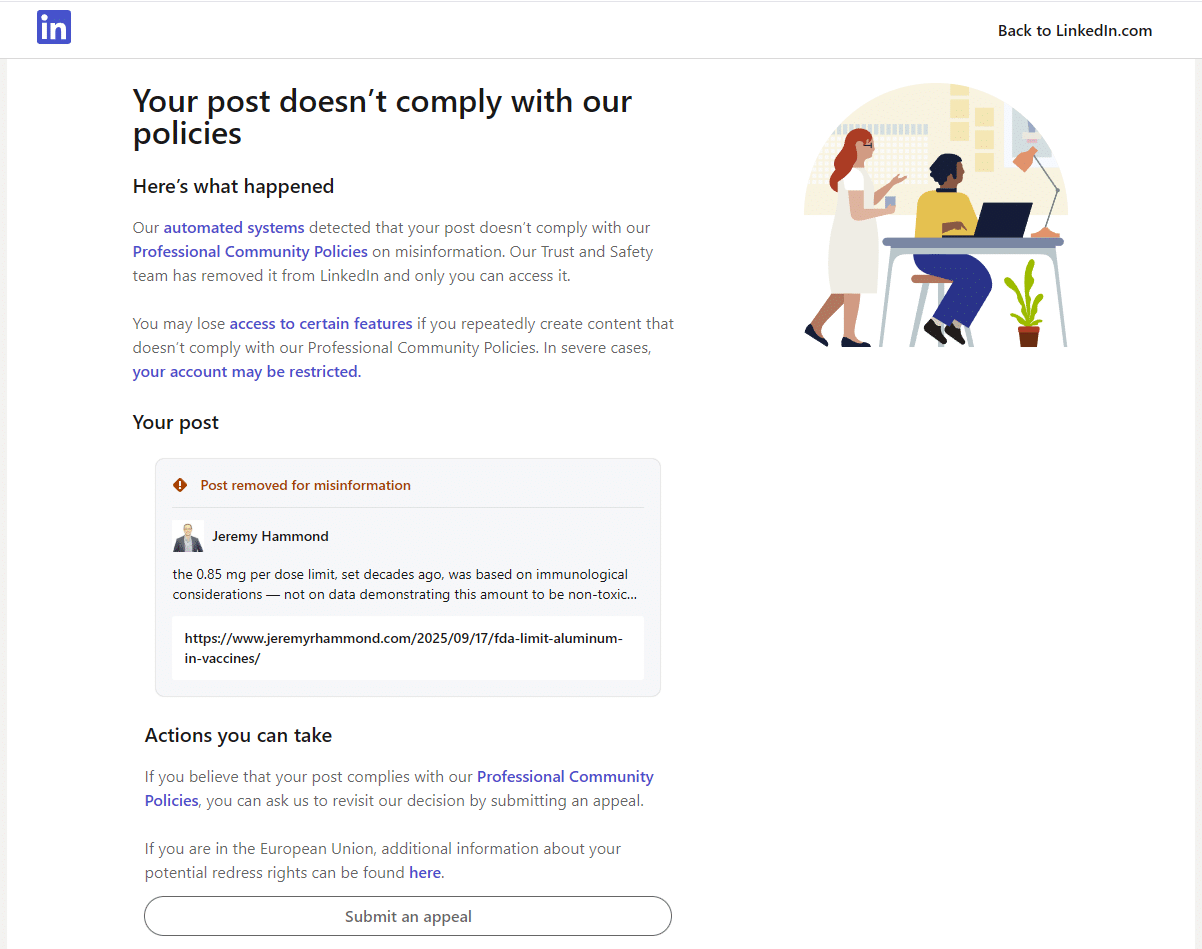
There's an "appeal" option, but it's a farce. I've been through it before.
In fact, I was previously banned by LinkedIn for accurately reporting how the CDC's August 2021 claim that COVID-19 vaccines provided protection that was superior to natural immunity was contradicted at the time by virtually all of the non-CDC-originating medical literature and subsequently falsified by the CDC's own data as reported by the agency's own researchers in its own journal.
See, if you cite the CDC lying to support the claim of vaccine safety and effectiveness, that's fine, but it is prohibited to cite the CDC's own data to show how the CDC lies.
I managed to regain access to my account after a long ordeal of trying vainly to get LinkedIn to reason with me and threatening legal action for violating their Terms of Use with me by suspending my account on the pretext of allegations that were not merely unsubstantiated but demonstrably false.
Each time I went through the "appeal" process for various censored posts, I repeatedly requested that they specify what information, specifically, they were claiming to be false or misleading, but they perpetually refused.
Consequently, they also refused to explain how they had determined that information to be false or misleading.
The basis for their accusation of "misinformation" was their Community Guidelines, which state:
Do not share content that directly contradicts guidance from leading global health organizations and public health authorities; including false information about the safety or efficacy of vaccines or medical treatments.
Note that they say "including"—but not limited to—false information.
True information is also prohibited by LinkedIn if it contradicts "public health authorities", i.e., the CDC.
Thus, journalists are forbidden by LinkedIn from reporting factually accurate information to correct government-approved disinformation about vaccines.
When I directly asked LinkedIn whether that was how it was enforcing its rules, their answer was that LinkedIn "does not provide interpretations of its Professional Community Guidelines."
Of course, the only logical reason why LinkedIn would refuse to explain the meaning of its guidelines is because it enforces them precisely as I've deduced.
Help me circumvent the censorship. Share my article "FDA’s Allowable Level of Aluminum in Vaccines Based on Decades-Old Tests — but the Tests Had Nothing to Do With Safety".

So glad I dumped LinkedIn a decade ago; wonder who owns it? One of the evils, I would guess.
Oh, look, Microsoft. (Sound of me clutching my pearls….;])
That explains so much.