

Table of Contents
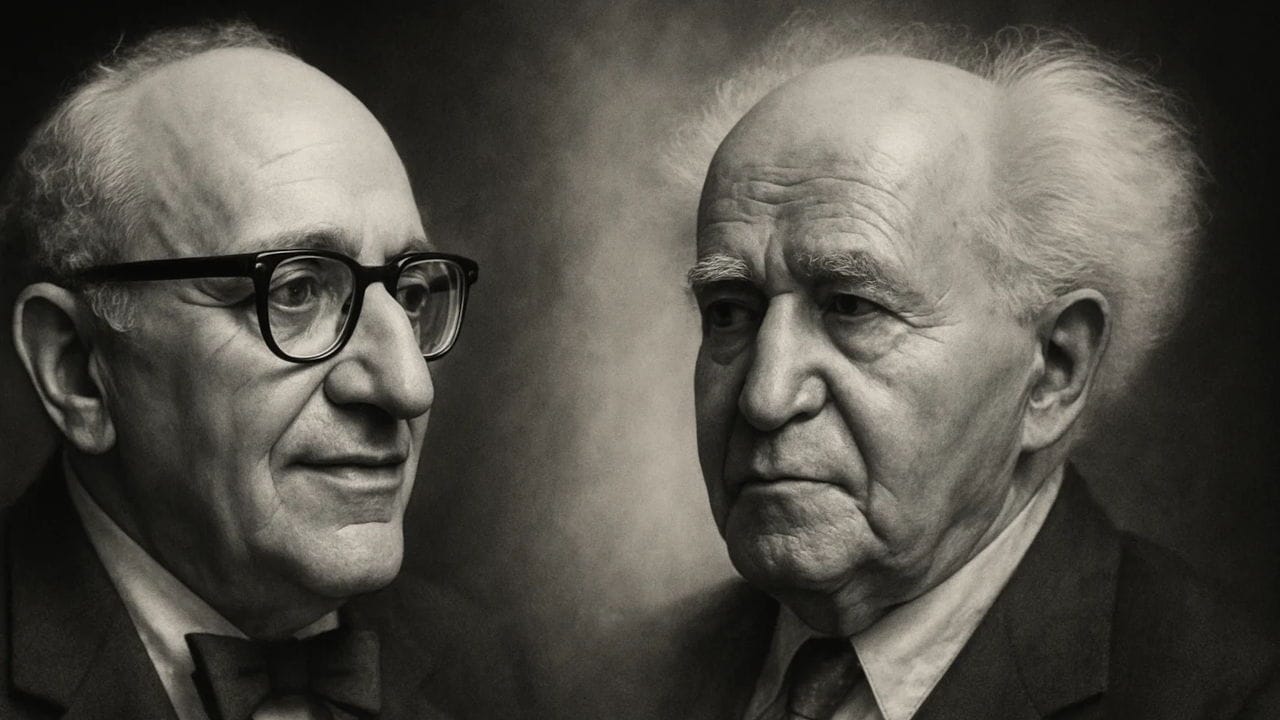
Libertarianism vs. Zionism
"The libertarian creed rests upon one central axiom: that no man or group of men may aggress against the person or property of anyone else. this may be called the 'nonaggression axiom.' 'Aggression' is defined as the initiation of the use or threat of physical violence against the person or property of anyone else. Aggression is therefore synonymous with invasion." — Murray N. Rothbard, "For a New Liberty: The Libertarian Manifesto" (1973)
"If you wish to colonize a land in which people are already living, you must provide a garrison for the land, or find a benefactor who will maintain the garrison on your behalf.... Zionism is a colonizing adventure and, therefore, it stands or falls on the question of armed forces." — Ze'ev Jabotinsky, "The Iron Law" (1925)
"Zionism sought to create a Jewish state in a land that was already inhabited by another people. Labor Zionists denied that this entailed the resort to force, while right-wing Zionists admitted it. That was the main difference between them." — Avi Shlaim, "The Iron Wall Revisited" (2012)
I have never tended to label myself a "libertarian" because the word seems to mean so many different things to so many different people. But inasmuch as I believe in the non-aggression principle, I am a libertarian. Never having previously associated myself with that word, it was Ron Paul who first brought me to that realization.
To me, the non-aggression principle is basically the Golden Rule. Everyone has a right to do whatever they please as long as they don't infringe on—or aggress against—the equal rights of others. Do unto others as you would have them do unto you. And don't do to others what you wouldn't want done to you.
It's simple.
"Zionism" is another word that means different things to different people. But I am using it to mean the modern political movement that arose in the late 1800s and culminated in the early 1900s in the settler-colonial project to reconstitute Arab Palestine into a demographically "Jewish state".
The means by which the Jewish supremacist state of Israel came into existence in 1948 was through the ethnic cleansing of Palestine by Zionist forces engaged in what Israeli historian Benny Morris has described as their "war of conquest".
Ever since, the Zionist regime has maintained itself through the use of force and oppression against the land's indigenous inhabitants, with its additional crimes against humanity including its apartheid regime and the US-backed genocide in Gaza.
Debates on the Israel-Palestine Conflict
There are people who call themselves "libertarians" who are also extreme Zionists. But this is cognitive dissonance. It is not logically possible to be both a libertarian and a Zionist.
A logical corollary of belief in the non-aggression principle is opposition to the use of force and oppression that characterizes the Zionist regime.
Conversely, to believe that the means by which Israel was established and has maintained itself as a Jewish supremacist state are legitimate is to reject the non-aggression principle.
It is simply not possible to hold both beliefs.
There are four six debates where this fundamental incompatibility between libertarianism and Zionism is highlighted that I'd like to draw your attention to, in the first three of which I participated.
(Update, November 24, 2025 — Since publishing this post, I've added two more debates to the list: Block vs. Hornberger and Block vs. Mercer.)
Farber vs. Hammond on Tom Woods Show
In 2016, Walter Block, Alan Futerman, and Rafi Faber wrote a paper arguing that the means by which Israel was created was legitimate and consistent with libertarian principles.
That paper was written as a rejoinder to the great libertarian and Austrian economist Murray Rothbard, who in 1967 wrote the paper "War Guilt in the Middle East" taking up the anti-Zionist position and rejecting the 1948 ethnic cleansing of Palestine as a legitimate means for the establishment of the state of Israel.
I was invited onto the Tom Woods Show to debate Rafi Farber about the proper libertarian position. Farber argued in favor of the resolution "Israel was founded on the basis of legitimate homesteading of land and reclamation of lost Jewish property from previous generations of Jews."
Essentially, their paper's argument was that all the land belongs to "the Jews", and therefore the Jews were justified in taking that land back to establish their state.
I explained why their position was grounded in a complete distortion of the documentary historical record, that the Zionists' settler-colonial project was backed by British guns, that the demographically "Jewish state" of Israel was in fact established by ethnically cleansing most of the Arab population from their homes in Palestine, and that to defend this aggression against the Palestinians is wholly incompatible with the central axiom of libertarianism.
To support my argument that their position is incompatible with libertarianism, I quoted from their paper and agreed with what they wrote about the proper libertarian view of property rights. I emphasized the inherent contradiction between their own explanation of how libertarians should understand land ownership and their conclusion that Israel was legitimately established according to those same principles.
You can listen to that 2016 episode here:
There was no formal winner of the debate, but you can scroll through the YouTube comments to get an idea of the general impression from Woods' audience. (It was my first debate, and I think I could have done a lot better, but I've received positive feedback about it over the years since.)
Also read more here about how Farber and I continued the debate on our respective websites and Twitter, the end result of which was that I got him to admit that they cannot prove their paper's contention that "the Jews" own all of Palestine under libertarian principles of land ownership.
That thesis of their self-contradictory paper is utterly preposterous.
Futerman vs. Hammond on Tom Woods Show
After the Hamas-led "Operation Al Aqsa Flood" attacks in Israel on October 7, 2023, and Israel's response of imposing a total siege and indiscriminately bombarding the Gaza Strip, Walter Block and Alan Futerman wrote an article in the Wall Street Journal arguing that Israel is justified doing "whatever it takes" to "completely destroy" Hamas in Gaza.
I was again invited onto the Tom Woods Show to debate that assertion with Walter Block. However, Block declined to debate me and deferred to Futerman, who accepted.
Futerman reiterated their Wall Stree Journal article's argument, while my counterargument boiled down to the simple observation that, no, Israel does not have a "right", much less a "moral duty", to commit war crimes in Gaza.
Watch that debate here:
Again, there was no formally declared winner, but the YouTube comments seem clearly to favor my argument. (And rewatching it a couple of years later, I feel I did a good job.)
Read a transcript of my opening argument in that debate below.
While I didn't end up debating Block in that episode, he did later participate in a debate on Tom Woods' show about the situation in Gaza, which I'll come to.
Lake vs. Hammond at Soho Forum
Evidently, my debate with Futerman was watched by Gene Epstein, director of the Soho Forum in Manhattan, which hosts Oxford-style debates on all kinds of political issues, because he soon after invited me to New York.
Gene first learned of my work from my short book Ron Paul vs. Paul Krugman: Austrian vs. Keynesian Economics in the Financial Crisis, which he wrote a very positive review about while working as economics and books editor at Barron's, calling me "a writer of rare skill" and my book a "must-read" that "can make you laugh" while conveying in fewer than 100 pages "more insight into the causes and cures of business cycles than most textbooks".
We began corresponding, which led to me writing a number of book reviews for Barron's. He was also gracious enough to read and provide feedback on the manuscript of my book Obstacle to Peace: The US Role in the Israeli-Palestinian Conflict, which led to me inviting him to write an Introduction—which he honored me by accepting. (The book also features a Foreword by former UN Special Rapporteur Richard Falk.)
Anyhow, after my debate with Futerman, he invited me to the Soho Forum to debate journalist Eli Lake about the root cause of the conflict. I accepted and argued against the resolution "The root cause of the Israeli-Palestinian conflict is the Palestinians’ rejection of Israel’s right to exist."
Watch the Soho Forum debate here:
In that one, the audience voted on the debate resolution before and after, and I was declared the winner by virtue of persuading more people to my position than Lake did to his.
Read a transcript of my opening and closing arguments in that debate below.
The fourth debate I did not participate in, but after watching it, I wrote a detailed review of the opposing arguments, supplementing the information with additional details and arguments of my own.
Block vs. Smith on Tom Woods Show
In August 2024, Tom Woods hosted another debate on his show about the Israel-Palestine conflict, this time with Walter Block arguing in favor of the resolution that "The proper libertarian position is to support Israel in its war with Hamas."
I'd have argued against that resolution if invited, but this time the debate was between Block and a far more prominent libertarian, Dave Smith.
Watch that debate here:
Watching that debate compelled me to write a detailed destruction of Block's arguments titled "Walter Block Is a Zionist Extremist, not a Libertarian".
To summarize my argument in that article, it is simply not logically possible to be both a libertarian and a Zionist extremist defending Israel's genocide.
I deconstruct Block's arguments, covering major historical episodes including the Mandate, the 1948 War and ethnic cleansing, the 1967 War and occupation, and the US-led so-called "peace process".
Read the whole article here:
Block vs. Hornberger on Tom Woods Show
In an episode released on September 25, 2025, Tom Woods had on Walter Block again to debate Israel's assault on Gaza, this time to debate Jacob Hornberger of the Future of Freedom Foundation.
Hornberger confronts Block's bloodthirsty lunacy and rightly explains how his support for Israel's genocide is incompatible with libertarianism.
Block vs. Mercer on Tom Woods Show
In an episode released on November 18, 2025, Tom Woods had Block on again, this time to oppose views with author Ilana Mercer, who is Jewish and grew up in Israel until fleeing the state at age nineteen, refusing to compulsory service in its miltary, the Israel Defense Forces (IDF).
Block denies that Israel has committed genocide while claiming Hamas did on 10/7. To sustain the latter claim, he says "genocide" doesn't mean killing all Israelis, just "significant" numbers of them. But then later, he argues that Israel's killing of significant numbers of Palestinians isn't a genocide because of Israel wanted to conduct genocide "and kill all of them", it would have just done so. Again later he repeats his own self-contradiction, saying, "If IDF wanted to exterminate all the Palestinians and have genocide," then it could have done so.
Block throughout remains oblivious to his own anti-intellectual hypocrisy of defining "genocide" one way if Jews are the victims of violence but another way when Palestinians are the victims.
To deny Israel's idiscriminate bombing, Block claims that the ratio of civilian to combatant deaths in Gaza is far lower than a claimed average ratio for all wars of 9 to 1. But the 9:1 claim isn't true. It's a myth. When confronted by Mercer about repeating Israeli propaganda and citing a "made up" ratio, Block's pathetic response was that he'd looked it up in Google and AI and "all the usual sources".
Mercer mercilessly destroys Block's argument by citing actual statistics and showing how, by his own logic of a civilian to soldier death ratio, if what Hamas did on 10/7 qualifies as genocide, then all the more so does Israel's assault on Gaza.
Block throughout falls back on his claim that the only reason so many civilians are killed by the IDF is because Hamas uses civilians as "human shields". As in his other debates, he uses little dolls or other figures to say, look, I'm Hamas and have these babies strapped to my chest, and I'm coming to kill you, so what do you do? You are within your right to self defense to shoot me through the babies, and their death isn't your fault, it's my fault for trying to kill you.
This idiocy bears no relationship to the reality on the ground in Gaza, where from the start Israel's attacks are characterized by deliberate use of disproportionate force, with systematic targeting of civilian infrastrucure, including the health care system, and indiscriminate massacres of civilians.
Among other devastating rebuttals to Block's bloodthirsty defense of mass murder, Mercer responds to Block's argument that if Israel had wanted to commit genocide, then it could have just leveled Gaza, by noting that Israel has leveled Gaza. "Israel has inverted the standards of morality," she says. "We have to bring it back to the axiom of non-aggression. These are gross violations of every system of ethics known to man."
Appendix
The following are my opening argument in the debate with Alan Futerman and my opening and closing arguments in the Soho Forum debate with Eli Lake.
October 2023 Debate with Alan Futerman
Opening Argument
Introduction
Alan and I agree that there can be no possible justification for the horrific atrocities committed by Hamas terrorists against Israeli civilians on October 7, nor for indiscriminate rocket attacks launched from Gaza at Israel.
However, Alan would have us believe that Israel’s violence against Palestinian civilians is justified, and to support that conclusion, he claims that the root cause of the conflict is inherent Arab hatred of Jews.
The implicit assumption of that argument is that Palestinians have no legitimate grievances against Israel.
To support that assumption, in his WSJ article, Alan cites the Hebron massacre of 1929, which occurred during the Mandate period, and by looking at his own example, we can see that this assumption is false.
The root cause of the conflict is not Arab anti-Semitism but rather the rejection by the Zionists and their Western supporters of the Palestinian’s right to self-determination.
In 1917, Great Britain pledged support for the Zionist project to establish a Jewish state in the place of Palestine while at the same time contradictorily promising support for Arab independence from Ottoman rule.
After WWI, Britain enforced a belligerent occupation aimed at preventing the inhabitants of Palestine from exercising self-determination until the Jewish population, through mass immigration, became the majority.
The Arab Palestinians were well aware of how their rights were being prejudiced under the Mandate.
As acknowledged by the British government, it was that awareness among the Arab population that was the major cause of increasing Arab animosity toward Jews.
After each of the major outbreaks of violence in 1920, 1921, and 1929, Britain investigated the root causes, and in each instance, it determined that the underlying cause was not Arab anti-Semitism but the knowledge among Palestinians that the Zionist leadership aimed to subject them and ultimately to expel them from their land.
The Palestinians’ legitimate historical grievances include the Zionists’ ethnic cleansing of most of the Arab population from their homes in 1948, which was how the “Jewish state” of Israel came into existence.
Any serious analysis of the causes and solutions for the current horrific round of violence must take into consideration the legitimate historical grievances of the Palestinian people.
1967 War
To quickly touch on the 1967 war, the war started on the morning of June 5 when Israel launched a surprise attack on Egypt, destroying the Egyptian air force while its planes were still on the ground.
During the war, Israel invaded and occupied the Palestinian territories of Gaza and the West Bank, including East Jerusalem.
Around 300,000 Palestinians were expelled from those territories during the war, which is what the Arabs describe as Al Naksa, or “The Setback”.
The CIA accurately had predicted that if war broke out, it would be started by Israel, and that due to its overwhelming military superiority, Israel would defeat the combined Arab armies within a week or two.
This is what Israelis call the “Six Day War”.
In November 1967, the UN Security Council passed Resolution 242, which emphasized the principle of international law that the acquisition of territory by war is inadmissible and therefore that Israel was required to fully withdraw to the pre-June 1967 lines (also known as the 1949 armistice lines or the “Green Line” for the color with which it was drawn on the map.)
Resolution 242 serves as the legal basis for what is known as the “two-state solution”, which is not to be confused with what either Israel or the US have advocated under the US-led so-called “peace process”.
As I document in meticulous detail in my book Obstacle to Peace, the whole purpose of the so-called “peace process” was to block implementation of the two-state solution.
Hamas’s Rise
Coming to more recent history, Alan argues that Israel withdrew from Gaza in 2005 “so that Palestinian Arabs could begin building their own state”, but “They instead chose Hamas.”
In fact, the purpose of the Gaza withdrawal, in the calculation of then-Israeli Prime Minister Ariel Sharon, was that it would provide political cover for a planned expansion of Israel’s illegal settlement regime in the occupied West Bank and enable the Israeli military to shift focus from Gaza to advancing the goals of the settlement regime
Notably, today in Israel, Netanyahu is being criticized for advancing the same policy, to which critics attribute what has been called an “intelligence failure” preceding the October 7 terrorist attacks.
When Hamas was founded in 1987, Israel initially supported it as a means to undermine the PLO, whose leader Yassir Arafat had dangerously moved away from armed resistance toward international diplomacy and acceptance of the two-state solution.
Israel shifted its policy toward Hamas once it, too, started issuing statements indicating a willingness to move away from armed violence toward diplomatic engagement.
In 2004, Hamas offered a long-term truce with Israel in exchange for an end to Israel’s occupation of Gaza and the West Bank.
Israel’s response was to assassinate Hamas’s paraplegic founder, Sheikh Ahmed Yassin.
Critics of that attack included Israeli officials who observed that it served to reverse Hamas’s move toward moderation and to empower the more extreme members of the organization.
Since 2004, Hamas has repeatedly issued statements expressing its willingness to accept a Palestinian state alongside Israel along the pre-June 1967 lines, with a long-term truce to establish mutual intent and recognition, without prejudice to the internationally recognized right of Palestinian refugees from the 1948 war to return to their homeland.
This includes in 2017 Hamas’s issuance of what some media described as a “new charter” that stated that Hamas’s struggle was not against Jews because of their religion or because they are Jewish, but against the Zionist project to replace Palestine with a “Jewish state”; the document further reiterated Hamas’s acceptance of a Palestinian state along the 1967 lines, without prejudice to the rights of Palestinian refugees.
2005 Withdrawal from Gaza
Coming to Israel’s withdraw from Gaza in 2005, in February 2005, although not a party to the agreement, Hamas committed to honoring a ceasefire between Israel and Fatah, the party of Palestinian Authority president Mahmoud Abbas.
Rather than encouraging Hamas’s movement toward engagement in the political process, Israel continued to seek to isolate the group and ensure its radicalization by marginalizing the more moderate voices within its ranks.
The IDF completed its withdrawal from Gaza in mid-September 2005. No rockets were fired at Israel until September 23, when Israel launched a raid in the West Bank, killing three members of Islamic Jihad, prompting rocket fire from Islamic Jihad members in Gaza.
At the time, Hamas was holding a rally in Gaza, during which a truck exploded, and while Israel denied responsibility, Hamas joined in firing rockets.
On September 25, two days later, Hamas announced its return to honoring the ceasefire.
In January 2006, Hamas won legislative elections, defeating Fatah. The US and Israel then conspired with Fatah to overthrow the Hamas-led government, including by arming Fatah’s special forces.
Israel also responded by implementing a strict blockade of Gaza to punish the civilian population for having Hamas as their governing authority.
On June 9, 2006, Israel launched artillery into Gaza, killing Palestinians picnicking on the beach. Hamas responded with rocket fire.
The Western media — including CNN, the AP, the BBC, and the New York Times — acknowledged that Hamas had been honoring the ceasefire for 16 months.
This pattern repeated itself.
Again in 2008, for example, prior to Israel’s “Operation Cast Lead”, it was Israel that violated a ceasefire that until then was being strictly observed by Hamas.
Dahiya Doctrine
We can also look at “Operation Cast Lead” to get a better understanding of the nature of Israel’s military operations in Gaza.
When Walter and Alan write that Israel has a right to do “whatever it takes” to “completely destroy” Hamas, they are echoing Israel’s “Dahiya Doctrine”.
This was the policy the Israeli military announced it would implement for Operation Cast Lead, explained by IDF officials as the deliberate use of disproportionate force.
In other words, Israel announced in advance that it intended to commit war crimes in Gaza, which is precisely what it proceeded to do, with US support.
Israel’s indiscriminate attacks during Operation Cast Lead included attacks on residential buildings; news media offices; mosques; schools, including UN-run schools being used to shelter civilians; ambulances; mobile clinics; hospitals; UN humanitarian aid convoys; and the main UN compound where humanitarian supplies were being stored.
Israel maintained throughout that Hamas was responsible for all civilian deaths and destruction of civilian infrastructure on the grounds that Hamas was using civilians as “human shields”.
But Israel’s use of that term bears no relationship to its definition under international law.
What Israel means by “human shields” is any civilians that are killed by virtue of their being in Gaza.
Israel’s allegations were investigated by international human rights groups including Human Rights Watch and Amnesty International as well as numerous UN inquiries—including a UN fact-finding mission headed up by a self-described Zionist Jew, Richard Goldstone. There is not a single documented instance of Palestinian civilians being killed in Israeli attacks during Operation Cast Lead because they were being used at the time by Hamas to shield military targets or operations.
These investigations did document, on the other hand, the use of Palestinian civilians as human shields by Israeli soldiers.
Israel’s current military operation in Gaza has already killed more Palestinians than either the 22-day “Operation Cast Lead” or the 50-day “Operation Protective Edge” in 2014.
Apart from the devastating bombing, Israel’s total siege of the densely populated strip that has deprived Palestinians of food, water, electricity, fuel, and other essential goods is in itself a war crime.
To say that Israel has a right to do “whatever it takes” to “completely destroy” Hamas is equivalent to saying that Israel has a right to starve Palestinians to death and to engage in indiscriminate attacks including the deliberate use of disproportionate force to achieve a military objective.
I maintain the contrary position that Israel does not have a “right” much less a “moral duty” to commit war crimes in Gaza.
February 2024 Debate with Eli Lake
Opening Argument
Preface
We’re here this evening to explore the question: What is the root cause of the conflict between Israelis and Palestinians?
So, first, when I say “root cause”, what I mean is the single most fundamental grievance underlying the entire historical context from the conflict’s origin to today.
Secondly, I trust that we can all agree that expressing legitimate criticisms of Israel is not “anti-Semitic.”
It is also not “anti-Israel” to criticize government policies that harm Israelis, too, and among the most vocal critics of Israel have always been Jews.
So, to be clear, my position is simply one of being pro-humanity. The foundational premise of my argument is that Jews and Arabs have equal rights.
One of the major reasons for the persistence of the conflict is that much if not most of what people think they know about it just isn’t true.
In their book Manufacturing Consent, Edward Herman and Noam Chomsky showed how the US mainstream media serve the propaganda function of manipulating public opinion in favor of criminal government policies.
A perfect example vivid in my own memory is how the New York Times and other mainstream media propagated the government’s lies about Iraq having “weapons of mass destruction” to manufacture consent for an illegal war of aggression.
Reporting on the Israel-Palestine conflict is no different.
Western media report through the lens of Western culture, which includes the underappreciated influence of Christian Zionism.
We hear a lot about the outside influence of the Israel lobby, but AIPAC money isn’t required to explain US policy when Congresspersons are themselves ideologically Zionist.
There’s the financial interest of the billions in annual US military aid to Israel serving as an effective subsidy to the military industrial complex.
And, of course, Western governments have supported the Zionist movement since WWI.
Consequently, most of what Americans hear about the conflict is grounded in deceitful Zionist propaganda narratives bearing little to no relationship to historical reality.
The media fulfill their usual function by manufacturing consent for the US government policy of supporting Israel’s crimes against the Palestinians—including what the International Court of Justice one month ago today judged to be a plausible genocide in Gaza.
Indeed, without US government support, Israel’s crimes against the Palestinians could not continue.
Right to Exist
We’re supposed to believe that the conflict only exists because Palestinians reject Israel’s “right to exist”, which is simply because they hate Jews.
The Palestinians are simply uncivilized and incapable of being reasoned with.
The purpose of this narrative is to dehumanize the Palestinians and to deny that they have legitimate grievances against the self-described “Jewish state”.
If we accept that Israel has a “right to exist”, then in what form? With what type of government? In what borders? And what about the right of Palestine to exist?
The truth is there is no such thing as the “right” of a state “to exist”. It’s an absurd concept. Arbitrarily defined political entities do not have rights.
Individual human beings have rights, and the sole legitimate purpose of a state government is to protect the rights of the individuals living within its legally defined territory.
The proper framework for analysis, therefore, is the equal right of all peoples to self-determination, which isan internationally recognized right codified in the UN Charter to which Israel is a party.
Israel’s “right to exist” is a propaganda term aimed at trying to reframe the discussion away from the principle of self-determination … for the obvious reason.
Certainly, the Israeli people have a “right to live in peace and security”.
But Palestinians have that equal right, whether they live in a state of their own or in the territory under Israel’s de facto control.
We hear a lot that Israel is a “democracy”. But if Israel were a democracy, it would be called “Palestine”.
It should hardly be controversial to note that Israel exists as an unashamedly Jewish supremacist state.
To illustrate, it suffices to point out that Israel’s “Jewish Nation State Law”, upheld by its Supreme Court, defines self-determination in the territory under its control as a right exclusive to Jews.
And all of the territory from the river the sea is under the de facto control of the Israeli government.
So, does Israel have a right to systematically discriminate against and oppress the Palestinians under a regime that UN agencies, Human Rights Watch, Amnesty International, and the Israeli human rights organizations Yesh Din, B’Tselem, and Gisha have all concluded amounts to the crime of apartheid?
My argument in opposition to tonight’s debate resolution is that the true root cause of the Israeli-Palestinian conflict is the rejection of the Palestinians’ fundamental human rights, including their right to self-determination.
The Ethnic Cleansing of Palestine
The rejection of the Palestinians’ right to self-determination was manifested in Great Britain’s belligerent occupation of Palestine after WWI, the very purpose of which was to facilitate the Zionist’s settler-colonial project to reconstitute Palestine into a Jewish state.
The Arabs’ proposal was for a single democratic state in which the rights of minorities were protected, but the Zionists and the British rejected that idea.
When outbreaks of Arab violence against Jews occurred in the 1920s, the British conducted inquiries and in each case determined that the root cause was not inherent anti-Semitism but the growing realization among Arabs that the Zionists aimed ultimately to subject and dispossess them.
Indeed, the British noted that Arabs and Jews had peaceful relations in Palestine before the Zionist movement.
The rejection of Palestinian self-determination was manifested in Britain’s 1937 Peel Commission proposal for a “compulsory transfer” of hundreds of thousands of Arabs to facilitate the creation of a Jewish state.
The Palestinians’ rejection of that idea was certainly not unreasonable.
The rejection of Palestinian self-determination manifested again after WWII with the partition plan endorsed by the UN General Assembly in Resolution 181 of November 1947.
At the time, according to a UN subcommittee, even within the proposed Jewish state, when not excluding the Bedouin population, Arabs were a majority and owned more land.
Yet the plan proposed that about 56% of Palestine should go to the Jews for their state.
The report of the UN committee that came up with the partition plan readily admitted that the principle of self-determination was “not applied to Palestine, obviously because of the intention to make possible the creation of the Jewish National Home there.”
The Palestinians’ rejection of this rejection of their rights was certainly not unreasonable.
The rejection of Palestinian self-determination was manifested in the ethnic cleansing of the Palestine, which is how the demographically “Jewish state” of Israel was created.
Contrary to popular myth, Resolution 181 neither partitioned Palestine nor conferred any legal authority to the Zionist leadership for their unilateral declaration of Israel’s existence on May 14, 1948.
By that time, over a quarter million Arabs had already been ethnically cleansed from their homes.
The neighboring Arab states militarily intervened to try to stop the ethnic cleansing but mostly failed. Jordan held onto the West Bank while Egypt held onto the Gaza Strip. The Zionist forces conquered territory well beyond the partition proposal, leaving the Palestinians with just 22% of their historic homeland.
By the time armistice lines were drawn in 1949, most of the Arab population had become refugees, never allowed to return despite this right being internationally recognized in UN General Assembly Resolution 194 of December 1948.
Over 400 Arab villages were literally wiped off the map so that Palestinians would have no homes to return to.
In the words of Israeli historian Benny Morris, (quote) “A Jewish state would not have come into being without the uprooting of 700,000 Palestinians. Therefore, it was necessary to uproot them.”
The rejection of Palestinian self-determination was manifested in the US government’s immediate recognition of Israel on May 14 while the Zionist forces were busy with what Benny Morris describes as their “war of conquest”.
It was manifested again in the UN’s admission of Israel as a member state in May 1949, despite the Zionist regime patently failing to meet the criteria for membership: (a) internationally recognized borders, (b) demonstration of being “peace loving”, and (c) acceptance its obligations under the UN Charter.
The Zionist leadership, Great Britain, the US, and the United Nations itself were all complicit in perpetrating a crime against humanity, and it is little wonder, therefore, that Western governments and mainstream media have attempted to whitewash this injustice from the historical record by characterizing the Palestinians as the villains instead of the powerless victims.
The “Peace Process”
The rejection of Palestinian self-determination is manifested in Israel’s oppressive occupation regime ongoing since June 1967; in Israel’s illegal settlement regime in the West Bank aimed at de facto annexation of even more Palestinian land; and in Israel’s 17-year illegal blockade of Gaza aimed at collectively punishing its civilian population.
It is manifested in the very framework of the US-led so-called “peace process”, which is the means by which Israel and its superpower benefactor have long blocked implementation of the two-state solution.
UN Security Council Resolution 242 of November 1967 required Israel to withdraw its forces to the 1949 armistice lines in accordance with the principle of international law that the acquisition of territory by war is inadmissible.
This resolution serves as the basis for the two-state solution, which is premised on the applicability of international law to the conflict, including an end to the occupation and a just resolution for the Palestinian refugee problem.
We are told that Israel and the US accept Resolution 242 as the basis for a peace agreement, but that is a deception.
What the US instead adopted is Israel’s unilateral mis-interpretation of 242, which has no legal validity.
Under the absurd alternative framework of the “peace process”, the people living under Israel’s occupation must negotiate with their oppressors over how much of their own land they can keep and maybe someday exercise some kind of limited autonomy over—while Israel continues to prejudice the outcome of said negotiations with its illegal settlement regime.
The “peace process” is premised on a rejection of international law.
This reality is instructively revealed in the prejudicial use of language by the New York Times and other mainstream media. We’re told that Israel has offered enormous “concessions”, including a willingness to “cede” land to the Palestinians. East Jerusalem is routinely described as “disputed” territory.
But all this language operates within the framework of what Israel wants, whereas the proper framework for discussion is rather what each party is legally entitled to; and under international law, all of Gaza and the West Bank, including East Jerusalem, are “Occupied Palestinian Territory.”
This rejection of international law was the operative framework at the Camp David talks in 2000. The Zionist propaganda narrative places sole blame for the failure of those negotiations on Yasser Arafat.
But the PLO had already officially accepted the two-state solution back in 1988, which was already an enormous concession by the Palestinian leadership.
And when examined in the proper framework, the truth is that all the concessions made at Camp David came from the Palestinian side, none from the Israelis; and Israel’s so-called “generous offer” consisted of demands for the Palestinians to surrender rights and cede even more of their own land to Israel.
For anyone who wants to know who the true rejectionists are, it’s a matter of public record.
Every year, the UN General Assembly votes on a resolution titled “Peaceful settlement of the question of Palestine”, which reiterates the international consensus in favor of the two-state solution.
The UN also votes annually on a short resolution that simply reaffirms “The right of the Palestinian people to self-determination”.
Every year, for both resolutions, Israel and the US defy the world by voting “No.”
Hamas
The rejection of Palestinian self-determination was manifested in the 1977 charter of Likud, the party of Israeli Prime Minister Benjamin Netanyahu, which stated that “between the Sea and the Jordan there will only be Israeli sovereignty”.
It was manifested in the map that Netanyahu held up in the UN General Assembly this past September showing no Palestinian territory, only Israel … from the river to the sea.
It was manifested in the Netanyahu government’s explicit policy of utilizing Hamas as a strategic ally to block any movement toward peace negotiations with the Palestinians.
It is precisely Israeli policies that have strengthened Hamas while undermining the PLO and its subagency the PA.
There is no possible justification for the horrific atrocities perpetrated by Hamas against Israeli civilians on October 7, and Israelis certainly have a right to national self-defense.
But Israel also has a moral and legal obligation to exercise that right in accordance with international humanitarian law, and there is likewise no possible justification for the horrific atrocities perpetrated by Israel against Palestinian civilians in Gaza.
The rejection of Palestinians’ fundamental human rights is on gruesome display with Israel’s military assault on the civilian population of Gaza for nearly 5 months now.
Israel has systematically targeted civilian infrastructure, including its education and health care systems, with the aim of rendering Gaza uninhabitable.
Over 60% of Gaza’s housing stock has been damaged or destroyed.
Northern Gaza has been turned into a moonscape.
Israel has placed Gaza under siege, denying the population access to goods and services necessary for their survival, using starvation as a method of warfare; outright famine is imminent.
Over 28,000 Palestinians have been killed by Israel’s indiscriminate bombardment, 70% of whom have been women and children; children alone account for nearly half the dead.
On December 29, the government of South Africa filed an application at the International Court of Justice accusing Israel of violating the 1948 Genocide Convention.
On January 26, the ICJ ordered Israel to comply with the Convention, ruling that South Africa has presented a plausible case that Israel is committing genocide.
And it’s been happening with the support of the US government.
Conclusion
To conclude, the demand for Palestinians to recognize Israel’s “right to exist” as a “Jewish state” is effectively an ultimatum for them to accede that the ethnic cleansing by which Israel came into existence was legitimate.
It is yet another manifestation of the rejection of the Palestinians’ fundamental human rights, including their right to self-determination. That is the root cause of the conflict. This is the historical and ongoing injustice that must be remedied for a just peace to be realized.
Existing government policies fuel the oppression and bloodshed, and the task of effecting the paradigm shift required to make it politically infeasible for those policies to be continued is up to us.
Thank you for your attention.
Closing Argument
The debate resolution that Mr. Lake has argued in favor of is that “the root cause of the conflict is the Palestinians’ rejection of Israel’s ‘right to exist’.”
But the concept of states having a “right to exist” is a logical absurdity.
Rather, there is the individual right of all human beings to life, liberty, and the pursuit of happiness; and when people work together to establish a form of government for the purpose of protecting those rights, it is known under international law as “the right to self-determination”.
States can only derive just powers from the consent of the governed, and protecting individual rights is the sole legitimate purpose of a state government.
Now, I would be willing to understand the specific wording of tonight’s debate resolution as figurative instead of literal: we could take the words about Israel having a “right to exist” to simply be a shorthand way of saying that the Jewish people have a right to self-determination, a right to form a state of their own.
And that premise would certainly accord with own position, as I explicitly stated in my opening remarks.
But the whole purpose of the claim that the reason for the conflict’s existence is because the Palestinians reject Israel’s “right to exist” is to serve the propaganda function of shifting the discussion away from the proper framework for analysis, so that the discussion isn’t framed in terms of the equal right of Jews and Arabs to self-determination.
And the reason for this rhetorical sleight-of-hand is obvious: It is a simple historical fact that it is the Palestinians who have been denied this right by Israelis, and not vice versa.
The demand for Palestinians to recognize not just that Israel exists but that it has a “right to exist” as a “Jewish state” originated in the 1970s after the PLO began expressing its willingness to accept a Palestinian state alongside Israel in the 22% of historic Palestine comprised of the West Bank and Gaza Strip, without prejudice toward the right of Palestinian refugees to return to their homes.
Israel then as now rejected the two-state solution because from the start the Zionists wanted all the land of Palestine but without the Palestinians.
Hence Israel’s strategic use of Hamas as a counterforce to the PLO and PA.
Hence Israel’s de facto control over all the land from the river to the sea, which can no longer be reasonably perceived as a temporary occupation; it is rather a permanent regime of oppression, a system of governance characterized by institutionalized discrimination and the systematic violation of Palestinians’ fundamental human rights.
And that is essentially the definition of “apartheid” under international law, which along with ethnic cleansing and genocide falls under the category of “crimes against humanity”.
Now, you will note that my position does not seek to justify any violation of the rights of Israelis by Palestinians. I join Mr. Lake in opposing terrorism and war crimes committed by Palestinians against Israeli civilians.
So, you can stand with me in opposition to tonight’s debate resolutionwith a clear conscience, on a solid moral foundation and with respect for the rule of law.
But you cannot logically stand in favor of the debate resolution without prejudice toward the rights of the Palestinian people; without applying moral principles selectively instead of universally; and without rejecting the rule of law in favor of the barbaric premise that might makes right.
Whereas I seek to justify no crimes, proponents of the claim that has been adopted as tonight’s debate resolution do just that. Again, the claim itself serves to deny that Palestinians have major legitimate grievances against the self-described “Jewish state”.
And the claim by its very essence seek to maintain:
- …that Britain’s belligerent occupation of Palestine to deny its inhabitants their right to establish an independent state of their own was legitimate;
- …that the Zionists’ settler colonial project aimed ultimately at subjecting and dispossessing the indigenous Arab population was legitimate;
- …that the ethnic cleansing of Palestine by the Zionist forces to fulfill their aim of establishing a demographically “Jewish state” was legitimate;
- …that the institutionalized discrimination and oppression of non-Jews within the territory under Israel’s control is legitimate;
- …that Israel’s criminal violence and mass killing of Palestinian civilians, including what the ICJ has ruled to be a plausible genocide in Gaza, is legitimate.
When it comes to tonight’s vote, there is only one logical choice consistent with basic moral principles that we all claim to espouse, with a decent respect for the rule of law, and with the goal of advancing humankind toward someday becoming civilized.
You can take a step right now to help effect the paradigm shift required to make it politically infeasible for the government policies that perpetuate the oppression, violence, and bloodshed to be continued. Join me in taking up the negative position to tonight’s debate resolution.
Thank you for listening and considering my argument.

Excellent article as usual. There’s another topic on this conflict particularly prescient to libertarian thought that has been completely unexplored (at least as far as I’m aware of). That would be the effects of a license & permit regime on the West Bank.
I’ve only come across leftists and/or environmentalists like Jan Selby or Nahla Zu’bi talking about this. Where they blame capitalism or wistfully proclaim on how great the systematic violation of property rights via the nationalization of water and land resources into protected areas and National Parks would be, if only it wasn’t being done under the motives of settler colonialism.
From the information I’ve come across, the permit & license regime impoverished the West Bank. This fact coupled with the ease of leaving the west bank while simultaneously being difficult to re-enter left few options for the Palestinians. One of which was to work low paying menial jobs inside of Israel where they would guaranteed be evicted back to West Bank. I think the augment can be made that they were(are?) in a state of de facto slavery. This persisted until they got replaced by cheap labor from SE Asia, and now many are forced into working on the illegal settlements(which do not operate under the permit regime).
Personally, I think we have the best argument against this sort of thing. Far more convincing than the leftists.
Thanks! Your comment reminds me of the argument in Elan Journo’s “What Justice Demands” that the occupation is good for the Palestinians because — LOOK! — there’s been economic growth!
In my rejoinder e-book “Exposing a Zionist Hoax”, I show how that occurred DESPITE not BECAUSE OF the economically suffocating occupation. Excerpt:
I excerpted that in this article:
Yes, Palestinian Civilians Are Being Massacred
https://www.jeremyrhammond.com/2023/12/08/palestinian-civilians-massacred/
E-book here:
Exposing a Zionist Hoax: How Elan Journo’s “What Justice Demands” Deceives Readers about the Palestine Conflict
https://www.jeremyrhammond.com/product/exposing-a-zionist-hoax/
This is good stuff.
I look forward to one day seeing a Jeremy Hammond course on this topic at the Scott Horton Academy.
Thanks. I do plan to do a course on the Palestine conflict, down the road, after a few other courses, but it’ll be hosted here on my site. I have the learning management system (LMS) in place already.
Jeremy and readers, as a lifelong non-supporter of coercive collectives, especially governments, Aka, Voluntaryist (we use this rather than “Anarchist”, which etymologically simply means “no ruler”), I am very familiar with Walter Block’s work and considered him one of the Responsibly Free prior to 2016 when his support of Trump stated him to be a Statist.
Since then he has gone not merely downhill but jumped off the cliff into sheer Totalitarianism come Covid-1984 when he stumped for mandatory lockdowns and the jab.
And his championing Child Abuse in arguing for the moral right as a “Libertarian” to physically hit children caps–or decapitates–whatever libertarian legitimacy he might have had.
So his recent sanctioning of the Gaza Genocide is pure Walter Block(head–or chip off the Totalitarian Block).
Keep up your good work, Jeremy, it is needed and appreciated.
Thanks for your comment, Jack. I never followed his work per se, except with regard to his support for ethnic cleansing and genocide in Palestine, so I didn’t see him advocating the medical tyranny at the time, but I’ve heard others talk about him doing so. It is so crazy to see someone calin themself a “libertarian” while advocating totalitarianism and crimes against humanity. He has really gone off the deep end.
I was disappointed in several other prominent libertarians who decided it would be strategically wise to align with MAGA. My own view, as you may know, is that we ought not to support our own disenfranchisement and legitimize the criminal organization in Washington, short of some extraordinary candidate with real anti-establishment credentials. I’m proud to still be able to say the only candidate I’ve ever voted for, twice, is Ron Paul.