

Table of Contents
Audio and PDF Versions of This Article
Dismissing Evidence of Vaccine Harm
In September 2022, researchers from the US Centers for Disease Control and Prevention (CDC) published a study investigating whether aluminum-adjuvanted vaccines can increase children’s risk of asthma.
Conducted by Matthew F. Daley et al. and published in Academic Pediatrics, the study found a 19% increased risk of asthma per 1 mg of aluminum exposure among children without eczema. Among children with eczema, it found a 26% increased risk per 1 mg of aluminum exposure.
In a secondary analysis comparing exposures of 3 mg or less with exposures to more than 3 mg, receipt of aluminum-containing vaccines was associated with a 36% increased risk among children without eczema and a 61% increased risk among children with eczema.
The study did not include an unexposed control group, but as Dr. James Lyons-Weiler observed, since children following the CDC’s schedule would receive a typical exposure of 5.64 mg by the age of 13, the findings suggest that “children with eczema have a 78% increase in their risk of developing asthma by age 13 compared to kids who receive no aluminum-containing vaccines.”
As discussed in my book The War on Informed Consent, Dr. Lyons-Weiler was the senior author of a study published in March 2020 that showed how the CDC’s schedule exposed children to “a high degree of chronic [aluminum] toxicity” during their first year of life.
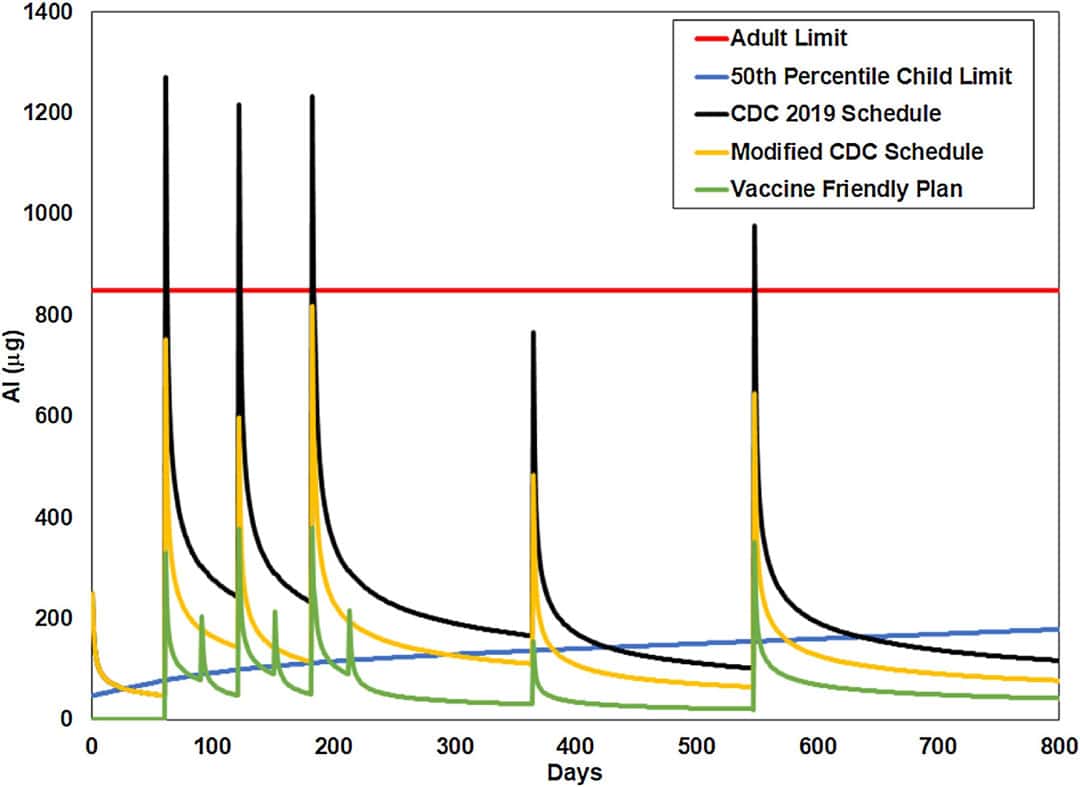
As with any study showing evidence of harm, the finding of an association between vaccines and asthma was dismissed by the mainstream media as unconcerning.
The AP, for instance, opined that since the study didn’t prove a causal relationship, it was “not a reason to change the current vaccine recommendations.”
It was dismissed as a “flawed” study that had “important shortcomings”, such as failing to account for other sources of aluminum exposure besides vaccines.
There were “hard-to-explain inconsistencies, like why, in one subset of thousands of fully vaccinated kids, more aluminum exposure didn’t seem to result in a higher asthma risk.”
Explaining why the study was published despite being so “flawed”, the AP paraphrased infectious disease researcher Michael Osterholm saying, “if CDC had the information and didn’t publish it, the agency might be seen as misleading the public, further eroding trust”.
The AP did not disclose that, as noted by Daley et al. in their paper, little to no ingested aluminum is absorbed through the gastrointestinal tract, so “the absence of dietary aluminum data in the present study would not appear to invalidate the current findings.”
The AP’s remark about “inconsistencies” also implied that fully vaccinated children were not at higher risk of asthma than children who received fewer vaccines. But, actually, that subanalysis found a statistically significant 12% increased risk of asthma among children without eczema.
Moreover, the subanalysis did not compare asthma rates between fully vaccinated children and a real cohort of children who received lower aluminum exposure. It only considered how different formulations could contain different amounts of aluminum, so there could be variable exposure within the fully vaccinated cohort.
Daley et al. relied on a statistical model that assumed a linear dose-response relationship and estimated risk by comparing real children to hypothetical counterfactual versions of themselves at slightly different exposure levels. This modeled reference group is undefined by the authors, rendering the finding practically uninterpretable.
Point being, this one subanalysis does not invalidate the findings of their primary analysis of greater aluminum exposure being associated with an increased risk of asthma.
This also speaks to a valid criticism of the study overlooked by the media, which is that its assumption of a linear dose-response could result in inconsistencies explainable by the 2017 finding by Crépeaux et al. of selective low-dose aluminum toxicity.
Uncritically Accepting Findings of No Harm
The dismissals of the findings of Daley et al. due to its methodological limitations contrast greatly with the findings of a Danish study by Niklas Worm Andersson et al. published in Annals of Internal Medicine on July 15, 2025.
Despite adopting the same basic design as Daley et al., the Danish study was uncritically accepted in the mainstream discourse as conclusive proof that aluminum-adjuvanted vaccines do not increase the risk of allergic diseases, autoimmunity, or neurodevelopmental disorders such as autism.
There were no dismissals of the study, for instance, on the grounds that it didn’t consider aluminum exposures from other sources, like food.
There were no criticisms about unexplained inconsistencies in their results—namely, the biologically implausible finding that injecting children with aluminum protects them against neurodevelopmental disorders and other chronic conditions.
I’ve written about major problems with the study by Andersson et al. in the following articles:
- How the Danish Study on Aluminum in Vaccines Was Designed to Find No Harm
- HHS Sec. Kennedy Calls for Retraction of Bogus Study on Aluminum in Vaccines
- Danish Study Claiming Safety of Aluminum in Vaccines Slammed in New Peer-Reviewed Paper
For contributing a few insights and reviewing the manuscript, I was acknowledged in the byline of that peer-reviewed paper, which I encourage you to read:
- Guillemette Crépeaux et al., “Aluminium adjuvants and childhood health: a call for science”, Journal of Trace Elements in Medicine and Biology, December 29, 2025
I won’t repeat the criticisms of the Danish study for my purposes here, except where specifically relevant to comments made by the study’s senior author, Dr. Anders Hviid, in an interview that serves as the focus of this article.
It suffices to observe how, in the mainstream discourse, the key criterion used to determine whether a study should be dismissed as fatally flawed or accepted as conclusive evidence is whether it finds vaccines to be associated with harm.
This illustrates the institutionalization of confirmation bias.
This systemic bias is further illuminated by how studies claiming to exonerate vaccines are motivated by a desire to exonerate vaccines.
As Hviid’s interview reveals, such was the case with the study by Andersson et al. published last July in Annals of Internal Medicine.
Of course, designing a study to support the claim of “safe and effective” vaccines is a very different endeavor than scientifically inquiring whether vaccines might be a contributing factor to the alarming rates of chronic illnesses among children.
The effect on study design is palpable.
‘We seem to have this signal . . .’
In an interview published in September, senior author Anders Hviid explained his motivation for doing the study that purportedly exonerates aluminum-adjuvanted vaccines.
The interview was for the “Progress, Potential, and Possibilities” podcast hosted by Ira S. Pastor. The show’s title itself states Hviid’s motivation: “Reassuring The Public About Vaccine Safety”.
You can watch the full interview or read the AI-generated transcript on YouTube, but following is an edited excerpt in which Hviid explains why he and his colleagues set out to do the Annals study on aluminum-containing vaccines:
In the clip, Hviid explains how he was approached by someone from the CDC who expressed the concern about the findings of Daley et al.
By Hviid’s own account, the person from the CDC told him, “We seem to have this signal—this association that we can’t really get rid of no matter how we analyze the data.”
This, of course, implies that they tried to reanalyze the data in ways that would eliminate the signal.
Lest the implication be disregarded as a mere slip of the tongue, Hviid’s further comments about how the study came to be clearly demonstrate that very motive.
Dr. Stanley Plotkin’s Revealing Deposition
In explaining how the Annals study came about, Hviid begins by referencing the deposition of Dr. Stanley Plotkin, who is considered the “Godfather of Vaccinology”.
Hviid refers to the attorney who questioned Plotkin for a court case as “the lawyer from the anti-vaccine side”.
The reference is to attorney Aaron Siri, who testified in September 2025 before a Senate hearing about how the corruption of science influences public perceptions about vaccine safety.
During that hearing, Siri introduced onto the record a study out of Henry Ford Health comparing health outcomes between vaccinated and unvaccinated children. It was led by Dr. Marcus Zervos, who initially agreed to do the research on the grounds it would allay parents’ concerns about vaccine safety.
Instead, the study found that vaccinated children have significantly higher rates of chronic illnesses—and by his own on-camera admission, Zervos refused to publish the data out of concern that it would end his career.
I reported about that study, and how the dismissals of it demonstrate the institutionalized confirmation bias, in my article “Scientific Data Show Unvaccinated Children Are Healthier”.
Aaron Siri’s deposition of Plotkin occurred in January 2018, and a 9-hour video recording of it can be viewed here:
View a transcript of the deposition here.
Hviid says that Plotkin was naïve to agree to the deposition because he was “not at all prepared” to answer Siri’s questions.
For instance, sticking just to the issue of aluminum in vaccines, starting on page 295 of the transcript, Plotkin is asked whether he is aware of studies indicating that injected aluminum can be transported into the brain, and Plotkin confesses his ignorance of that body of research.
On page 302, Siri asks Dr. Plotkin whether an increase in the inflammatory cytokine interleukin-6 (IL-6) has been shown to induce autism-like symptoms in lab animals. Plotkin responds that he isn’t aware of that research, either, “but it’s quite possible that that could happen if you use enough IL-6.”
Siri then pointed to a study titled “Maternal Immune Activation Alters Fetal Brain Development through Interleukin-6”, published in the Journal of Neuroscience, which Plotkin agrees is a reputable journal. When Siri presses him on the risk to the developing fetus of vaccinating pregnant women, Plotkin concedes the potential harm by observing, “Immune activation is the objective of vaccines.”
Plotkin later described his experience being deposed in an article titled “How to Prepare for Expert Testimony on the Safety of Vaccination”, which was published in Pediatrics Perspectives in November 2018.
Plotkin disclosed the following potential conflicts of interest to the journal:
Dr Plotkin is a paid consultant to Sanofi Pasteur, GlaxoSmithKline, Merck, Pfizer, Inovio Pharmaceuticals, Variations Bio, Takeda Pharmaceutical Company, Dynavax Technologies, Serum Institute of India, CureVac, Valneva SE, Hookipa Pharma, and NTxBio. Vaxconsult gives advice to vaccine developers.
The purpose of Plotkin’s article was to portray Siri as having relied on junk studies to support his “anti-vaccine” position. Instead of substantively addressing the legitimate concerns Siri had raised, Plotkin offhandedly dismissed them.
Plotkin prefaced the article by stating his motive, which was not to ensure vaccine safety but rather to achieve the political and financial goal of a high vaccination rate.
As Plotkin explained,
The Centers for Disease Control and Prevention has recently announced that vaccine coverage in American children has begun to decline as more parents seek medical, religious, and so-called philosophical exemptions. The proportion of unvaccinated American children has now reached 1.3%. This was a depressing announcement but not surprising in view of the increase in anti-vaccinationism, or as it is euphemistically called, “vaccine hesitancy.” One of the reasons for the decline in vaccination became clear to me in January 2018, when I was asked to do a pro bono deposition . . . .
Plotkin went on to complain how Siri’s law firm “represents those opposed to mandatory vaccination”.
Then he tried to characterize Siri’s stance in favor of the right to informed consent as though this were equivalent to rejecting science—and as though Siri was incapable of citing studies from reputable journals validating parental concerns.
Plotkin dismissed Siri’s questions as “antivaccination tropes” unworthy of consideration.
The literature Siri relied on for his questioning, Plotkin maintained, was “of doubtful scientific quality”.
Plotkin further condescended that “the differences between valid studies and those of poor quality is understood by scientists, but judges and lawyers may be misled” by studies that “lack scientific integrity.”
Siri’s questions, Plotkin insisted, were “not grounded in accepted science.”
Plotkin’s conclusion was not that more studies should be done to seriously address the legitimate concerns about vaccine safety but that vaccination rates “must not” be allowed to fall “as a result of the antivaccination movement’s specious and unfounded objections”.
The goal, you see, is a high vaccination rate—and to achieve that aim requires scientists to dismiss parents’ concerns instead of meaningfully addressing them.
‘There’s an association that we can’t really get rid of . . .’
In his interview, Hviid goes on to explain how Plotkin’s experience with Siri led him to assemble researchers in London to figure out how to deal with “key controversies” about vaccine safety, including concerns about aluminum adjuvants.
It was Plotkin’s call to action, Hviid says, that “planted” in his mind the idea to do a study on aluminum-adjuvanted vaccines.
Large epidemiological studies designed to determine the effects of aluminum-containing vaccines on childhood development, Hviid confessed, “were quire rare, if they even existed.”
The idea of doing a study to reassure parents about the safety of aluminum-containing vaccines was put on the backburner, however, because of the COVID‑19 pandemic.
Then in 2022, Hviid was contacted by a colleague from the CDC who told him,
We have this research project. We’ve tried to look at aluminum and asthma, and we seem to have this signal. There’s an association that we can’t really get rid of, no matter how we analyze the data.
Hviid goes on to explain how he agreed to use data from Denmark’s national registries to assist in that task.
He says they “tried to emulate the CDC study design-wise” but found no associations between aluminum-adjuvanted vaccines and chronic illnesses.
However, that’s actually not true.
In his own zeal to exonerate vaccines, show host Ira Pastor inadvertently reveals the falsehood, as we’ll come to.
Dismissing Conflicts of Interest
After Hviid explains that he was motivated by Plotkin and the CDC to do a study aimed at alleviating concerns about aluminum-containing vaccines increasing the risk of chronic childhood illnesses, the host gleefully brings up criticisms of the study.
Saying he wants to have “fun” addressing the “laughable” critiques, Pastor notes how US Secretary of Health and Human Services Robert F. Kennedy, Jr. wrote an article calling for the study’s retraction.
Kennedy’s basis for retraction is how the study was systematically biased in favor of finding no association. But Pastor does not disclose that argument, and at no point during the interview is any criticism of the study substantively addressed.
Pastor instead offhandedly dismisses what he calls Kennedy’s “nonsensical conspiracy stuff and pharma industry nonsense”.
What he’s referring to is Kennedy’s observation that three of the study’s authors were associated with the Statens Serum Institute (SSI), a government agency that develops vaccines and is responsible for purchasing and supplying vaccines for Denmark’s vaccination program.
Hviid has also received funding from the Novo Nordisk Foundation, which through a subsidiary holding company owns a controlling interest in Denmark’s largest pharmaceutical company.
These conflicts of interest also existed for a 2019 study by Hviid et al. purporting to show that the measles, mumps, and rubella (MMR) vaccine is not associated with autism even in genetically susceptible children.
In a paper published in the Journal of Biotechnology and Biomedicine in May 2025, Dr. Brian Hooker, Dr. Jeet Varia, and I thoroughly critique that study, revealing how it was effectively designed to find no association.
Our paper, titled “Hviid et al. 2019 Vaccine-Autism Study: Much Ado About Nothing?”, also documented the authors’ conflicts of interest.
This is referenced by Crépeaux et al. in the recent peer-reviewed critique of Andersson et al., whose “potential conflicts of interest appear to be the same as those in a previous study, which have already been discussed.”
These conflicts, Crépeaux et al. observed, “raise legitimate concerns about impartiality”.
It’s a valid observation that helps to explain the systemic bias in study design, and Pastor’s stupid dismissal of it as “nonsensical conspiracy stuff” simply reveals his own intellectual dishonesty.
Dismissing Positive Associations
Next, Pastor mocks Kennedy for “cherry picking” data related to Asperger’s syndrome, without elaboration.
The details matter.
When the study was first published, it was accompanied with a supplement that corresponded to the main paper’s conclusion of finding no associations between aluminum-containing vaccines and increased risk of any chronic illness.
But that supplement was missing data on thousands of children and was subsequently corrected. The updated version in fact showed statistically significant positive associations.
As Kennedy pointed out in his article,
The data show a statistically significant 67% increased risk of Asperger’s syndrome per 1 mg increase in aluminum exposure among children born between 2007 and 2018. Compared to the moderate exposure group, for every 10,000 children in the highest aluminum exposure cohort, there were 9.7 more cases of neurodevelopmental disorder, 4.5 more cases of autistic disorder, and 8.7 more cases of the broader category of autism spectrum disorder. Yet the authors gloss over these harms to children by claiming they “did not find evidence” for an increased risk.
Crépeaux et al. similarly note that “a review of the article and the supplemental material updated two days after publication highlights an increased risk of certain disorders” among the cohort with the highest exposure.
Thus, it is not a matter of critics “cherry picking” but of data from study’s supplement directly contradicting the authors’ uncorrected statement that they found no evidence of harm.
Pastor goes on to call it a “pathetic” criticism—as though it weren’t valid to observe the contradiction between their statement and the corrected supplementary data.
And then in his zeal to defend the study against that valid criticism, Pastor brings up another key observation that he seems to think vindicates the study—thus demonstrating total imperviousness to its true significance.
Accepting Biologically Implausible Findings
As the interview continues, Pastor points out how the study by Andersson et al. in fact found statistically significant negative associations for numerous outcomes, including asthma, allergic diseases, and neurodevelopmental disorders—including autism.
Pastor seems to think that these findings from the main paper bolster his point that Kennedy “cherry picked” data from the supplement. He argues,
You know, it’s interesting because here—you know, aside from an obvious case of cherry picking a small, small subgroup from over a million kids, you actually turn around and show, wait a second. Um, no, there’s actually a decreased risk in certain neurodevelopmental conditions.
In fact, far from ignoring these negative associations, Kennedy highlighted them in his article.
“If the medical establishment truly believed these data,” Kennedy observed, “they would be recommending aluminum injections to children as a prophylaxis against neurological and autoimmune diseases.”
Here is the key graph from the paper showing the significant negative associations:
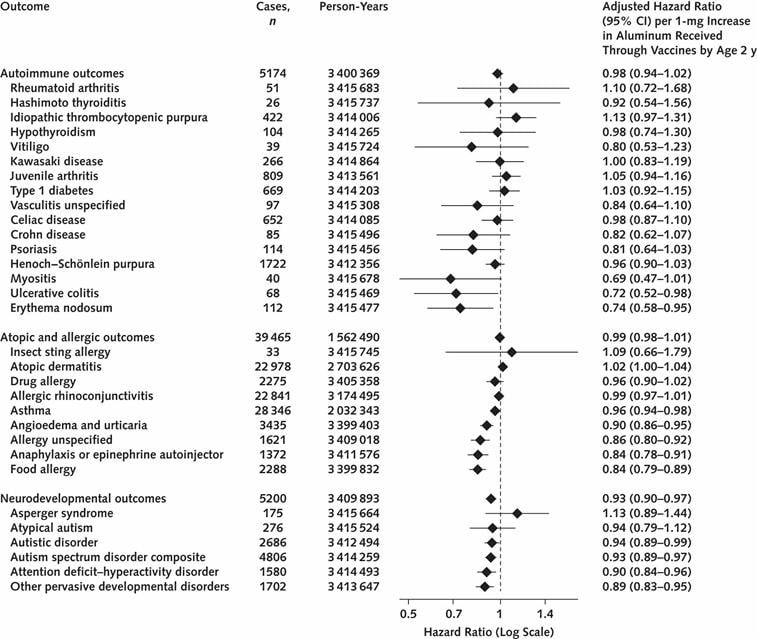
The null hypothesis, of course, is that there is no association. And the study has been reported by the mainstream media as having found none. Hviid himself repeats that claim in the interview. But that’s false.
As I pointed out in my own analysis of the study, the biological implausibility of this finding of statistically significant negative associations is a huge red flag indicating systemic bias in the study design.
As Crépeaux et al. state, these “implausible protective effects” of aluminum exposure indicate “systemic data bias” in the study’s design. They further comment,
To our knowledge and understanding, this is the first time in medical literature where exposure to Al has been shown to be beneficial. Bearing in mind what is known about human exposure to Al these unlikely benefits seriously challenge the validity of the whole study and its conclusions, and this fails to meet Hill’s criterion of biological plausibility.
The Bradford Hill criteria are guidelines scientists use to judge whether a statistical association is likely to reflect a real cause-and-effect relationship rather than coincidence or bias.
Clearly oblivious to how these findings support the conclusion that the study was systematically biased in favor of finding no association, Pastor prompts Hviid to “say a couple words about that specific rebuttal”, the finding “that potentially there is a protective effect”.
Pastor’s so-called “rebuttal” is thus a nonstarter—and Hviid’s response is revealing.
Hviid answers that there is “uncertainty” about their findings, but that, yes, “children who’ve received more aluminum through vaccines” appear to be “slightly protected” against chronic illnesses.
He then moves on, offering no further comment about how injecting children with a known neurotoxin could possibly protect them against neurodevelopmental disorders.
The fact that Hviid says nothing about the biological plausibility of that finding says everything.
It’s his silence that speaks volumes.
He simply has no response to the observation that the implausibility of these results supports the conclusion of systemic bias in study design.
He instead just insists that their findings are valid, and he’s not the least bit curious about the mechanism by which aluminum from vaccines could reduce children’s risk of chronic illnesses.
That lack of inquisitiveness reflects his true motive for doing the study.
You’d think a sincere scientist lacking any financial or political agenda would have some curiosity about that, but nope!
Stanley Plotkin had rallied Hviid and other scientists to support the policy of “mandatory vaccination” by helping to combat the trend of “vaccine coverage in American children” declining “as more parents seek medical, religious, and so-called philosophical exemptions.”
The CDC had tasked Hviid and colleagues to help them solve the problem of an association between aluminum-containing vaccines and asthma that they couldn’t “get rid of”, no matter how they analyzed the data.
Hviid’s silence on the question of biological plausibility shows how, as far as he is concerned, their findings are good enough. Mission accomplished. Nothing more to see here. Move along.
Appeal to Authority
As the interview continues, no substantive responses to any of the many criticisms of the study appear.
Pastor and Hviid instead offhandedly dismiss critics, whom they call “vaccine skeptics”, essentially for not sharing their faith in the practice of vaccination.
The “skeptics”, you see, are guilty of the crime of heresy against the vaccine religion.
Hviid denies that any methodological flaws have been identified. He specifically mentions only one alleged flaw, which he rejects as “silly”—without any explanation as to why it’s not a serious and valid concern.
That exchange, too, is highly illuminating.
Hviid states,
It’s technical details that they try to make look like—that they’ve sort of caught us in some major methodological flaw. But that’s not the case. I mean, we’ve—we think we’ve analyzed the data appropriately, and a lot of the specific critiques that we have seen have been on specific design choices where you simply have to make a choice one way or the other.
Hviid never addresses the core criticism that each of these design choices seemed to bias the study in favor of finding no association.
The choices weren’t made “one way or the other”—just one way.
Instead of addressing the substance of critics’ arguments, Hviid defends his work with an appeal to authority fallacy.
As though trying to convince himself as much as anyone else, Hviid continues (bold emphasis added):
I think the majority of people skilled in epidemiology and health research would agree with these choices that we’ve made. All right? Yeah. Yeah. Yeah. You know, specifically along those lines, and I had to research a little bit about what collider bias was all about, but that was another piece that he tries to catch which is so ridiculously silly. But, you know, the fact that the Annals of Internal Medicine said, “We’re not taking this study down. It’s well done and thorough, and, you know, very rigorously done—[it] is a testament to what your organization is all about.” So, yeah, I was very pleased to see the response from Annals.
Hviid’s critics can certainly agree that the study represents what his team is all about—as usefully illustrated by the way he dismisses the observation of collider bias as “silly”.
Dismissing Collider Bias
The problem of collider bias was first raised by Dr. James Lyons-Weiler in a response published the same day as the study by Andersson et al.
In his article, titled “Designed to Fail: Brand New Hailed Study Exonerating Aluminum Has a Fatal Flaw”, Lyons-Weiler emphasized how the authors inappropriately adjusted their data in a way that would nullify any true effect of aluminum exposure on rates of chronic childhood illnesses.
As he explained,
The most egregious violation lies in the study’s statistical modeling: the authors adjusted their hazard ratios for the number of general practitioner (GP) visits before age two. This variable is not a confounder. It is a direct downstream consequence of vaccine exposure itself. Infants receiving multiple aluminum-containing vaccines in their first year may present with fever, seizures, inconsolable crying, rashes, hypotonia, gastrointestinal distress, or developmental regression. These symptoms drive parental concern, which in turn drives GP visits.
. . . Imagine studying the association between smoking and lung disease adjusting for having nicotine-stained fingers, carrying a lighter, or frequency of coughing in the 24 months before lung cancer diagnosis.
What you are doing, in effect, is mathematically erasing the very signal you are supposed to be detecting.
. . . Kids under 24 months of age receiving more aluminum-containing vaccine on their way to being sick due to aluminum are effectively removed by this statistical maneuver. The study authors do not provide any justification for adjusting for these particular variables and do not show the results of alternative models. They cherry-picked the model that gave the result they desired.
. . . In order to control for a variable, that variable must not be influenced by the exposure. When that parity fails, adjustment introduces collider bias, a statistical distortion that misrepresents the relationship between exposure and outcome. In plain terms, the study design effectively deletes from analysis the children most likely to show early signs of aluminum-related harm.
As I wrote in my own analysis of the study the following day, collider bias “can suppress real associations or even make them appear protective.”
Secretary Kennedy in his article likewise noted how “the authors inappropriately treated general practitioner visits before age two as a confounder, without assessing whether these GP visits reflected early aluminum-related illness or were predictive of later diagnoses.”
Crépeaux et al. also point out this problem in our peer-reviewed critique, and in a report I wrote about that paper to explain its criticisms for a general audience of lay people, I summarized,
In effect, this data adjustment assumes away the possibility that children may have fewer doctor visits precisely because they are healthier due to avoiding exposure to aluminum-adjuvanted vaccines.
In the interview, Anders Hviid confessed having “had to research a little bit about what collider bias was all about”, but he does not even attempt to provide an explanation for why we should regard this criticism as a “silly” non-issue.
He accuses his critics of having no substantive arguments, but the truth is that these criticisms are valid, and it’s Hviid who has no substantive response.
‘Non-Specific Effects’ and Confirmation Bias
Confirmation bias is the tendency to seek out and accept information that conforms to one’s pre-existing beliefs while avoiding and ignoring any information that contradicts or challenges those beliefs.
Examples of how confirmation bias is institutionalized have already been provided, but the interview with Anders Hviid presents yet another stark illustration.
Before discussing the Andersson et al. study, Pastor prompts Hviid to comment about “beneficial off-target effects” of vaccines.
He’s referring to a body of literature on what are called “non-specific effects” of vaccinations.
This refers to vaccine effects that may be beneficial or detrimental and are unrelated to the specific intended effect of protecting against the target disease.
Concerningly, this body of research has found that so-called “non-live” vaccines, which are inactivated vaccines that generally contain aluminum adjuvants, are associated with an increased rate of childhood mortality.
The two leading researchers in this field are Dr. Peter Aaby and Dr. Christine Stabell Benn. As they and coauthors noted in a paper published in 2017 in the Lancet journal eBioMedicine (emphasis added),
It should be of concern that the effect of routine vaccinations on all-cause mortality was not tested in randomized trials. All currently available evidence suggests that DTP vaccine may kill more children from other causes than it saves from diphtheria, tetanus or pertussis. Though a vaccine protects children against the target disease it may simultaneously increase susceptibility to unrelated infections.
On the other hand, studies have found “live” vaccines, to be associated with beneficial non-specific effects on mortality.
Indeed, research into this field was prompted by a surprise finding that the measles vaccine was associated with a lower rate of childhood mortality that could not be explained by the prevention of measles deaths alone.
Prompted by Pastor to comment on this research, Hviid explains how live vaccines are associated with beneficial “off target” effects on mortality, while non-live vaccines are associated with increased mortality.
After explaining how these were observational studies done in Africa, Hviid puzzlingly states, “I am not so optimistic anymore.”
Offering insights into his meaning, he goes on to explain how randomized controlled trials (RCTs) have since been done to examine non-specific effects of vaccines.
As Hviid states,
These studies are all negative on the—sort of the primary endpoint of all cause mortality, and that is of course disappointing and difficult to accept for the researchers who have spent 20 years, 30 years on these hypotheses.
What’s most curious about Hviid’s loss of optimism is that he ought to be encouraged if randomized trials have failed to find non-live vaccines to be associated with increased mortality.
Puzzled, I sought out the studies he was referring to and—lo and behold!—discovered that Hviid coauthored a paper just published on January 2, 2026, on the preprint server medRxiv.
Their paper is titled “Non-specific effects of vaccines on all-cause mortality: a meta-analysis of randomized controlled trials (RCTs) 2012-2025”.
A read of that review resolves the ambiguity about Hviid’s meaning.
See, their review turned up only trials aimed at confirming beneficial mortality effects of three live vaccines: measles, oral polio, and Bacillus Calmette-Guérin (BCG).
Apart from one failed trial of the non-live diphtheria, tetanus and whole cell pertussis vaccine (DTP) by Aaby, Benn, and coauthors, they found no trials aimed at verifying the detrimental effect of increased mortality.
Hviid’s disappointment is that the trials found no benefit of live vaccines on all-cause mortality.
As also noted in the paper, these findings challenge the hypothesis that measles infection causes an “immune amnesia”, effectively wiping out children’s ability to fight off other infections and thus increasing their risk of dying from other causes.
The “immune amnesia” claim is also contradicted by the observational data, as I explained in my January 2020 article “NY Times Deceives about the Odds of Dying from Measles in the US”.
The problem with the “immune amnesia” hypothesis was succinctly stated in a study published in BMJ Open in 2016, which is that “all available studies—including the present one—suggest lower mortality rather than excess mortality among those who survive the acute phase of measles infection.”
In other words, far from wiping out the immune system, studies suggest that, in addition to conferring lifelong protection against measles disease, surviving measles infection also protects children against dying from other causes.
Of course, you never hear about that observation in the mainstream media, which only ever try to frighten parents into vaccinating by claiming—as though it were a proven fact—that measles infection will wipe out their children’s immunity to other infections.
The review by Hviid and coauthors of trials examining live vaccines’ effects on all-cause mortality further illustrates the institutionalization of confirmation bias.
After being called by the World Health Organization (WHO) in 2014 to conduct randomized controlled trials to test findings from observational studies on non-specific effects, scientists responded by seeking to affirm beneficial effects of live vaccines—which produce immune responses more similar to those induced by natural infection.
But there is a dearth of interest in answering the question of whether non-live vaccines— which are generally those containing aluminum—increase the risk of death.
Thus, the general view within the scientific community, with rare exception, is that if a potential benefit of vaccination is to be found, it’s worth studying—but if the results risk confirming parents’ fears and increasing “vaccine hesitancy”, the question is best left unanswered.
It’s worth noting in this context how the 2025 study by Andersson et al. could have included mortality among the measured outcomes but didn’t.
It’s best not to look for what you don’t want to find.
Conclusion
In the mainstream discourse, there is a clear tendency for studies finding an association between vaccines and harm to be dismissed as fatally flawed, while studies purporting to exonerate vaccines are uncritically accepted as conclusive—no matter how brazenly biased in favor of producing a predetermined outcome.
The obvious operative criterion for determining the worthiness of a study is whether its findings support or question public vaccine policy.
If a study finds evidence of harm, then it a priori had a flawed design; but if evidence of harm is found, then its methodology is beyond reproach, and we may regard the findings as determinative.
This phenomenon is evident even when both studies share the same methodological limitations.
The interview with Anders Hviid, the lead author of the 2019 MMR-autism study and senior author of the 2025 aluminum-adjuvanted vaccines study, offers additional insights into the mindset of public vaccine policy apologists.
Hviid’s remarks are a further testament to how confirmation bias and cognitive dissonance are institutionalized within the “public health” establishment and scientific community.
Hviid explains how the aluminum-adjuvanted vaccine study was motivated by Plotkin’s call for scientists to essentially help manufacture consent for vaccine mandates in furtherance of the political and financial goal of maintaining high vaccination rates.
That is a very different motive than genuinely seeking to inquire about vaccine safety and seriously addressing the many legitimate concerns parents have about the long-term effects of vaccines on children’s health.
By Hviid’s own account, perhaps a Freudian slip in choice of language, the CDC had triedto “get rid of” the association between aluminum-containing vaccines and asthma. Their failure in that endeavor resulted in their trusted Danish partner being tasked to do his thing and make the signal go away.
And Hviid and colleagues delivered.
As critics have observed, including in the peer-reviewed paper by Crépeaux et al., the study was systematically biased in favor of the null hypothesis, which sufficiently explains the implausibility of its main findings.
Public vaccine policy apologists, including Hviid, have responded to valid criticisms by dismissing them as “anti-vaccine” nonsense.
The observation of conflicts of interest is deemed a “conspiracy theory”.
The observation of statistically significant increased risks directly contradicting the authors’ claim of no evidence of an association is deemed “cherry picking”.
Findings suggesting a protective effect of a known neurotoxin against neurodevelopmental disorders and other chronic illnesses are uncritically accepted as valid despite their biological implausibility.
The study’s design is deemed valid by virtue of the publishing journal refusing to retract it—without any kind of substantive response to the most important criticisms.
Instead of a serious response to the observation of collider bias, which helps to explain the implausible findings of negative associations, the criticism is mindlessly disregarded as “silly”.
The institutionalized confirmation bias is further illustrated by scientists’ interest in heeding the WHO’s call by doing randomized trials aiming to verify observational data suggesting non-specific mortality benefits of live vaccines while ignoring findings suggesting that aluminum-containing inactivated vaccines have a detrimental effect on children’s immune systems that increases their risk of dying from other causes.
It is by such means that the illusion of “safe and effective” vaccines is maintained in the public discourse.
The prime directive of scientists like Anders Hviid is not to achieve a healthy childhood population but rather a high vaccination rate—which helps to explain the alarming rates of chronic diseases in the highly vaccinated US childhood population.


0 Comments