Yesterday, I reported about a peer-reviewed study done by high school students under the supervision of US Food and Drug Administration (FDA) scientists at an FDA lab and how they verified that mRNA COVID-19 vaccines are contaminated with DNA from the manufacturing process at levels exceeding the FDA’s own “safety limit”.
This is not a “conspiracy theory”. It is not “misinformation”. It is an uncontroversial fact.
Of course, the DNA contamination has raised a great controversy about the health risks it poses, but there is no controversy at all that this is a real issue, not made up. It has been repeatedly verified by scientists who have published their findings, including in the medical literature.
And yet, I can’t report the fact that it has now been verified by researchers at one of the FDA’s own labs on LinkedIn because LinkedIn has long maintained a policy of censoring truth in service to the criminal organization in Washington and, by extension, in service to the financial interests of the pharmaceutical industry.
This, of course, constitutes a violation by LinkedIn of its own User Agreement with me and represents contract fraud.
My article about the new study was posted to LinkedIn yesterday and consisted of the link and the factually accurate statement, “Yet another study has verified the problem of DNA contamination in mRNA COVID‑19 vaccines, this time at one of the FDA’s own labs.”
There is nothing in that statement that is false or misleading.
This morning, however, I found yet another email in my inbox from LinkedIn’s “Trust & Safety Team” saying there’s a “problem” with one of my posts, resulting in its removal by LinkedIn.
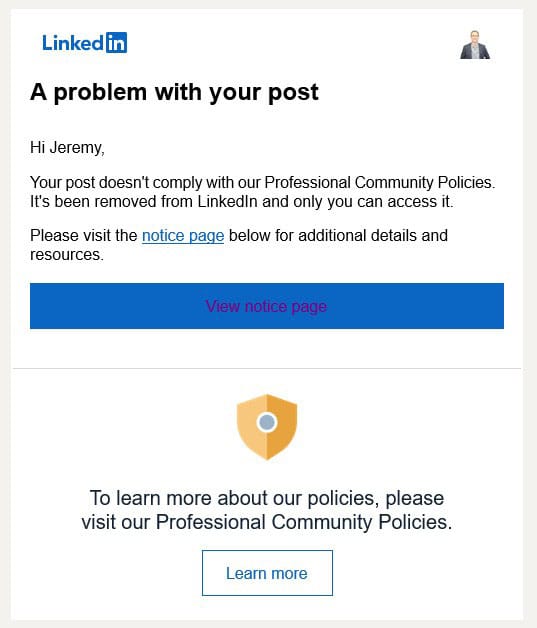
There’s a link to view the “notice page” on LinkedIn. I click it and am taken to a page claiming that my post “doesn’t comply” with LinkedIn’s “Professional Community Policies on misinformation.”
The page also threatens that if I try to share the truth with people again, my LinkedIn account could be restricted — which I know from past experience means that I could be outright banned from the social media platform.
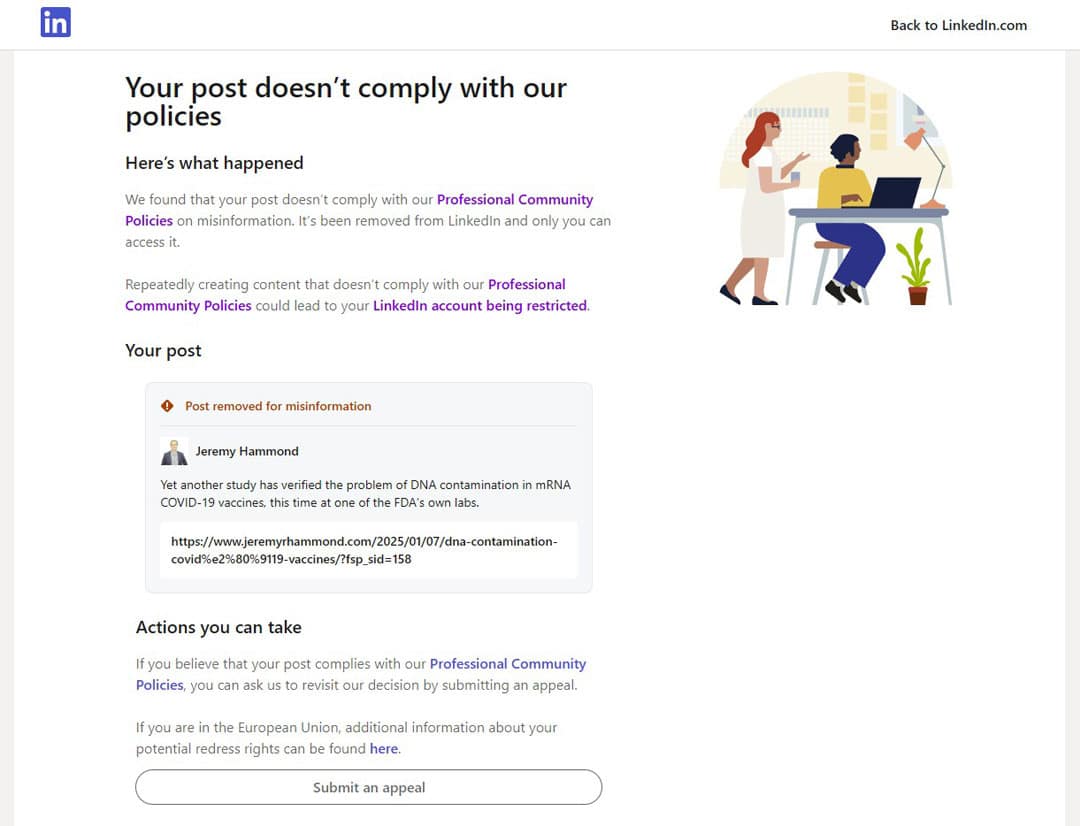
I’ve been through this before, many times. Each time, it is the same. I share factually accurate information, and LinkedIn prohibits it by falsely accusing me of spreading “misinformation”, which would be prohibited by its community guidelines.
LinkedIn interprets the word “misinformation” in bad faith as a euphemism meaning any information, no matter how factual, that does not align with certain political agendas, such as the authoritarian lockdown regime or the policy goal of achieving high vaccination rates.
And that constitutes contract fraud by LinkedIn.
See, LinkedIn and I have a “User Agreement“, with is “a legally binding contract”. By having an account, I agree to certain terms of LinkedIn’s, including my promise to be truthful with my profile information and to “only provide content and other information that does not violate the law or anyone’s rights”.
and LinkedIn in turn is to “allow sharing of information (including content) in many ways,” including through my “posts”, “articles”, and “links to news articles”.
By posting my content on LinkedIn, I retain ownership but am granting “a non-exclusive license to it”, which is of course necessary for LinkedIn to be able to have my content seen by other users.
LinkedIn promises to “honor the choices” I make “about who gets to see” my content.
So, for example, if I have used the settings to limit my content’s visibility so that my content is viewable only to people whom I’ve connected with, then other users will not be able to see it, but my connections will be able to.
That doesn’t mean my content will necessarily be seen by my connections, but it won’t be hidden from them.
As a user who might be exposed to other users’ content, I understand and agree that I “may encounter content or other information that might be inaccurate, incomplete, delayed, misleading, illegal, offensive, or otherwise harmful.” And I agree that LinkedIn is “not responsible” for users’ content.
The User Agreement states, “LinkedIn reserves the right to restrict, suspend, or terminate your account if you breach this Contract or the law or are misusing the Services (e.g., violating any of the Dos and Don’ts or Professional Community Policies).”
That statement ipso facto means that LinkedIn may not restrict, suspend, or terminate my account arbitrarily.
The same section of the agreement adds, “We can also remove any content or other information you shared if we believe it violates our Professional Community Policies or Dos and Don’ts or otherwise violates this Contract.”
Thus, LinkedIn may not remove my content or other shared information arbitrarily. If my content does not violate LinkedIn’s Professional Community Policies and LinkedIn removes it on an arbitrary basis, then LinkedIn has violated its User Agreement with me.
The User Agreement also refers to an “appeals process”, and a LinkedIn help article on account restrictions states that if you believe compliant content has been wrongly restricted, you can appeal the decision.
The section of the Professional Community Policies that LinkedIn has repeatedly cited as the basis for removing my content and making it inaccessible to the users to whom I’ve chosen to make it visible reads as follows (italic emphasis added):
Do not share false or misleading content: Do not share content that is false, misleading, or intended to deceive. Do not share content to interfere with or improperly influence an election or other civic process. Do not share synthetic or manipulated media that depicts a person saying something they did not say or doing something they did not do without clearly disclosing the fake or altered nature of the material. Do not share content that directly contradicts guidance from leading global health organizations and public health authorities; including false information about the safety or efficacy of vaccines or medical treatments.
The only good-faith interpretation of this section of the community guidelines is that I am not allowed to share false or misleading information that is contrary to that provided by “leading global health organizations and public health authorities”, such as the US Centers for Disease Control and Prevention (CDC).
Instead, though, LinkedIn consistently has used a bad-faith interpretation of this whereby “misinformation” is a euphemism meaning factually accurate information that corrects disinformation from “public health authorities”.
In fact, I discussed this in my article published yesterday, citing the example of how “public health” officials, including CDC director Rochelle Walensky and NIAID director Dr. Anthony Fauci, propagated the scientifically fraudulent claim that two doses of an mRNA COVID-19 vaccine would confer durable sterilizing immunity, stopping infection and transmission of SARS-CoV-2.
In that context, I wrote:
Journalists like myself who at the time were trying to warn members of the public how they were being brazenly deceived were censored on social media on the grounds that to provide any information that didn’t align with the proclamations of lying government officials was “misinformation”—the usual euphemism for any information, no matter how factual, that does not serve the adopted political agenda.
For instance, I was banned from LinkedIn for having accurately reported how the CDC’s August 2021 lie that natural immunity to SARS‑CoV‑2 was inferior to that induced by mRNA COVID‑19 vaccines was contradicted at the time by virtually all the non-CDC-originating medical literature and subsequently falsified by the CDC’s own data as reported by its own researchers in its own MMWR journal.
In September 2023, when I tried to share another factually accurate report by Maryanne Demasi, PhD, about the finding of DNA contamination in Pfizer’s COVID‑19 vaccine, my post was censored by LinkedIn on the false grounds that it contained “misinformation”.
Additionally, LinkedIn promises an “appeal process”, but that claim is fraudulent, too. In truth, there is no legitimate appeal process. LinkedIn never specifies what information it is claiming to be false or misleading, much less an explanation as to how the conclusion was drawn that it is false or misleading. You are consequently also never presented with an opportunity to present your case for why the information is factually correct or otherwise elaborate on how LinkedIn has made a mistake.
The notice page stating that my post was removed for non-compliance has a “Submit an appeal” button, but all this ever does is result in LinkedIn following up by reiterating its false claim that your post contained “misinformation”.
Even in past instances when I managed to communicate with a LinkedIn representative, LinkedIn refuses to specify what information it is claiming to be false or misleading.
Moreover, I have specifically asked LinkedIn whether its community guidelines prohibit me from reporting factually accurate information that corrects false or misleading information from “public health authorities” like the CDC. LinkedIn’s instructive response was that it does not provide interpretations of its community guidelines.
In other words, LinkedIn refuses to clarify the intended meaning of its own guidelines while expecting you to comply with their secret interpretation.
The obvious reason for that is that LinkedIn engages in contract fraud by interpreting its own community guidelines in bad faith to mean that users are prohibited from sharing true information if it contradicts false information emanating from government “health” officials.
Facebook Vows to End Censorship
On a related note, Meta, the company that owns Facebook, announced yesterday that it is ending its participation in the faux “fact check” industry and will instead shift to a “community notes” model similar to X.
Back in August, Meta CEO Mark Zuckerberg admitted in a letter to Congress that Facebook had censored factual information under pressure from the Biden administration.
In its press release announcing the decision yesterday, Meta said it will be “lifting restrictions on some topics that are part of the mainstream discourse” and “will take a more personalized approach to political content, so that people who want to see more of it in their feeds can.”
This is a very welcome development, notwithstanding weeping and gnashing of teeth from the faux “fact check” industry that serves the government by censoring truths that don’t align with the adopted political agenda.